
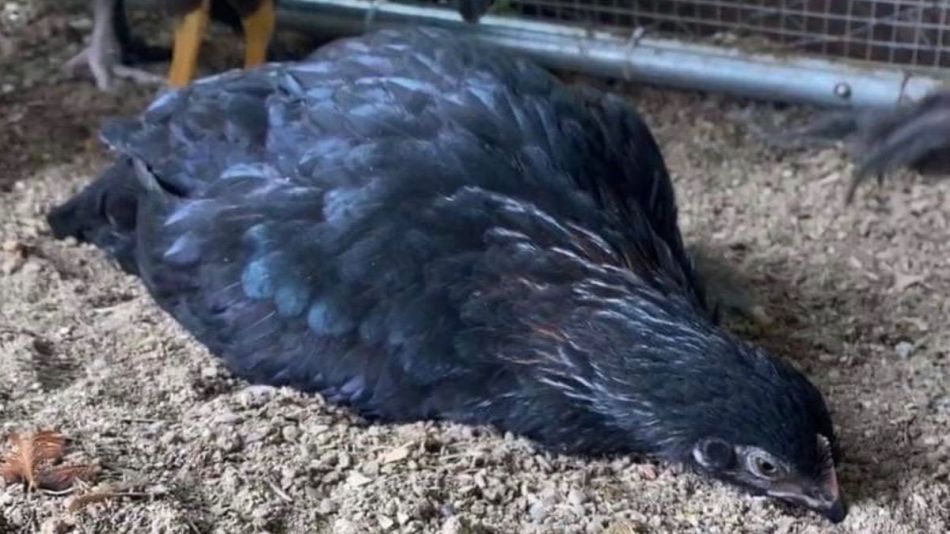
Spring is the time of year when we start to hear about birds getting into things that may cause troubling symptoms, including paralysis. Lots of folks’ go-to is Marek’s Disease, vitamin deficiency or wryneck, but another potential diagnosis could be botulism, a life-threatening condition seen in poultry and waterfowl.
Botulism (food poisoning) occurs when birds eat food or drink water containing a potent toxin produced by the bacteria Clostridium botulinum. These bacteria are commonly found in the soil, untreated water, rotting vegetation, food or carcasses. It can be consumed by, and concentrated in, maggots. The ingested toxin affects the nervous system by binding to the nerve endings, causing weakness and paralysis. Botulism tends to be more common in the wet season, because birds are more likely to have access to decomposing feed or stagnant water.
It often affects several flock mates and usually the most dominant ones, which are the most likely birds to eat first.
I recently saw a post in an online chicken group in which two birds from the same flock presented with the classic signs of botulism (drooping, outstretched neck). I suggested that diagnosis to the poster. Unfortunately every other response said it was wryneck and recommended a very different treatment regime. That was a classic case of too many folks, in their attempt to be helpful, who steered the chicken keeper in the wrong direction. As we’ll see from the following case, botulism is a form of toxin poisoning that must be treated immediately, in order to save the patient. And unfortunately, it was also a situation in which the incorrect advice led to the death of one bird and near death of another.
If you know anything about common chicken illnesses then it would be quite clear that neither bird had coccidiosis, which often presents as hunched, pale birds with ruffled feathers, diarrhea, loss of appetite and lethargy. Even wryneck, which would be a more plausible diagnosis, appears as more of a twisted or tilted (up or down) neck.
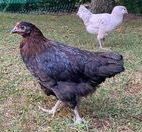
Betty Lou, Black Copper Marans, 12 weeks old
Day 1: I found Betty Lou standing in the corner of the run with her head and tail down. She would stand but would slowly drop her head, lay down with an outstretched neck, letting the other flock members walk over her.
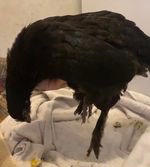


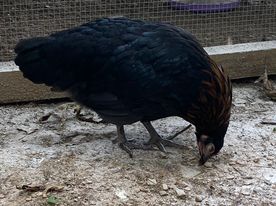
I separated her and messaged some chicken friends for help. They both thought she had coccidiosis and suggested treating with Corid. My gut told me to give her vitamins, but they were adamant that Corid was the best bet. I did so, and watched her quickly decline. In less than 24 hours she had bright green diarrhea, was completely paralyzed, unable to swallow and her sinus cavity rose and sank with each breath.
Day 3: I couldn’t watch her suffer anymore and decided to euthanize her. She was so dear to us, we named her after my grandmother who passed away in April and it absolutely killed me to see our sweet pullet die. Our whole family was sad.
Oprah, Black Copper Marans, 14 weeks old
Two weeks later
Day 1: Another pullet presented with the same symptoms as Betty Lou. We only had two Black Copper Marans and I really didn’t want to see this one end with the same fate. Knowing that Corid was absolutely not the answer I dove deep into the internet and my chicken health book to find answers. I’m very grateful that an online Facebook chicken group has an archive to help others with similar issues. An old post popped up when I searched the term ‘botulism’.
It recommended an Epsom salt flush and treatment with selenium. The poster’s chicken went from loss of muscle control of her neck to standing, clucking and back to normal within 24 hours. Desperate to try anything to save my girl, I quickly went to work. You can use Epsom salts, activated charcoal or molasses as a flush. I had some charcoal tablets on hand, which I dissolved into a ¼ full water bottle. I administered a small amount to Oprah with a syringe very slowly to avoid aspirating her.
Day 2: I gave her raw egg yolk with another charcoal capsule combined with Poultry Cell vitamins and minerals. I had to dip her beak into it because her head and neck were paralyzed. I put her in a playpen in my garage with a puppy pad and some hay for comfort and let her rest. My hope was the activated charcoal would bind to the toxins in her body and expel them. If a chicken survives the first 48 hours after botulism poisoning, they are likely to pull through.
Day 3: We had concert tickets the following day and ended up staying out of town overnight. The second we got home I ran straight to the garage and gave Oprah a drink. She was trying so hard to stand and swallow but the water just dribbled out of her beak. Assuming she was starving now, I gave Oprah a raw egg yolk, 3ml of Poultry Cell vitamins and a finger length of selenium. She was so limp I had to support her body with my legs while holding the dish with one hand and her neck and head with the other. I dipped her beak and held her neck up a little to help her swallow. She continued to struggle to drink. I was really losing hope but kept encouraging her.
I thought Oprah was going to aspirate a couple of times because her tongue muscles wouldn’t let her swallow. Botulism will start to paralyze their legs, wings, and neck and eventually paralyze the muscles of the heart, lungs and eyelids. Her eyelids were clearly struggling to work: one was completely paralyzed/shut, while her other eye was alert.
Oprah would take a drink then open her beak wide and shake her head. I took it very slowly, giving her lots of breaks in between beak dips. I got a small amount into her, which was difficult because she kept falling asleep.
Day 4: In the morning she was standing and holding her head up. I was in shock that she was able to walk, drink and talk. She spent another two days crated while she recuperated with lots of food and Poultry Cell water.
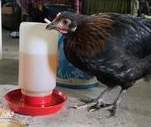
I believe both pullets got botulism from drinking from stagnant water puddles on a tarp covering a woodpile. I’m incredibly grateful that our sweet girl is doing so much better and incredibly sad about the loss of our Betty Lou that could have been saved. I wish I would’ve listened to my gut when Betty Lou was sick. I won’t dwell on it though because she helped us learn some very valuable information.
Many thanks to Lindsey for sharing her story and photos, used with permission.
 Bitchin' Chickens
So glad that you could save your second pullet. It is so hard to know, isn’t it? I had two chicks this spring that looked the same – standing with their head slowly drooping all the way into the bedding, then lying flat in their side like pancakes. They seemed weak to me, not paralyzed. I ruled out botulism because they were still in the brooder, indoors, only eating starter feed and filtered water. Then I discovered that the feed I had been sold as fresh was actually six months old. Treated for vitamin deficiency – vit e capsules, poultry cell, syring feeding to the side of the beak…. One recovered in 24hrs, the other took three days. Then I read about pseudo botulism, where Mareks can present with a hanging head and progressive weakness. Which was it? I have no idea. But I have now one of those pullets, a couple of months later, clearly dying from Mareks: leg paralysis, gasping. The other is just fine. Those two were the only unvaccinated birds in this year’s brooder batch – four other vaccinated birds are just fine and were never affected by the “vitamin deficiency “. So I now suspect I was dealing with pseudo botulism. But the vitamins helped enormously. It’s a mystery….
LikeLiked by 1 person
Coming back to add that I lost my second unvaccinated pullet to Marek’s a few weeks after posting this. What a miserable experience. I will never get unvaccinated chicks again….
LikeLiked by 1 person
Sorry for your losses.
LikeLike
Thank you!
LikeLiked by 1 person
Thank you for this post! I have been scouring the web for an explanation that fits my bantam hen’s symptoms and nothing really fit. I’ve been treating her for wry neck with NutriDrench and egg yolk and finally found Poultry Cell in stock. No improvements but it’s been four days and she’s still trying to drink when I offer her water, although her neck flops and she can’t move her legs. I don’t know if I caught it soon enough to reverse her symptoms but I am so relieved to finally find the information for a diagnosis. Please keep posting what you know. The specific info about behaviour and causes and the photos help immensely.
LikeLike
Thanks for the feedback. Good luck with your hen.
LikeLike