

For more than two years my mentor, Dr Vicki Bowes, avian vet/pathologist and I have been meeting up to look at cases that I collect to figure out a diagnosis and treatment plan, if possible. She’s alternately called these sessions ‘Show And Tell’ or ‘Best Guess’. Recently she invited me over for what she termed ‘Gore-fest’ which was fitting as I’ve endeavored to find some more interesting and challenging cases for her. It’s especially satisfying if I can come up with conditions she’s never seen before.
We’ve worked on close to 200 cases and have definitely come across some oddities before, but I thought it would be interesting to dedicate several posts specifically on the weird stuff that happens to chickens.
Weird Eggs

Dr Bowes: The egg is very dark which makes me think the hen normally lays a pigmented egg. It was probably stuck in the oviduct and accumulated that texture. I’m curious as to the contents and if they were normal or not.
My two-year-old Buff Orpington hasn’t laid in months. She still goes to the nest almost every day but lays nothing. Today, she pooped, then closed her eyes and started having contractions. Eventually this other thing came out. It appears to be an old egg, not a lash egg. It’s hollow, has a membrane like an egg does. No smell. – Aimee Lawson
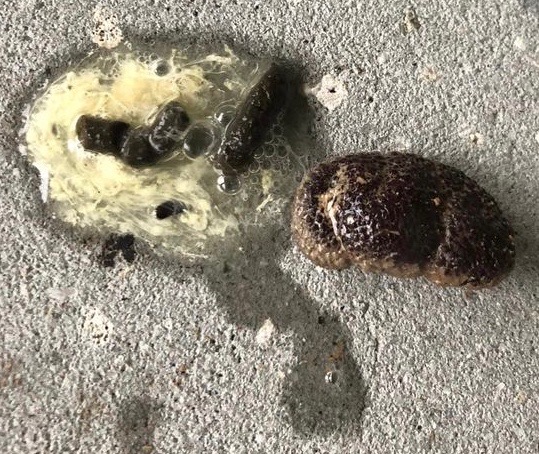

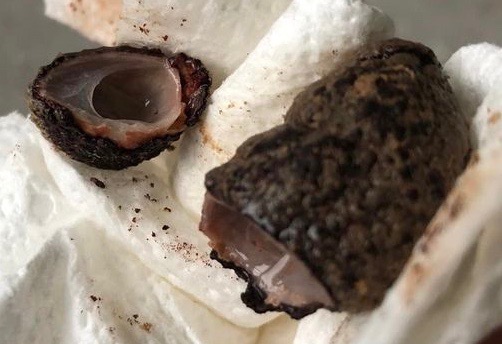
Dr Bowes: That is an old, mummified egg. The dark colour is blood pigment not a bacterial infection. The reason she kept going into the nest box is because she was triggered by hormones despite the fact her ovary had regressed.
Gosling Bumps
This has been on my gosling since it was born. I thought it was to do with the yolk sac but it never went away. They are soft and growing, as the bird gets bigger. – Sarah Frayer
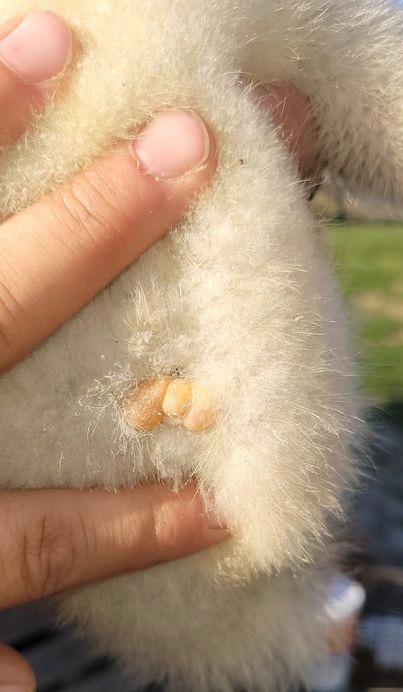

Dr Bowes: Is this around its navel? If it’s growing with the bird I think the origin is skin or a feather follicle cyst. I’ve never seen a case like this before, but recommend removal, as it’s easily resectable.
Testicles
Bitchin’ Chickens: I saw these photos posted in an online group suggesting they were three testicles. (photo: Heather Blarflemort-Ide)
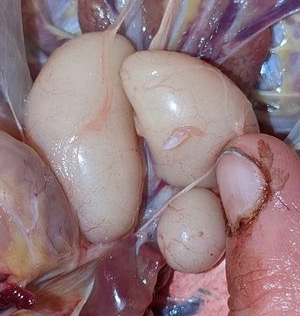
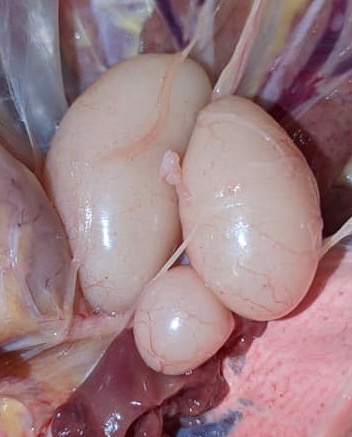
Dr Bowes: Although that’s what it looks like, I think that that one of the testicles had been constricted during development giving it an odd shape.
Herniated Tongue
I came home to my girl and her tongue hanging out of a hole under her beak. I had no idea what to do. Her tongue was still moist and, as scared as I was, I pushed it back through and cleaned it well. She had a good size hole, about the size of an eraser head, which I closed with super glue. She is eating and drinking beautifully. – Lauren MacKenzie

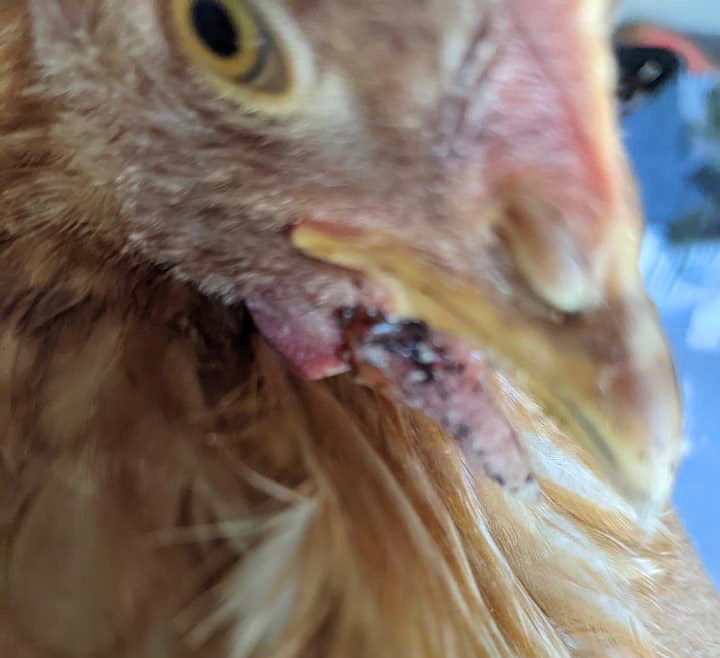
Bitchin’ Chickens: I presented this to Dr Bowes as I’m always searching for interesting cases and having seen several in online chicken groups apparently it is a ‘thing’.
Dr Bowes: This is new to me. I’m assuming that the hen had a penetrating injury under her lower beak, which allowed the tongue to drop down into the opening. It was imperative that it was fixed immediately, before the tongue became dry and necrotic.
Prolapsed Glottis
My chicken started sneezing at 6 pm yesterday. When I checked her again at 9 pm this is what she looked like. Her tongue appears sideways out of her mouth with this lump on the back sticking out. She was like this for a few minutes then shook her head and it all went back inside. Once back in, she was able to breath with her beak closed but had a crackled breathing sound. – Julia Viola Connors

Dr Bowes: The area of the mouth and throat have structures that keep everything in their anatomically correct positions. I wonder what happened internally to dislodge it? I would monitor and if happens more than a couple of times I would euthanize her. The glottis opens directly to the lungs and if it is exposed to the outside environment it makes her vulnerable to infection.
Cutaneous Horn (Conical Hyperkeratosis)
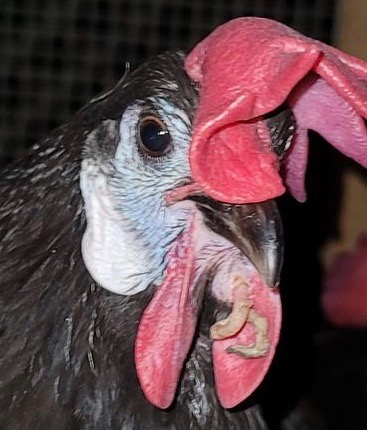
When I first showed Dr Bowes this chicken photo (credit: Jeni Barker) she had no idea what she was looking at. The scientific term is conical hyperkeratosis cutaneous horn, which is a mouthful meaning a lesion consisting of keratic material above the skin that resembles an animal horn.

Keratin, of course, is a type of protein that makes hair, fingernails, claws and feathers. Cutaneous horns can be found in a number of species including cats, dogs, people and chickens. The horns come in various shapes and sizes and are often benign; in people, they can be linked to skin cancer. They can be removed, but often regrow.
In chickens, they commonly grow from the comb, cere, or wattles. Here’s another example:

That wraps up another episode of the fun and wacky stuff found in nature and maybe even in your coop. I hope these cases didn’t disappoint.
Once again, my appreciation goes out to Dr Bowes for indulging my passion in the weird and wonderful, and along the way learning more about chickens with the intention of passing that on to my readers.
If you’ve got an interesting story you’d like to share drop me a line via the ‘contact’ button on my home page.
 Bitchin' Chickens
0 comments on “Avian Pathology Cases: 38 Oddities”