
This series is the result of my partnership with Dr Vicki Bowes, avian vet/pathologist whom I get together with regularly to look at what she calls ‘best guess’ or ‘show and tell’. I present my flash drive full of interesting health issues I’ve collected and we pore over them trying to figure out the most likely diagnosis. Our last meet up resulted in almost 30 cases. I’ve presented some relating to specific areas of the body (i.e. eyes) or issues related to pathogens. This one is a mixed bag of lumps, bumps and injuries.
Beak Injury (photo: Trena Willoughby)
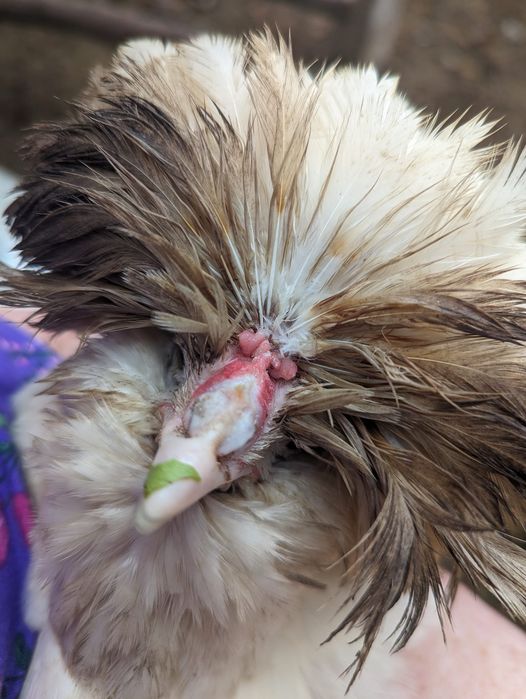
Dr Bowes: This looks like part of the beak was sheared cleanly off. The white area is poorly vascularized connective tissue that is the support structure for the beak. Given time the keratin covering should regrow.
Bumps On Comb
This happened within ten days and only one out of six hen has this. – Shelley Red Watson
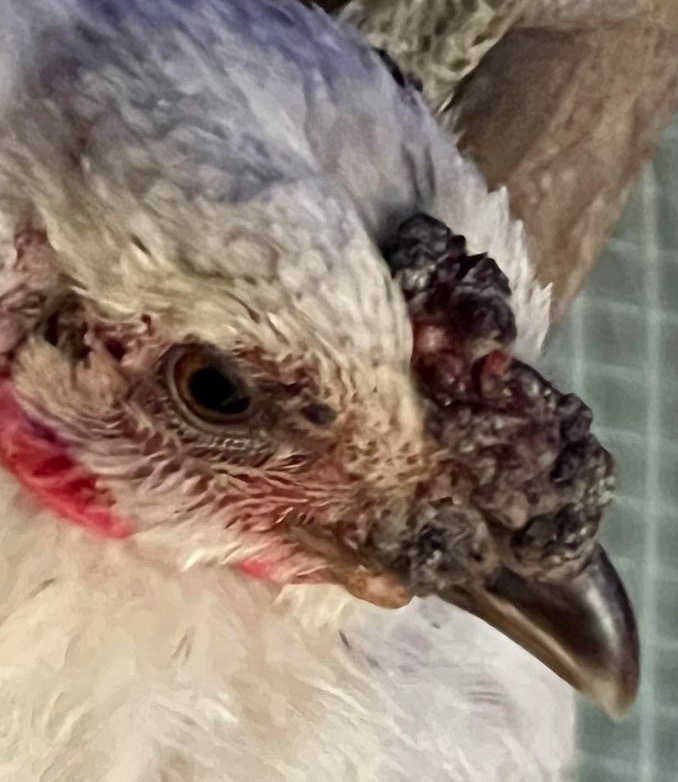
Dr Bowes: It looks like blood staining rather than Fowl Pox. Other options are an abscess, dermatitis or squamous cell carcinoma. You can use an antibiotic/ antifungal product like Polysporin. Take photos every few days to see if they change in size. The potential problem is if the bumps block her nares (nostrils).
Cutaneous Horn
These growths on her face started small and get bigger by the day. At first I thought they were Fowl Pox, so I’ve been letting run its course. She now has a reddish, almost bloody, blister on the other side of her nostril, which was not there yesterday. The growth on the top of her beak has gotten bigger in the past week. The one on her wattle now looks like it has a hole. It seems to blocking her nose and making it hard for her to breath. Is there anything I can do for her? I put an antibacterial cream on them, not sure if that’s helping anything. – Amber Vo

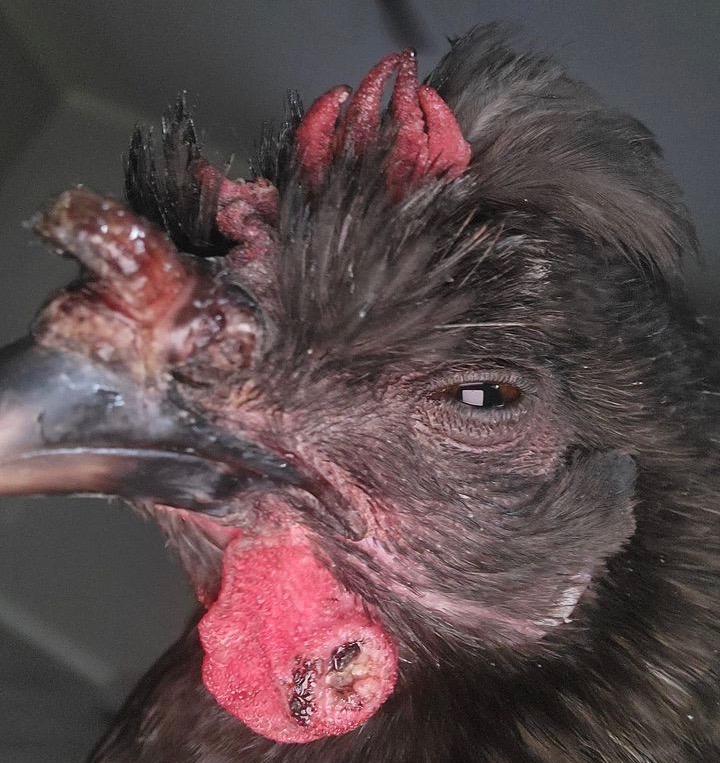
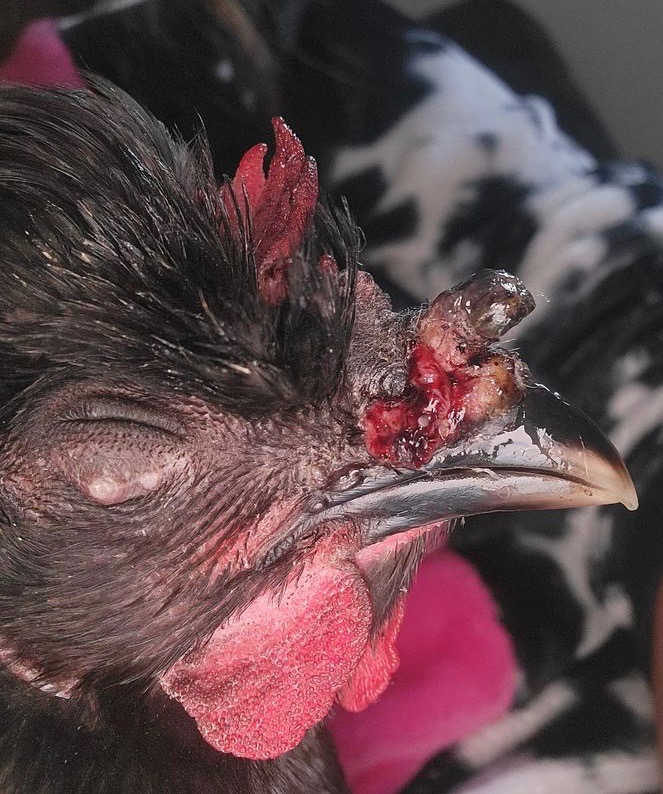
Dr Bowes: The bump on her beak is a cutaneous horn. The bumps around her eye could be squamous cell carcinoma. The proliferative nature of the spots on her wattles is potentially a tumour. Her treatment requires a vet who would remove the horn, clean the area and do a biopsy of the lesions on her wattles.
Bitchin’ Chickens: The scientific term is conical hyperkeratosis cutaneous horn, which is a mouthful meaning a lesion consisting of keratic material above the skin that resembles an animal horn.
Keratin, of course, is a type of protein that makes hair, fingernails, claws and feathers. Cutaneous horns can be found in a number of species including cats, dogs, people and chickens. The horns come in various shapes and sizes and are often benign; in people, they can be linked to skin cancer. They can be removed, but often regrow.
In chickens, they commonly grow from the comb, cere, or wattles. Here’s another example:
Cutaneous Horn #2
One of my dad’s chickens started limping a week or two ago and today she will no longer put weight on that foot unless she really has to; she seems healthy otherwise. I just noticed the growth today when I was trying to figure out why she was no longer walking on that foot. – Brittney Creasser
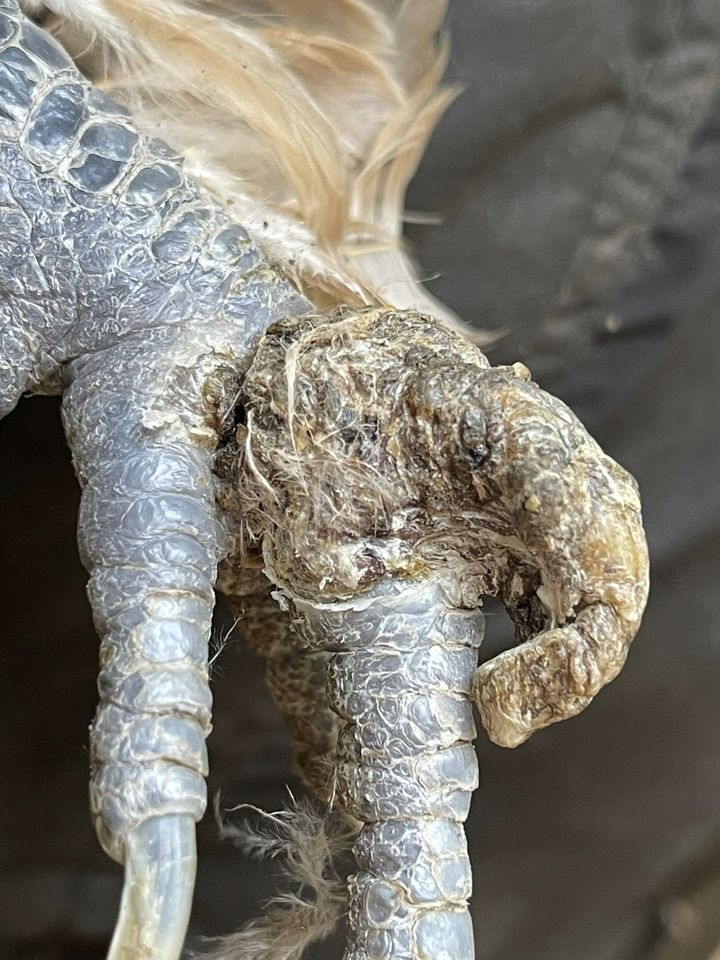
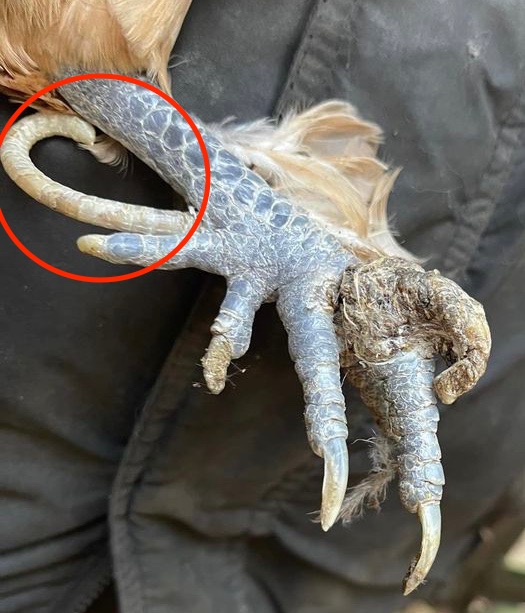
Dr Bowes: The growth on her foot is a cutaneous horn over the joint. There is inflammation in her toe, which may be compromising her vascular (blood) supply. You might be able to trim the horn back. Trying to cut it at the base won’t resolve it; the problem isn’t the length but under the base, which looks infiltrative. There are keratolytic products that might work to reduce the size.
Bitchin’ Chickens: She also has a massive spur (circled in red) which looks like it’s growing backwards into the leg. Don’t remove the whole spur, just trim it back to about 1½” from her leg.
Unaddressed Injury
I recently rescued this hen who has a hard knob on foot, which causes her to walk with difficulty. I will be taking her to a vet, but wanted suggestions for how to treat her. – Jane Brooks
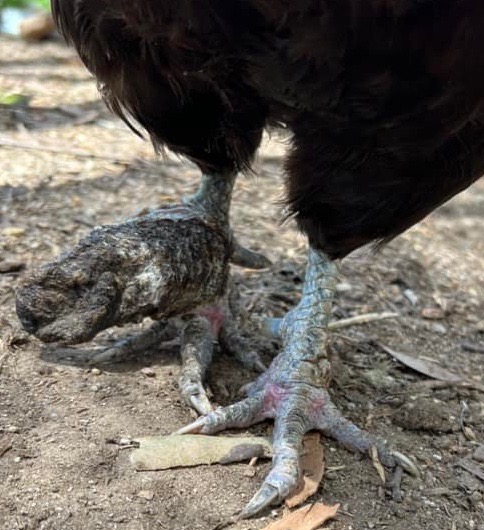
Dr Bowes: This would be simple surgery for a vet to debulk the mass, which was probably the result of an unaddressed injury. Most of the mass is proliferative scar tissue. It appears that something similar is happening with her other foot as well.
Pedunculated Lump

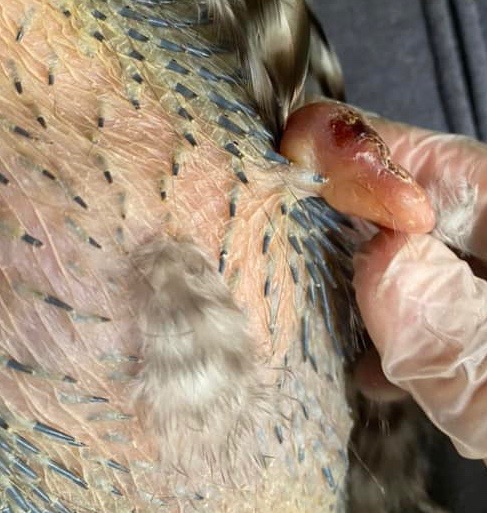
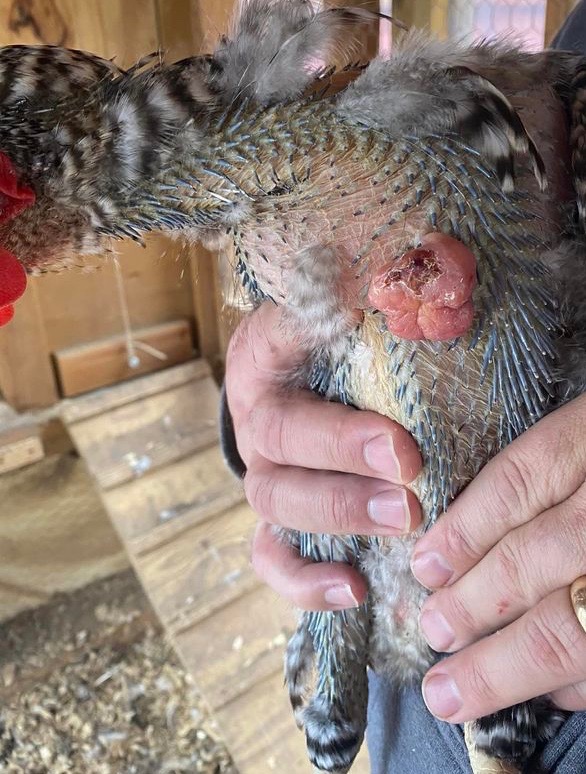
Dr Bowes: This is a pedunculated lump, maybe caused by a feather follicle cyst. It could be cut off at the base. Be prepared to stop any blood loss. A vet would use a local anesthetic and may need one suture to close the opening. Of note is the interesting pattern of the new feathers that are regrowing.
Glossary
Debulk: the removal of as much of a tumour as possible.
Keratin: a fibrous protein forming the main structural constituent of hair, feathers, hoofs, claws and horns.
Keratolytics are used to soften the keratin layer and for loosening scales.
Peduncle: a stem that supports a mass such as a cyst or polyp.
Proliferative: Proliferation is the growth of tissue cells. In many diseases, it is abnormal. Cancer cells are very prolific because they have high rates of cell division and growth.
Well, that wraps up another edition of Show & Tell With Bitchin’ Chickens and Dr Bowes. I hope that it’s been a learning experience for you.
If you’d like help with a case drop me a line using the ‘contact’ button on my home page. Remember to wear gloves, take good close up photos from several angles and supply us with plenty of information (e.g. timelines, symptoms, medications, general flock health, etc) so we’re able to more accurately pinpoint what’s going on.
Thanks again to Dr Vicki Bowes for her willingness to share her wealth of knowledge and experience to build capacity and skills in small flock keepers.
 Bitchin' Chickens
0 comments on “Avian Pathology Cases: 48”