
Evolution has provided most bird species with adaptations that allow them to fly: a compact body that is light at the top and bottom heavy; hollow bones; a shortened digestive system; and the lack of teeth, which are both dense and require heavy bones to support them. Of course, the development of barbed feathers should go without saying.
Whether you free-range your flock or pen them there may come a time when their ability to fly, even short distances, may be problematic. Out of curiosity they may hop over the neighbours’ fence or into your dog pen or garden. Or they may employ a combination of hopping and flying to roost high in a tree, which makes them vulnerable to predators.
For a short while, I free-ranged my birds. I loved seeing them out in the woods and field but ultimately I penned them for their safety and my peace of mind. Their enclosure is 30’x40’ with a number of fruit trees inside. It took awhile but I discovered that the open top left them vulnerable to hawks. I also learned that lightweight bantam breeds could get over the 6’6″ fence, especially if spooked.
I added a 10’x20’ car canopy frame which is partially tarped. Over time I used heavy-duty plastic deer fencing with 2”x2” squares to cover the entire top. The result: no more hawk issues and no flying out of the pen.
Not everyone wants to pen their birds. An oft-suggested solution is to clip their wings to prevent/reduce flight. If you check out the Internet you’ll soon discover the pros and cons and a number of different recommended methods about which feathers to cut, how often and whether to trim either one or two wings. I’ve seen too many photos of botched jobs that put those birds at risk.
My preference is to find remedies that address the issue rather than to interfere with their bodies. If your birds are free-ranging and have lost the ability to fly that may also put them at greater risk of a predator attack. My advice is if you don’t have to clip your birds’ feathers, then don’t, and if it is necessary then do it properly.
I reached out to Julie Ashley, DVM, for her thoughts on the practice.
I do not recommend clipping ANY bird’s feathers unless it’s absolutely necessary for the safety of the bird.
I’d like to share the proper, correct way to clip/trim wings. Anything other than the right way is definitely, absolutely just wrong and can far too easily cause severe injury to the bird. This is why it’s so important and why it matters. This is not my opinion; this is about the physical facts of flight aerodynamics. I’ve heard too many times how people do it differently and “they’ve never had a problem”, but it doesn’t change the facts or the serious risks to the bird.
Always, always do a TWO-WING clip. Clip both wings at the same time. Never clip just one wing.
A one-wing clip naturally causes asymmetry. It’s true that the bird can no longer really fly, but they always try and keep trying. And with just one wing clipped, the asymmetrical movement results in the bird spiraling, usually out of control. Even worse, the bird crashes back down, sometimes landing much too hard and this is when severe injury can happen. I’ve personally witnessed this multiple times and it really saddens me when people refuse to listen. They do not understand the biomechanics of flight and how it impacts the bird. Birds fly, so for any bird, this is everything.
When cutting feathers, NEVER cut a blood feather, which is a newly emerging feather after a molt. You must wait until the feathers have fully emerged, fully grown in and then have fully “dried”, whereby the blood vessels supplying each feather have completely receded.
Sometimes you can see that it’s dry when the shaft is translucent like in white or light colored feathers. If they’re still pink, do not cut! Otherwise it can be really hard to tell. I always wait a good two weeks after the feathers have fully emerged to be safe.
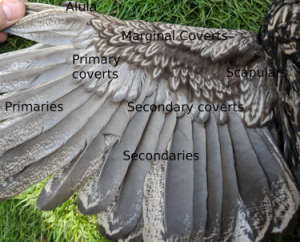

To clip the feathers, these images may help. The first diagram explains the type of wing feathers and their location. Wing clipping involves cutting only the primary feathers, or flight feathers, nothing else.
Start by clipping the first three or four primary feathers on each wing, which should be enough to stop them from flying over fences into dangerous territory. If not, clip one or two more primary feathers. Generally speaking, the smaller the bird the fewer the number of feathers needed to be clipped. Every bird is an individual and some may be more determined to attempt flight so watch and observe each bird until you’re satisfied.

If you don’t want to see unsightly cut feather ends sticking out then cut just above the dotted line shown in the first image and no more than ¼” underneath the overlaying covert feathers so that just the tips of the coverts hide the cut ends of the primary feathers.
The number of primary feathers you cut should be the same on both wings to maintain symmetry and will affect the bird’s flight capability.

Although some must be clipped for their safety, I personally want my ducks to still fly. Depending on the personality and determined willpower of the duck, I cut no more than seven primary feathers on each side. They can still “fly”, but not very high, maybe 2’-3’ off the ground, and not very far. It’s a perfect compromise for me. If you want no flight, cut more primary feathers, the same number on each wing.
This is the result IF you start with the first, outermost primary.

If you want to preserve the first few outer primaries for visual purposes (so that you can’t tell their wings have been clipped when they are naturally folded on their backs), then start with the fourth or fifth primary. Be aware you’ll then have to compensate by cutting more than six or seven primaries because those first few primaries have excellent flight power.
If you’re not sure how many to cut from each wing, start by cutting just a few making sure it’s the same number for each wing and then flight test your bird.
Note: If you’re clipping wings on geese or Muscovy ducks, you will need heavy duty clipping scissors; their feather shafts are thick and tough. Regular scissors won’t do it. I use sheet metal cutting scissors for one of my ganders and a few of my female Muscovies.
Thanks to Julie Ashley, DVM, used with permission.
 Bitchin' Chickens
0 comments on “Chicken Wing Clipping: When & How To Do It”