

For more than three years I’ve gotten together with Dr Vicki Bowes, vet/avian pathologist on a regular basis to pore over files in my memory stick loaded with interesting chicken health issues that I’ve collected for her expert opinion. She refers to it as ‘Show and Tell’, ‘Best Guess’ or, more recently, ‘Gorefest’ and has done a good job at making diagnoses given the information we have at hand. Sometimes all we are provided with is a short paragraph from the chicken’s owner, other times nothing more than a photograph.
My job is to write them up to share with my readers as a form of skills building for small flock keepers.
We met up recently to look at almost 60 cases. I’ve attempted to curate them according to the area of the body affected. These ones are grouped together as they involve various weird and wonderful things that can occur in chickens.
Albinism (Nichole Barlow)
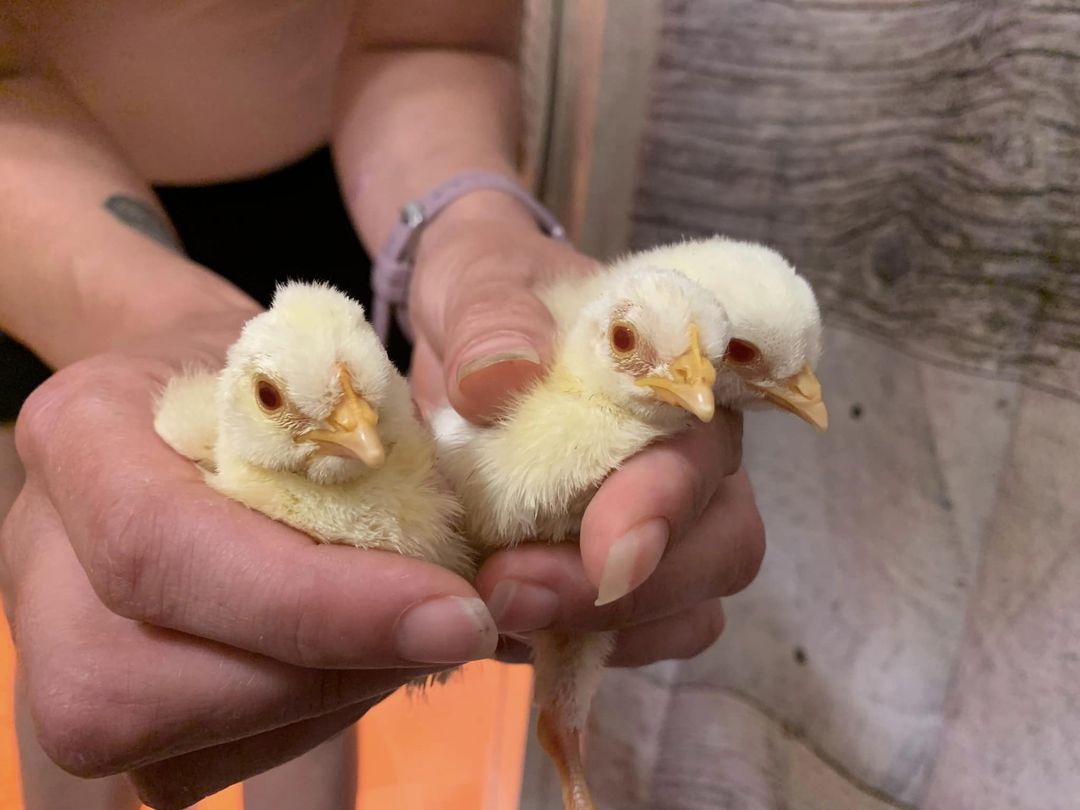
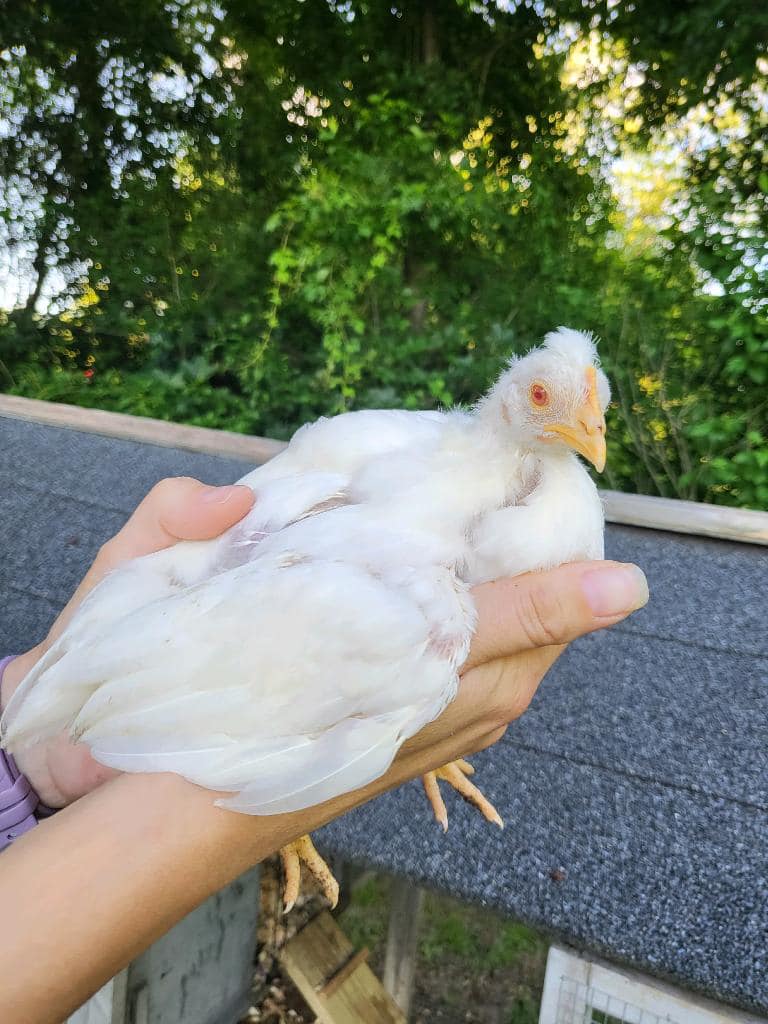
Bitchin’ Chickens: I saw these chicks posted in an online group and there was some disagreement as to whether they were albino or leucistic.
Leucism in birds is defined as the complete or partial absence of eumelanin (brown-black pigment) and pheomelanin (reddish-yellow pigment) in one or more feathers, but not in the eyes, beak or feet, resulting in white patches in all or part of the plumage
Albinism, on the other hand, is the complete lack of these pigments due to the absence of a particular enzyme (tyrosinase).
In the former you’d expect the chicks to have blue eyes, whereas if they were albinos their eye would be pink. The yellow beak and legs aren’t a result of skin pigment that would be affected by albinism. The yellow beak and legs are due to carotenoids, not pigment. If a bird that didn’t have the yellow leg gene were albino their legs would be white, or sometimes a bluish-pink colour.
In chickens, there are different mutations, resulting in different degrees of depigmentation, and consequently several types of albinism.
Dysplastic Alula
Sultans are supposed to have the extra toes, but this chick has six on each foot, as well as some kind of feather saber that sticks forward. – Joseph Edwards


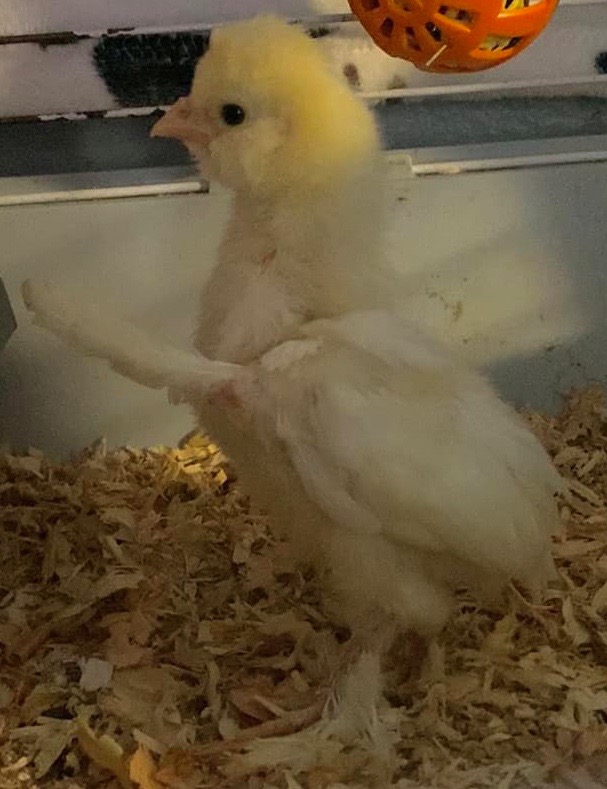
Bitchin’ Chickens: Having written an article about alula thumbs and wing claws I knew that the alula (plural: alulae) comes from the Latin for ‘winglet’ and is a small, freely moving first digit on the leading edge of the wings of flying birds. It’s considered the bird’s ‘thumb’ and is covered by three to five small flight feathers, which can stick out and in many bird species is clearly visible.
It is difficult to tell from that photo if this chick actually has an alula and that’s where the feather is situated.
Dr Bowes: Abnormally long feathers on chicks can be problematic, in that, the weight makes the bird off balance. Don’t pull it out. Cut the feather close to the body when it is out of blood. I would be curious if it a misplaced feather follicle in the skin tract.
Featherless Chick
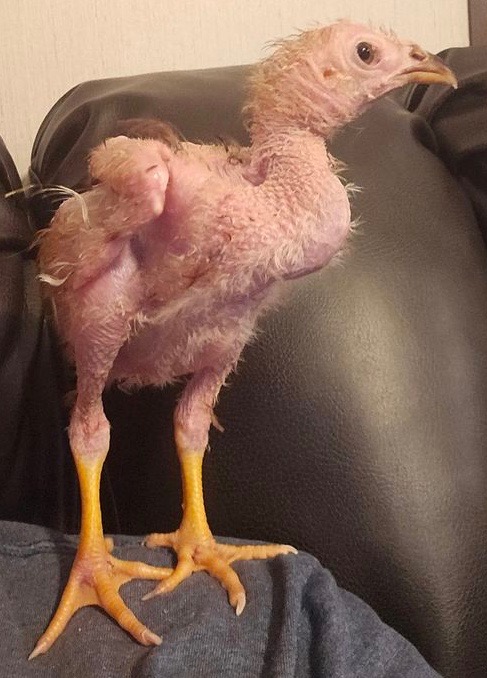
My two-month-old chick hatched early and ended up with a respiratory infection at two weeks old. She also had a skin condition that looked like some sort of dermatitis that is clearing up with oatmeal baths. She’s a little fighter and slowly getting better but has yet to grow her feathers in. – Lindsay Scriven

Featherless Chick 2
This one was hatched like this. All the other chicks have normal feather growth. – Anonymous
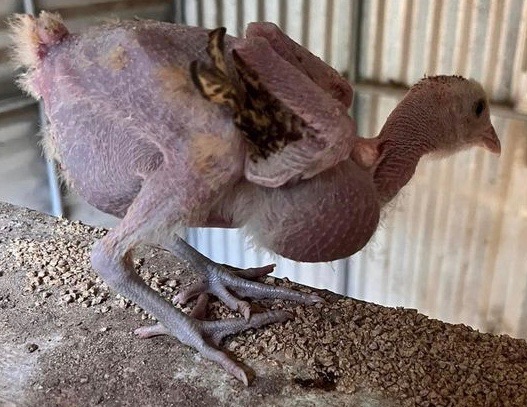
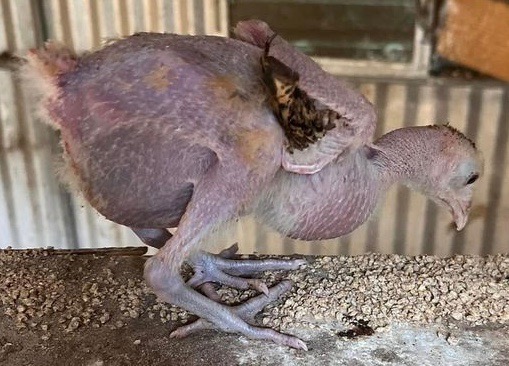
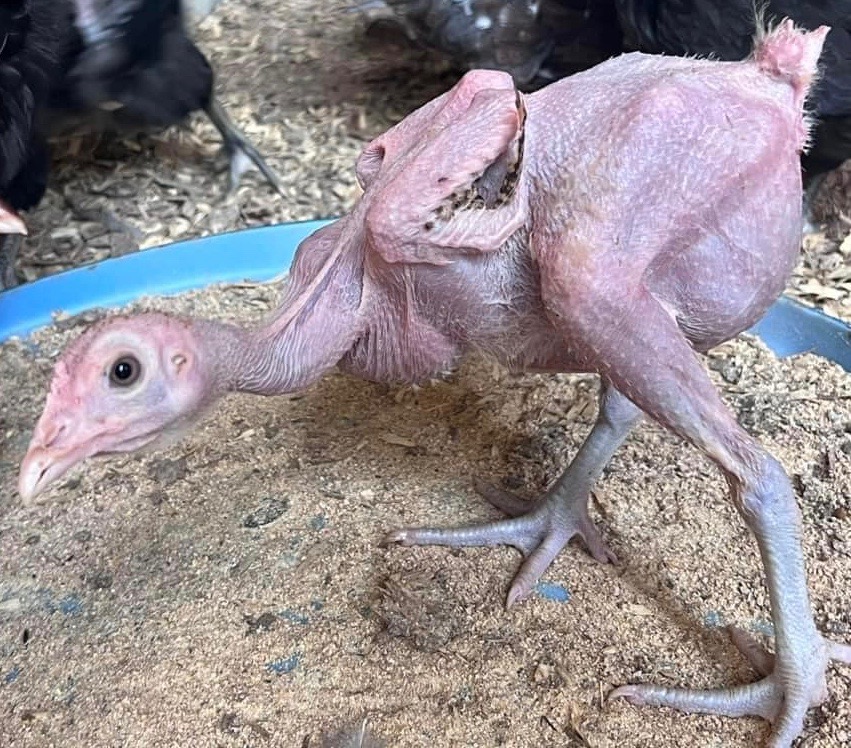
Bitchin’ Chickens: Chickens can be featherless for a number of reasons. One type of featherless chicken have no scales on their shanks and usually no feather follicles. The two cases above involve birds that have feather follicles, but sparse to no feathers. It might be a genetic issue or a problem with keratin. I’d be curious to see the parent stock.
Dr Bowes: The stress hormone cortisol can interrupt feather growth. Keep her warm, protected and get her to teenagehood when her feathers may come in. Some people feed cat food to boost protein and feather production. I advise against that in this case; she is not protein deficient and too much protein will be hard on her kidneys.
Cutaneous Horn (Ashlynn Seebach)

Bitchin’ Chickens: The scientific term is conical hyperkeratosis cutaneous horn, which is a mouthful meaning a lesion consisting of keratotic material above the skin that resembles an animal horn.
Keratin, of course, is a type of protein that makes hair, fingernails, claws and feathers. Cutaneous horns can be found in a number of species including cats, dogs, people and chickens. The horns come in various shapes and sizes and are often benign; in people, they can be linked to skin cancer. They can be removed, but often regrow.
Dr Bowes: The at-home solution is to take a small pair of sharp scissors or scalpel and cut it off.
A friend of mine gave me some eggs to hatch from her hens; out of 12 we had eight healthy chicks. We also had one live baby that was deformed. I had no idea until I helped it out of its shell. The chick had most of the shell chipped away for its head but couldn’t seem to zip the egg. Once I removed most of the shell the chick fell loose and I saw that it had no feet or wings but was very much alive. I went ahead and inspected the other two eggs that hadn’t pipped yet; seeing no signs of life I opened their shells to find both of them deceased. One was in late stage while the other was deformed with no wings or feet. – Jenna Chandler


Bitchin’ Chickens: Since there were multiple eggs with the same deformity I would venture to say it’s something passed on from the parents. Usually hatching egg ‘fails’ involve genetics, vitamin deficiencies, fluctuations in humidity and temperature during incubation or even exposure to chemicals/toxins.
Polymelia

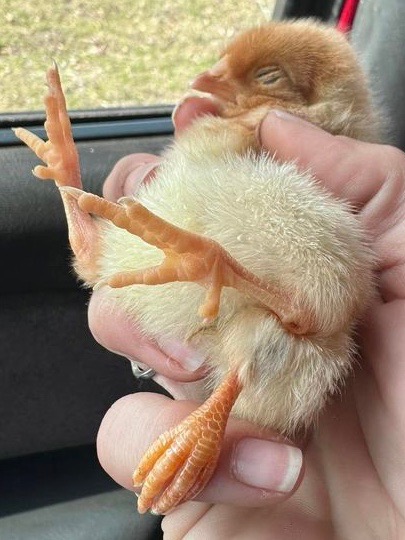
Credit: Shannon Kirkpatrick


Credit: Cassandra Wade
Bitchin’ Chickens: Lots of you might be familiar with polydactyly in cats; extra toes that appear as though the cat was wearing mittens.
A similar genetic birth defect, polymelia, from the Greek word meaning ‘many limbs’ can occur in various species of mammals and birds, including chickens but is considered rare. (i.e. one in ten million chicks).
The extra legs of polymelus birds are often underdeveloped and malformed, usually nonfunctional and the feet have fewer than normal toes. Several subcategories of polymelia exist, including pygomelia, which is defined by extra legs attached to the pelvis. Scientists are still working to understand what factors cause polymelia, especially in birds; possibilities include conjoined twins, genetic issues, chromosomes, or exposure to toxins in the environment during incubation.
Odd Feathers
Have you ever seen wing feathers look like this? Do you know what would cause them to grow this way? This is a Shetland chick hatched from shipped eggs. -Melissa Burrows

Bitchin’ Chickens: Dr Bowes and I were stumped by this one, never have seen anything like it. A little Internet sleuthing came up with the answer below.
The Shetlands grow out their baby feathers in a very unique way: the ends taper down to almost little teardrops; the narrow bit gets narrower and the ends fall off. They do this before their first molt when they get their juvenile feathering. The only other breed I’ve seen something like this with are Gold Deathlayers, but only their tail feathers are affected like this. – Jennifer Volcansek
Two Vents
My mom just processed this laying hen because she kept having episodes where she would drag her back end around, then recover. It turns out she had what appears to be two functioning vents. She didn’t realize there was an oddity until she plucked her.
From what she could tell, no other organs were doubled. There was only one intestine that split into two functioning vents. She didn’t dissect the two tails, but the one that had the tail feathers and was off to the side had full, regular bone development with the preening gland on top.
The other tail had very thin bone in it, but was mainly a fatty glob. There was one normal set of kidneys in the hips. – Anonymous


Bitchin’ Chickens: I have seen this condition before but this was a new one for Dr Bowes. It’s an uncommon development issue. Both of us were wondering why the hen experience bouts of dragging her abdomen and would also would have liked to see photos of her in life showing her two tails.
Well, that wraps up another edition of Show & Tell With Bitchin’ Chickens and Dr Bowes. I hope that it’s been a learning experience for you.
If you’d like help with a case drop me a line using the ‘contact’ button on my home page. Remember to wear gloves, take good close up photos from several angles and supply us with plenty of information (e.g. timelines, symptoms, medications, general flock health, etc) so we’re able to more accurately pinpoint what’s going on.
Thanks again to Dr Vicki Bowes for her willingness to share her wealth of knowledge and experience to build capacity and skills in small flock keepers.
Feature photo credit: Jeni Barker
 Bitchin' Chickens
0 comments on “Avian Pathology Cases: 54 The Oddities 4”