
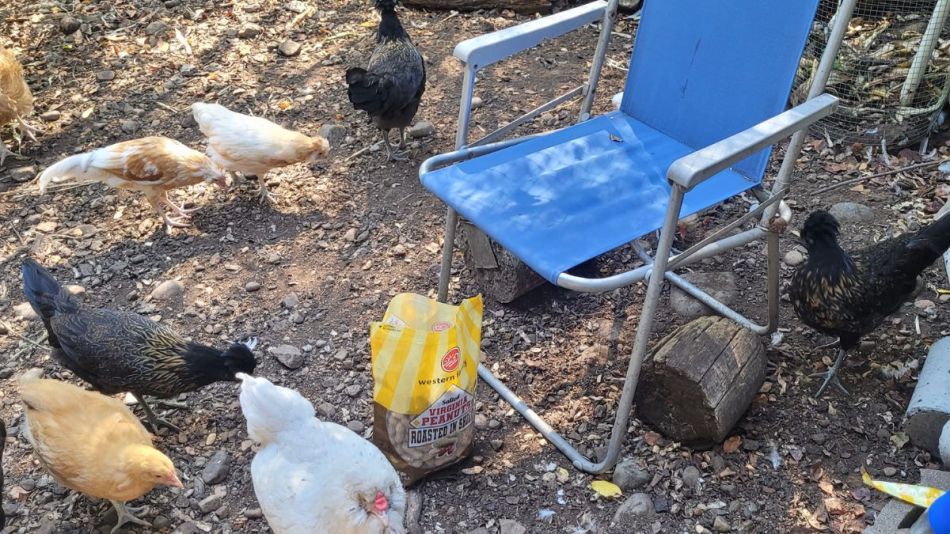
I haven’t gone on a vacation in almost 25 years. Whether it’s been due to work (at one point, six days/week) having dogs or chickens my preference has been to stay at home. I live on an island off the west coast of Canada 1/2 km from the ocean. Tourists come here and I sometimes feel like I live in a postcard. Between that beauty and the workload of my 4.5 acres it’s easier to stay home.
During the dark, rainy months of late fall – spring I don’t see my chickens as much as I’d like to. A few months ago I was dealing with sciatica and then a torn meniscus which forced me to slow down. Since then I’ve been commuting (via ferry) to work two days/week and working from home the other two. My afternoon break involves drinking coffee (me) and eating peanuts (them).
Recently I’ve been the fortunate recipient of more than 15lbs of peanuts in the shell. In the spring I cracked a whole bag full which I found both time consuming and messy indoors. As soon I was able to sit outside I headed out to my flock with coffee and peanuts in hand.
I have two pens: my 30’x40’ main one for @30 hens and a rooster and the adjoining 15.5’x30’ one for broody hens and their chicks. It’s currently home to two hens (the third headed back to the main coop last week when she was done with her chicks) and their cumulative 16 chicks born mid-June.
I grab a folding garden chair and park myself in the back pen close to the adjoining pen in a spot shaded by tall trees. I tuck the chair outside the pen having learned it could be a hazard. A couple of years ago one of the young cockerels was playing on the folded chair and must have slid in such a way that his leg was trapped. When I found him he was dangling upside down and there was swelling around his hock. I managed to extricate him and he made a full recovery.
Sometimes I bring lettuce, grapes or bananas I get from the local food recovery program, but peanuts are a staple. I crack them open and toss them to my flock. The adult birds are able to break them apart but the chicks aren’t as adept so I like to give them a head start. The ones I can’t break (always the singles) get hucked through the fence for the red squirrels.
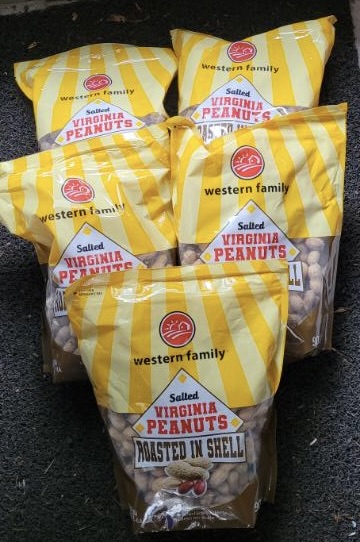
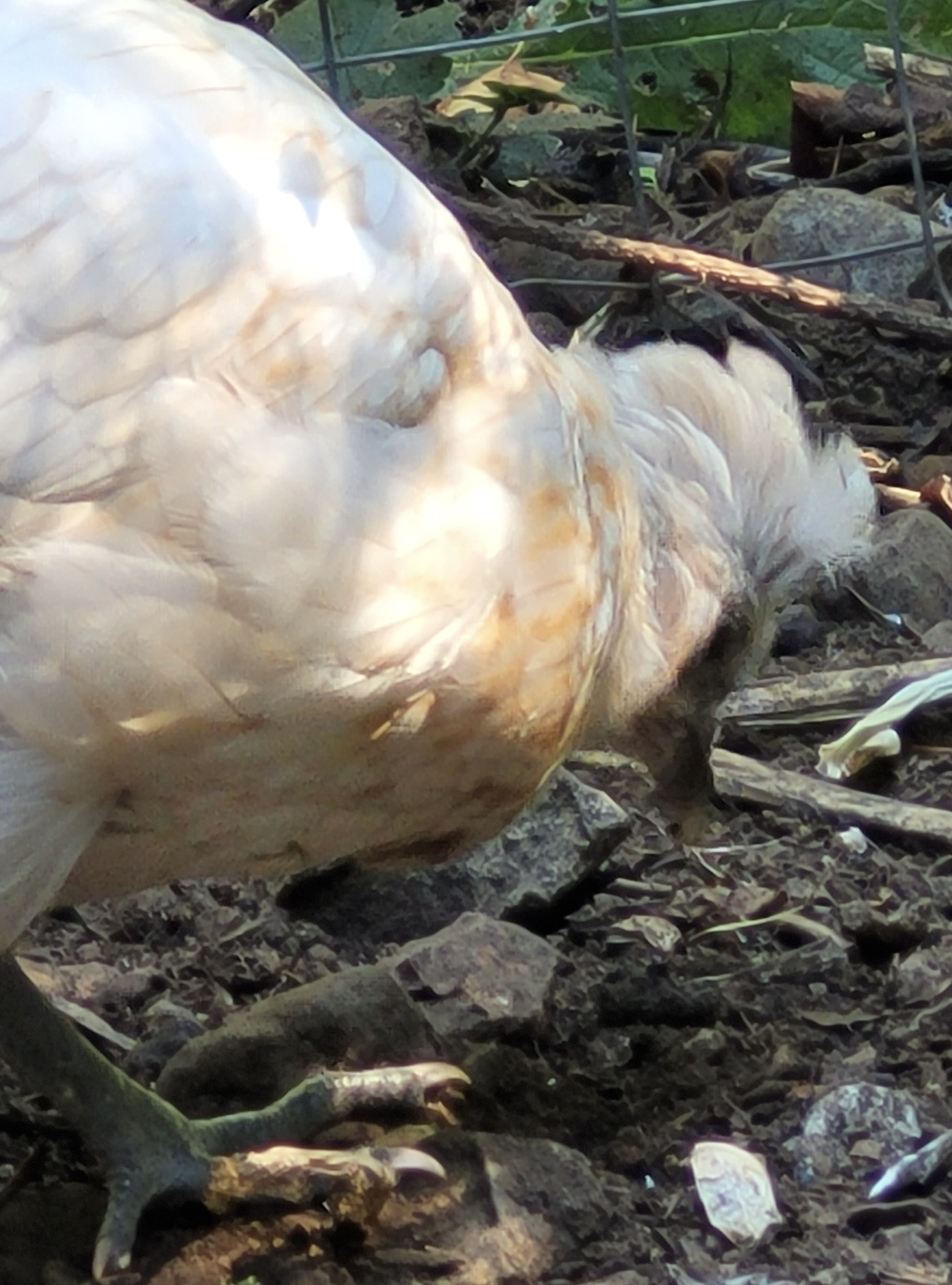
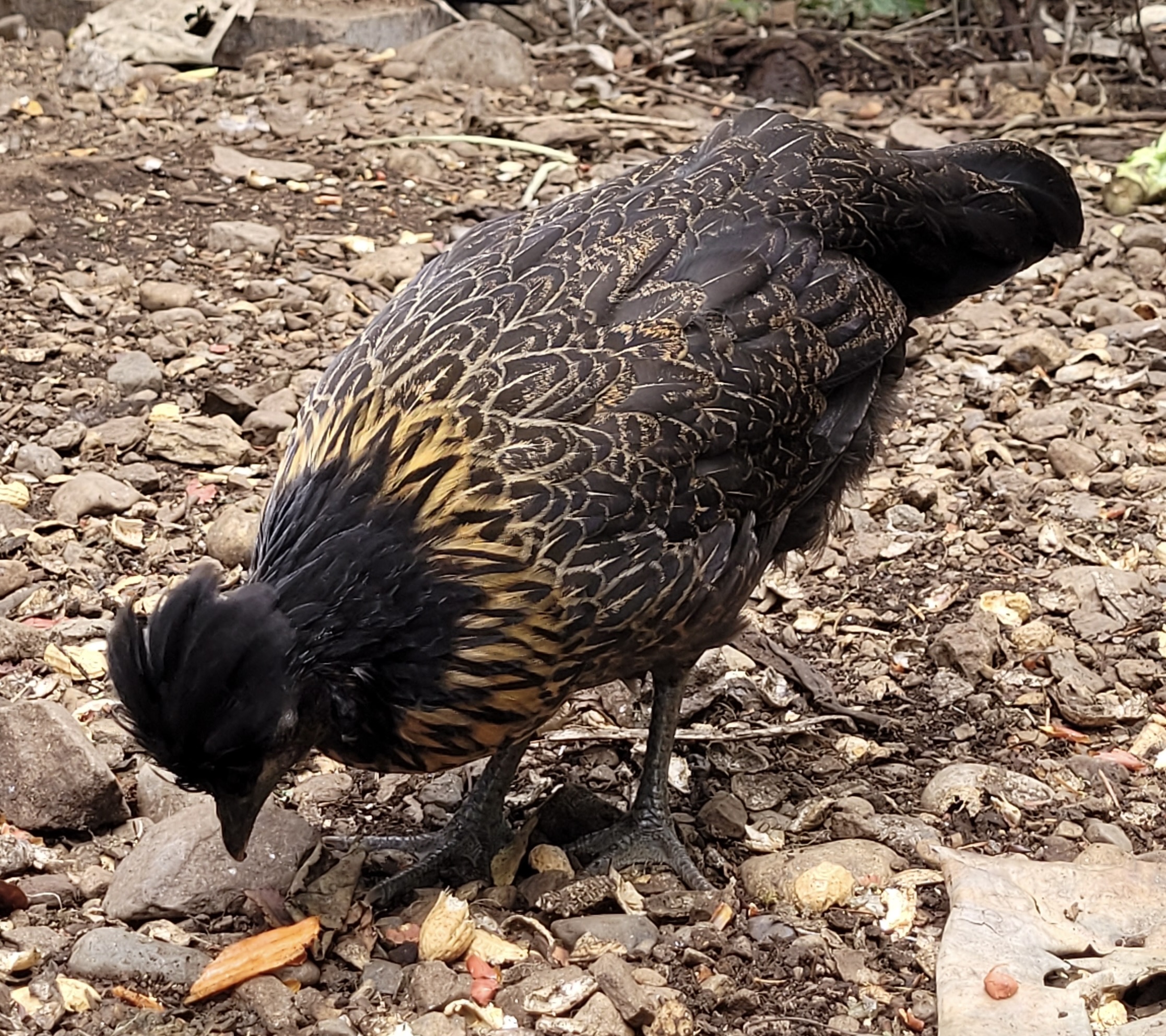
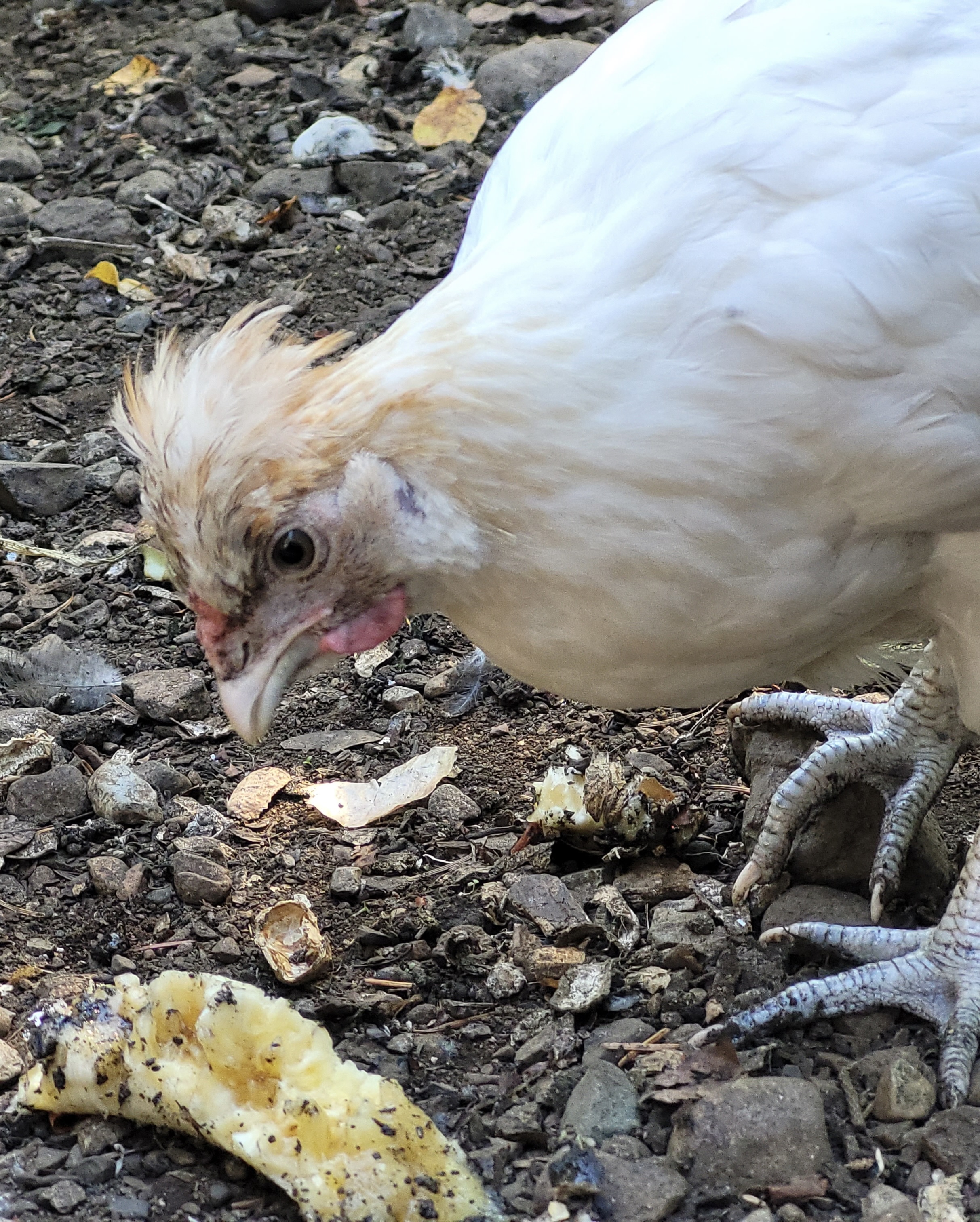
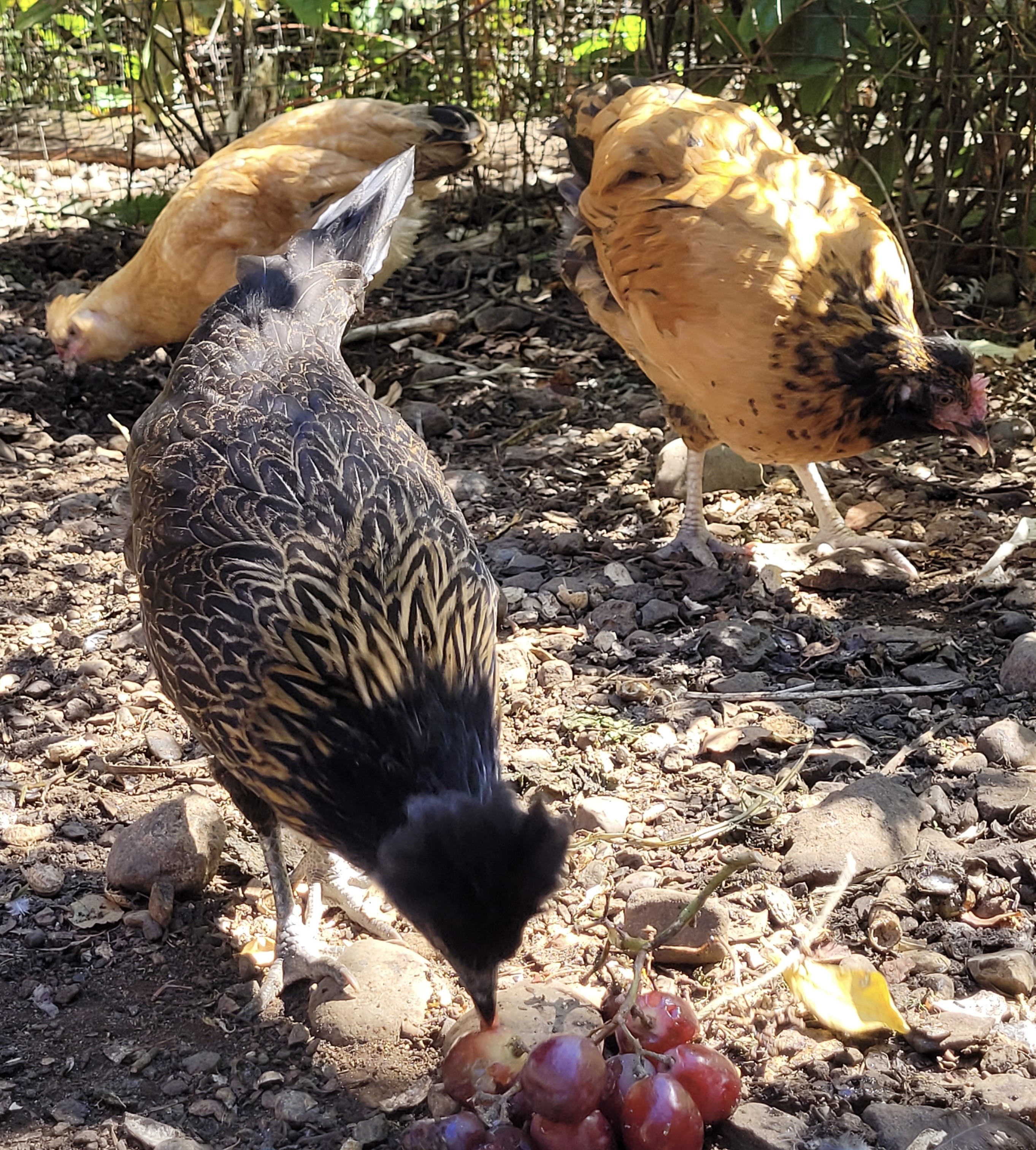
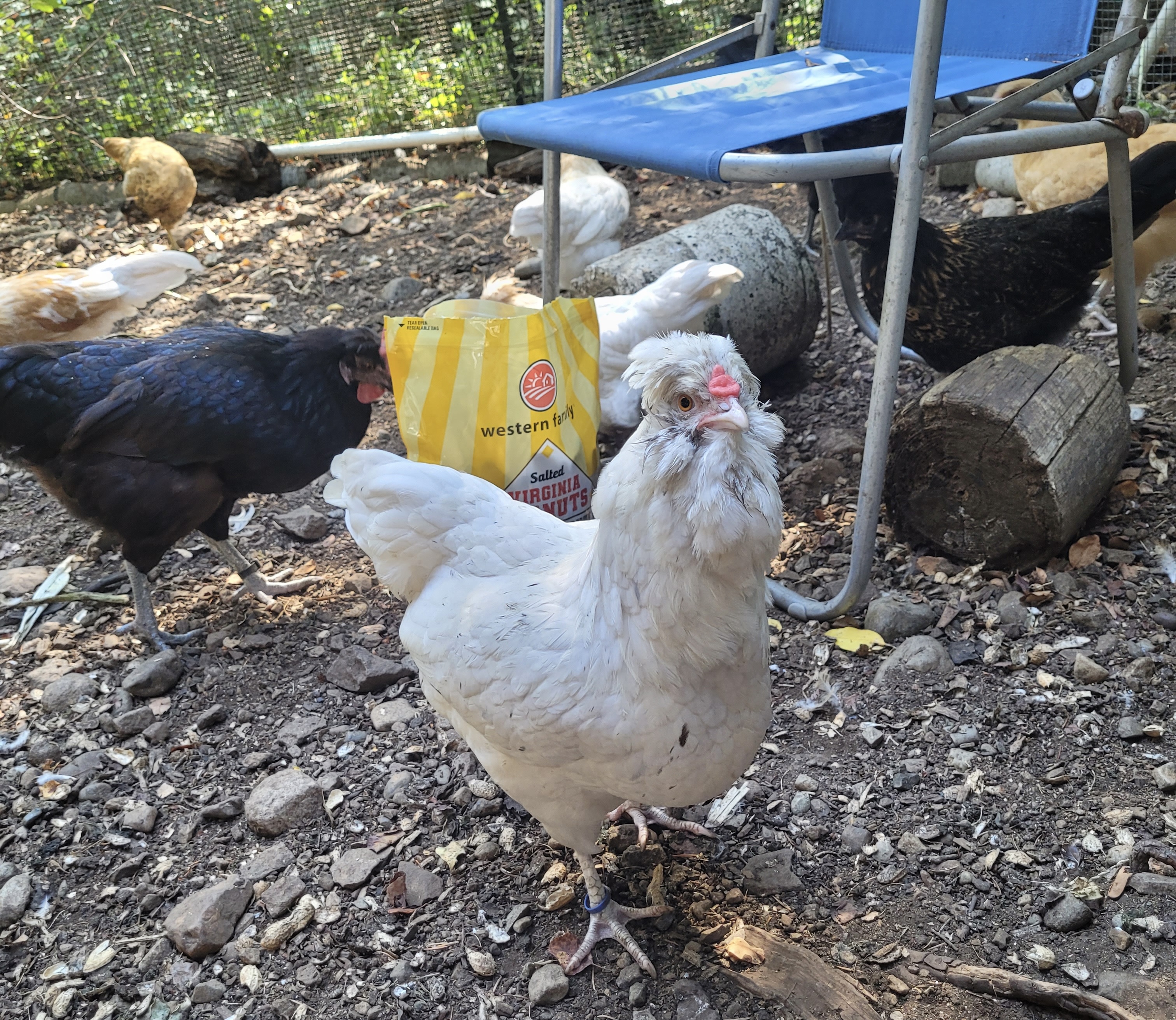
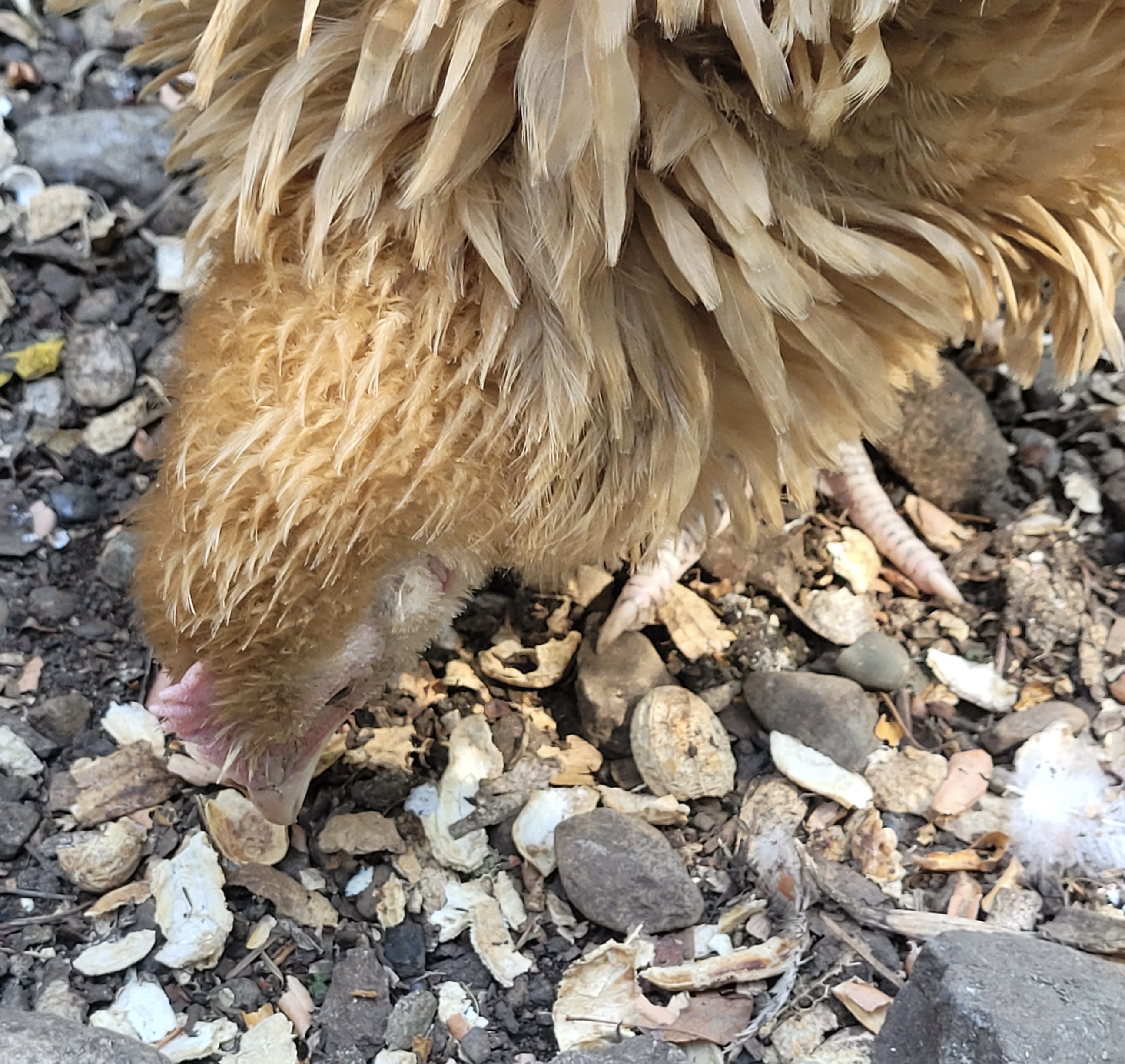
Some peanuts in the shell get tossed on the ground and some get thrown through to my flock standing on the other side of the fence. I make a game of improving my eye-hand coordination, seeing if I can get the peanuts to pass through, and not hit, the mesh. If it does the shell breaks open and my birds run for the contents. After throwing many hundreds of peanuts one managed to hit the fence and get stuck there. It was still there a week later so I decided to take a photo. Not ten minutes later another one got hung up so I had to document it before they drop to the ground.
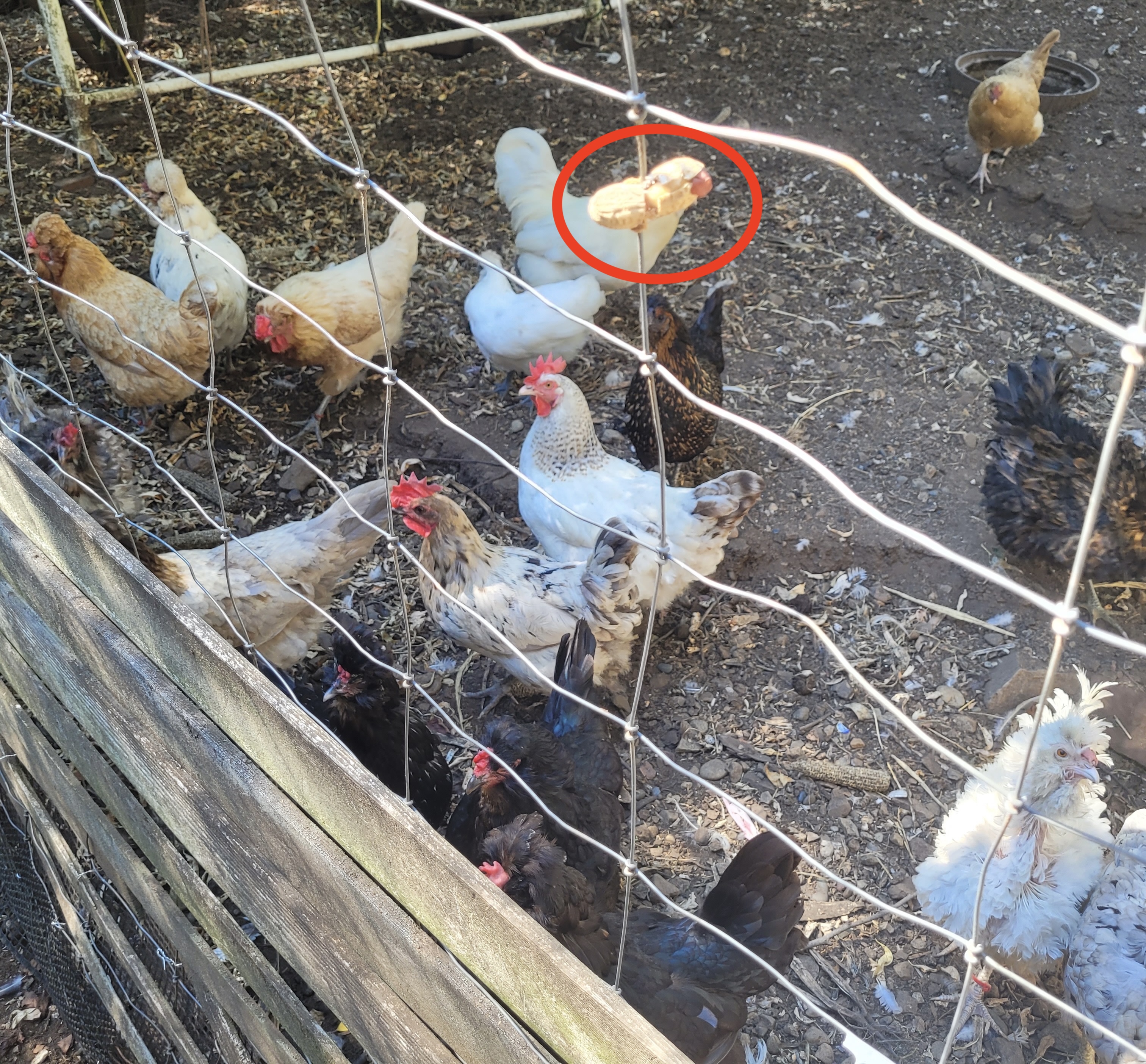
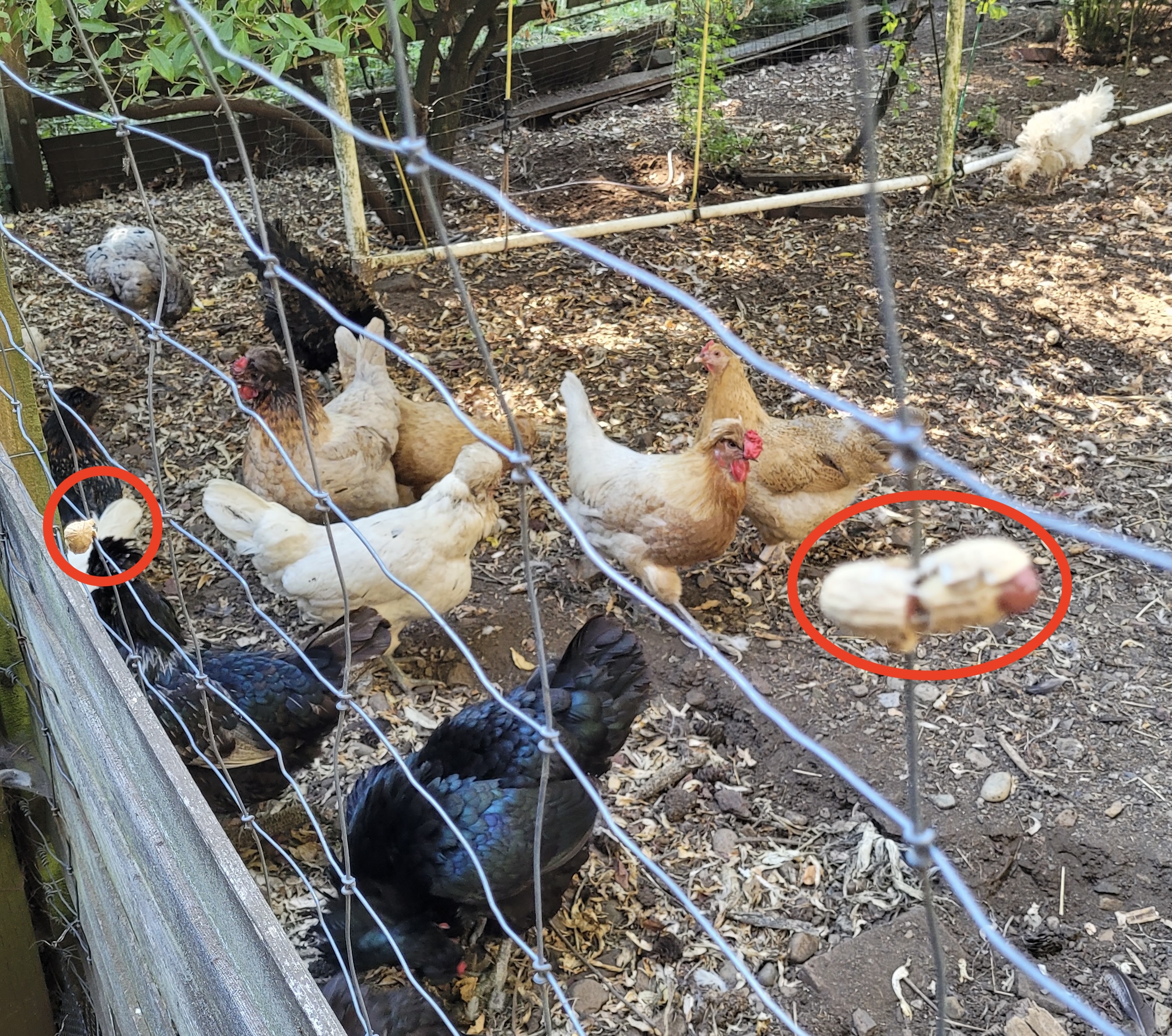
While I sit there I listen to the breeze blowing through the forest, watch the songbirds, say hello to the passing doe and her twins, and even got a surprise visit from a Cooper’s Hawk that flew by the length of my pen. I was pretty confident that my flock was safe but that didn’t stop them from alerting for more than ten minutes. Even in my presence they didn’t feel safe.
I’m often surprised when chicken keepers don’t notice or don’t know how to interpret their flock’s behaviour. Everyone is a newbie at some point but understanding what makes chickens tick comes from time and observation. Some behaviours like dust bathing are instinctual – chicks do it in the absence of ever having seen it demonstrated. Others are the result of being taught by members of the flock. When my rooster makes an alert call they don’t waste a second and scramble for cover. They learn to differentiate calls made for ground or aerial issues so they know where to look and how to hide.
A proverbial query in online chicken groups involves determining the sex of young birds. I used to marvel at folks who, with one glance, could confidently answer that question. I’m by no means an expert but I’m a lot better than I once was. In part, it’s about learning the general differences between cockerels and pullets (e.g. size, feathering), breed characteristics (sex-linked colours and patterns) and observing behaviour (e.g. chest bumping and raised hackles in cockerels). Of course, there are always exceptions but the more you spend time with your flock the more you learn. After a while it becomes second nature and intuitive.
This year I had 22 eggs hatch from three sources: my own flock and those from two friends. Emma collected eggs from both her pens: a Buff Laced Polish rooster with Cream Legbar, a frizzle and production red hens; and a Japanese Bantam rooster in with Buff Laced Polish hens. Laurie’s eggs came from barnyard mix hens and a frizzled Buff Orpington x rooster. My own birds are a real mix: some are descended from Polish, Appenzeller Spitzhauben, Legbar and Ameraucana. My rooster Kevin is several generations removed from his Silkie grand- or even great-grandfather. He sports a small crest, walnut comb, five toes and blue ears which clearly identify him as part-Silkie but he doesn’t have silkied feathers or dark skin. He appears white but who knows what genetics he carries. He’s the spitting image of his father who produced the occasional melanistic (black skinned) chick as well carried the barring gene.
I placed the three sets of eggs under three hens with the intention that I would be able to trace the origin of each hatch. It’s a long story (read here), but that didn’t pan out. Due to circumstances beyond my control (blame my hens) the eggs got mixed up a bit. One of my tasks during peanut hour is to try to figure out the sex and breed(s) of the chicks.
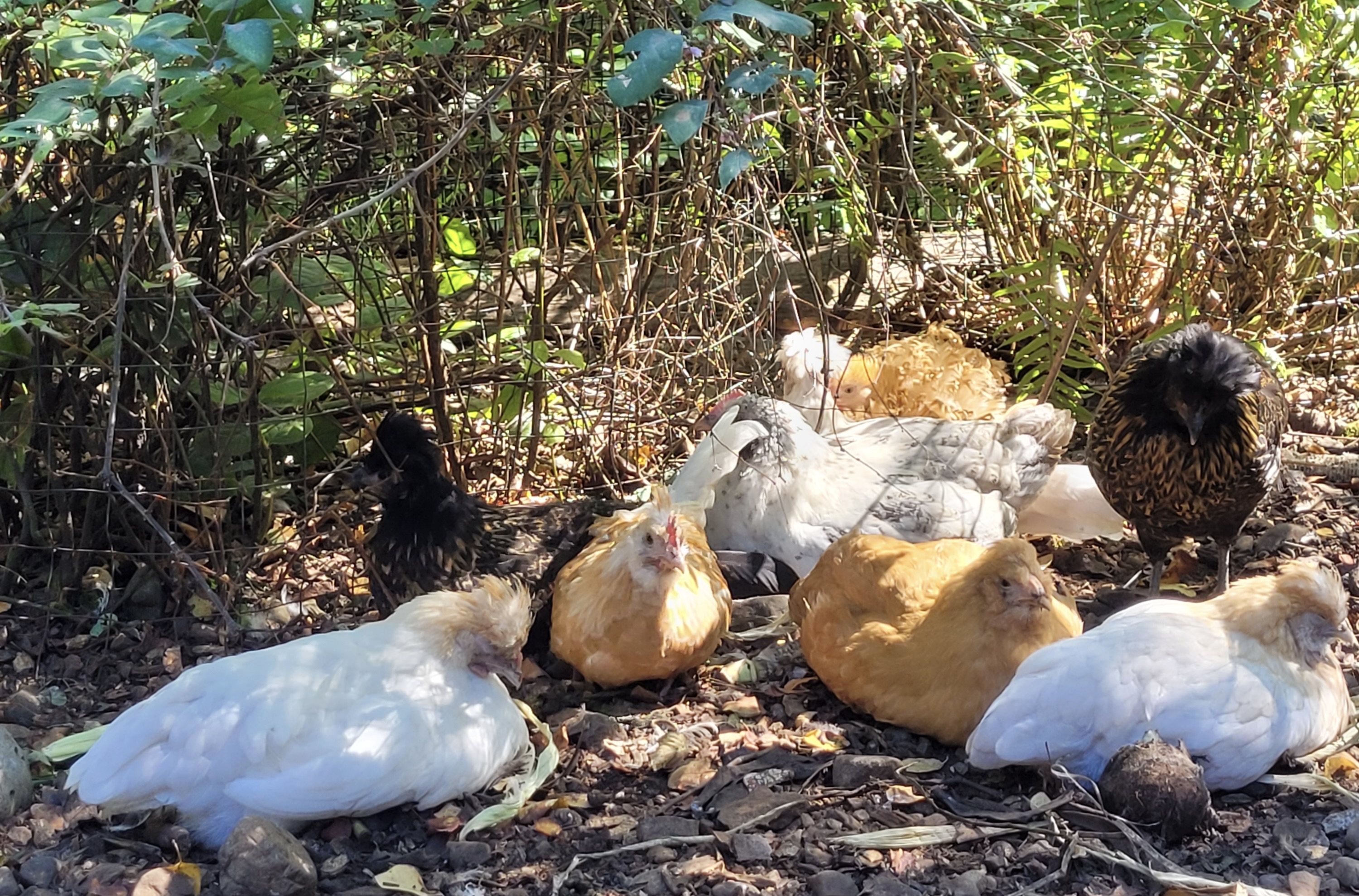
Pretty much all chicks start off as white, yellow, black or striped (chipmunk) and then develop patterns as they mature. Interestingly, 13 of the 16 carry some kind of crest (Polish, Legbar, Silkie?), while only two have 5-toes (definitely a distant Silkie trait). A couple more have blue ears (also a Silkie characteristic). Although ten eggs came from a frizzled parent only two carry and express that gene. Several of them have muffs (fluffy cheeks from Ameraucanas).
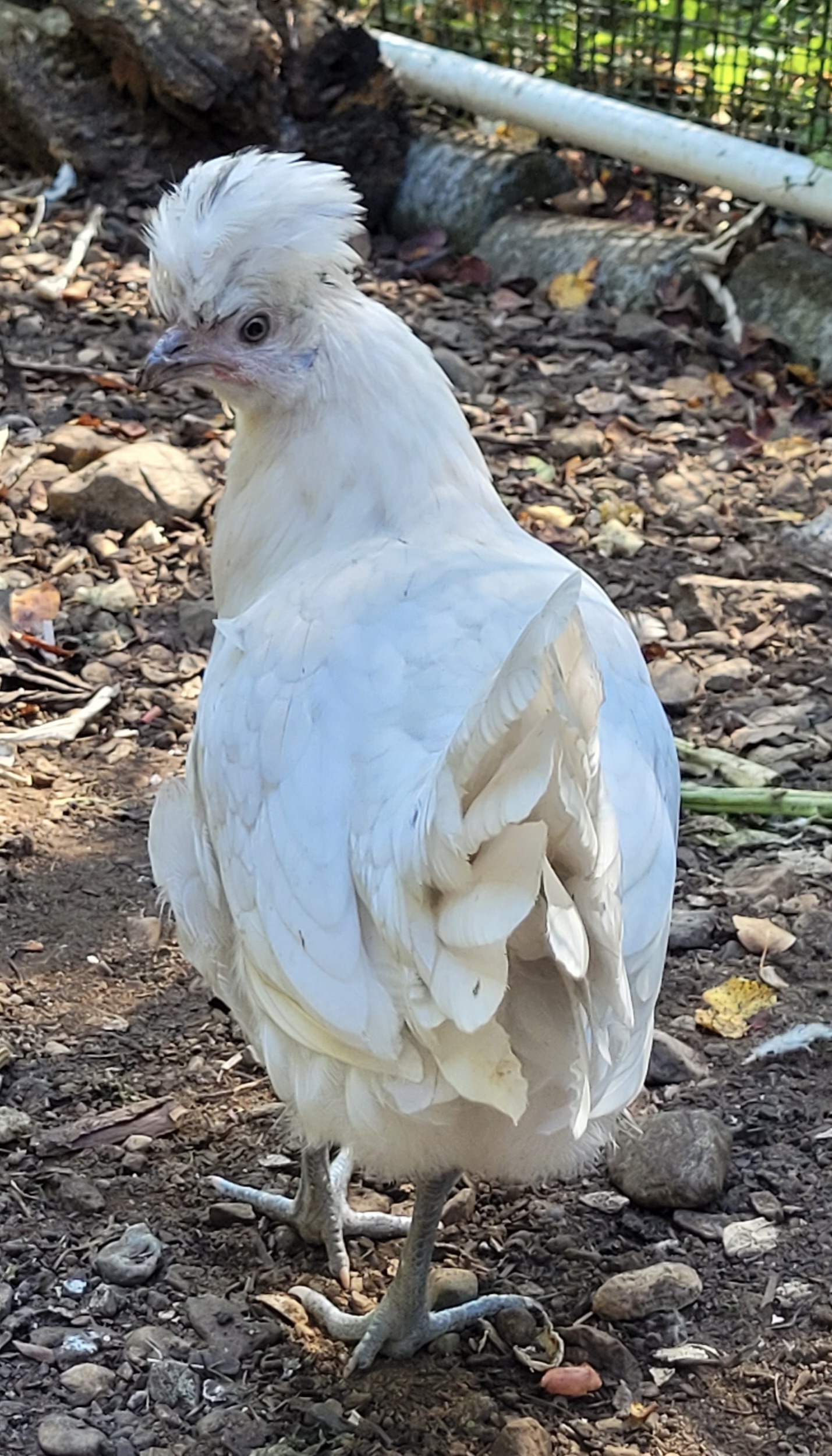
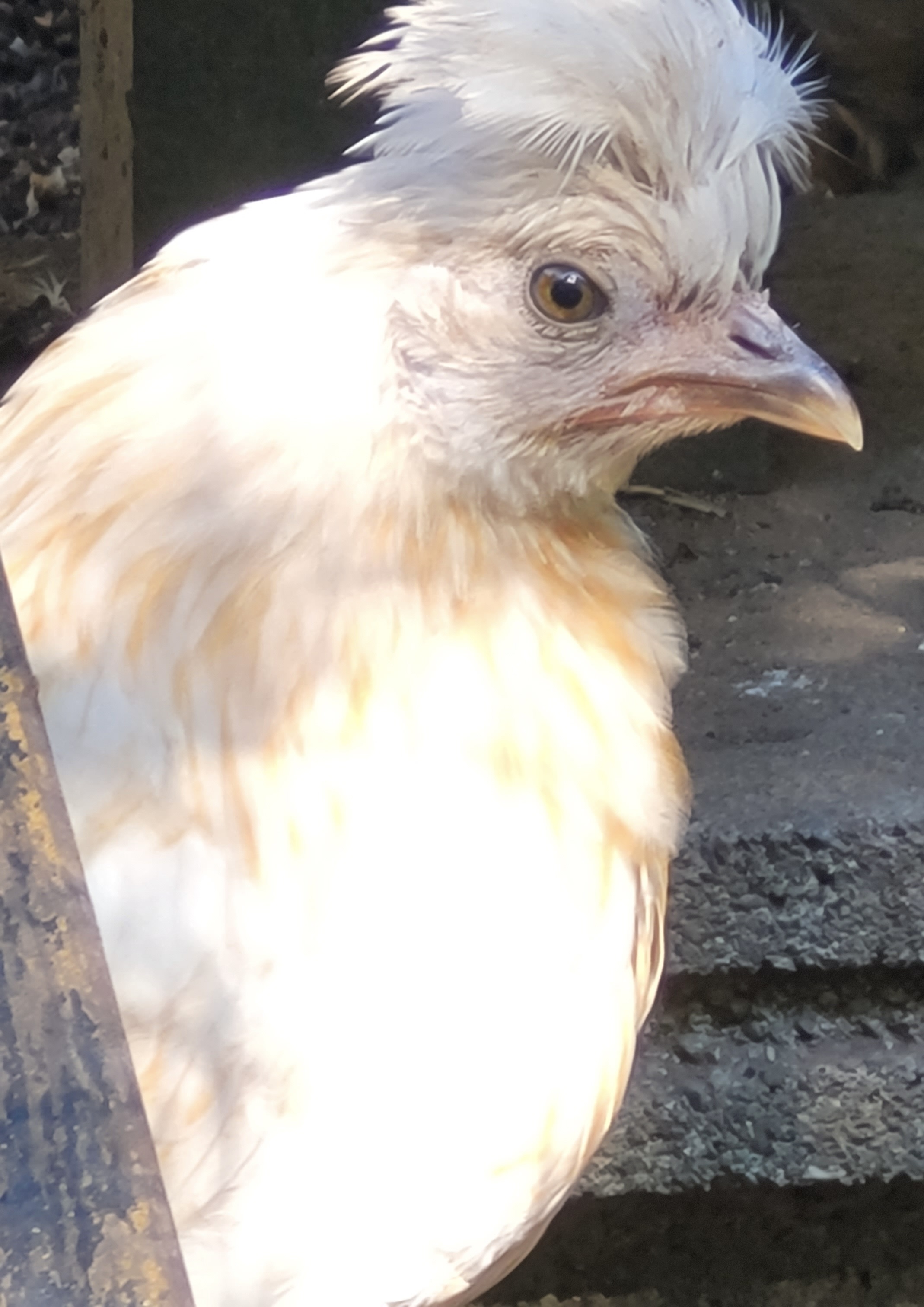
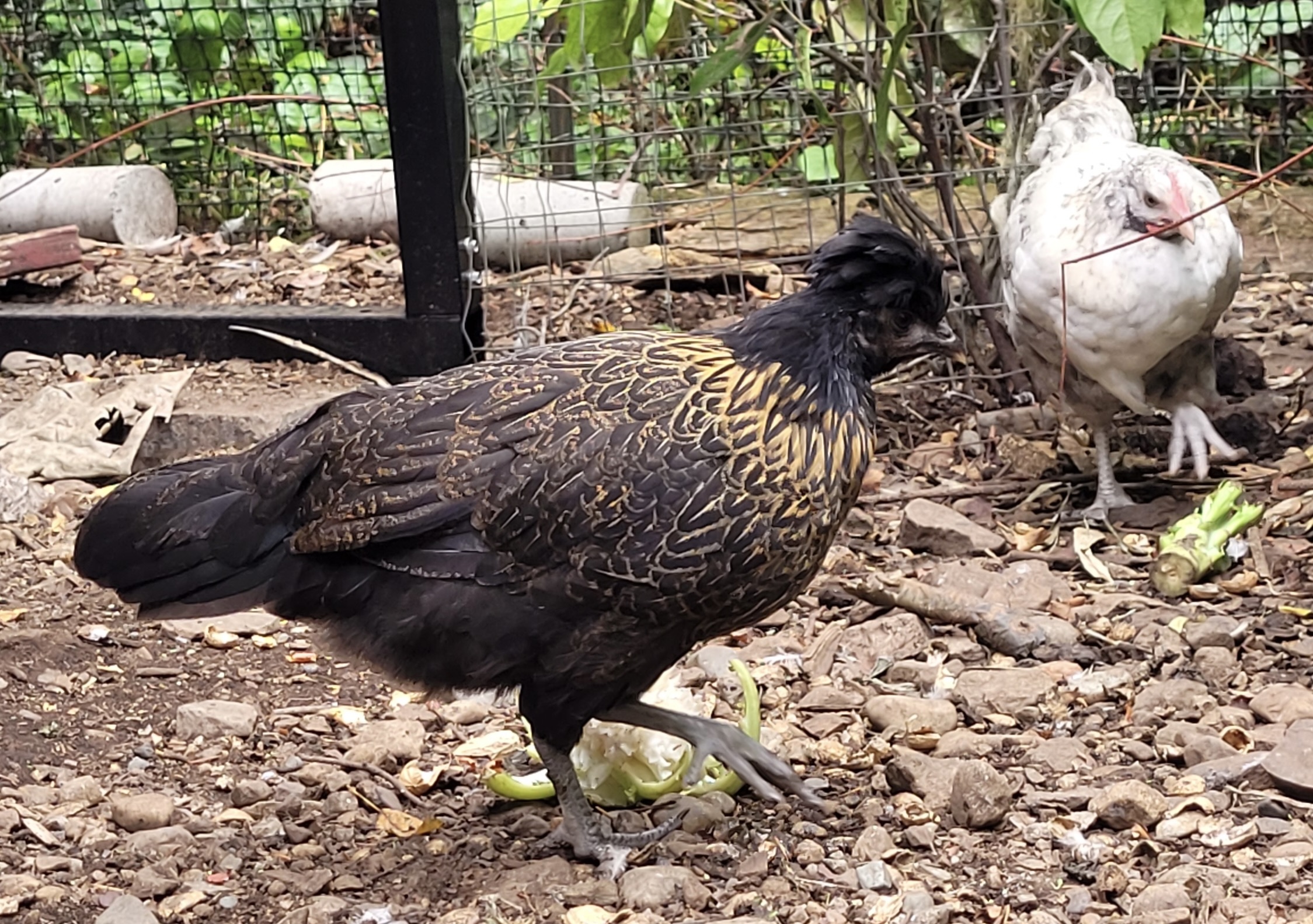
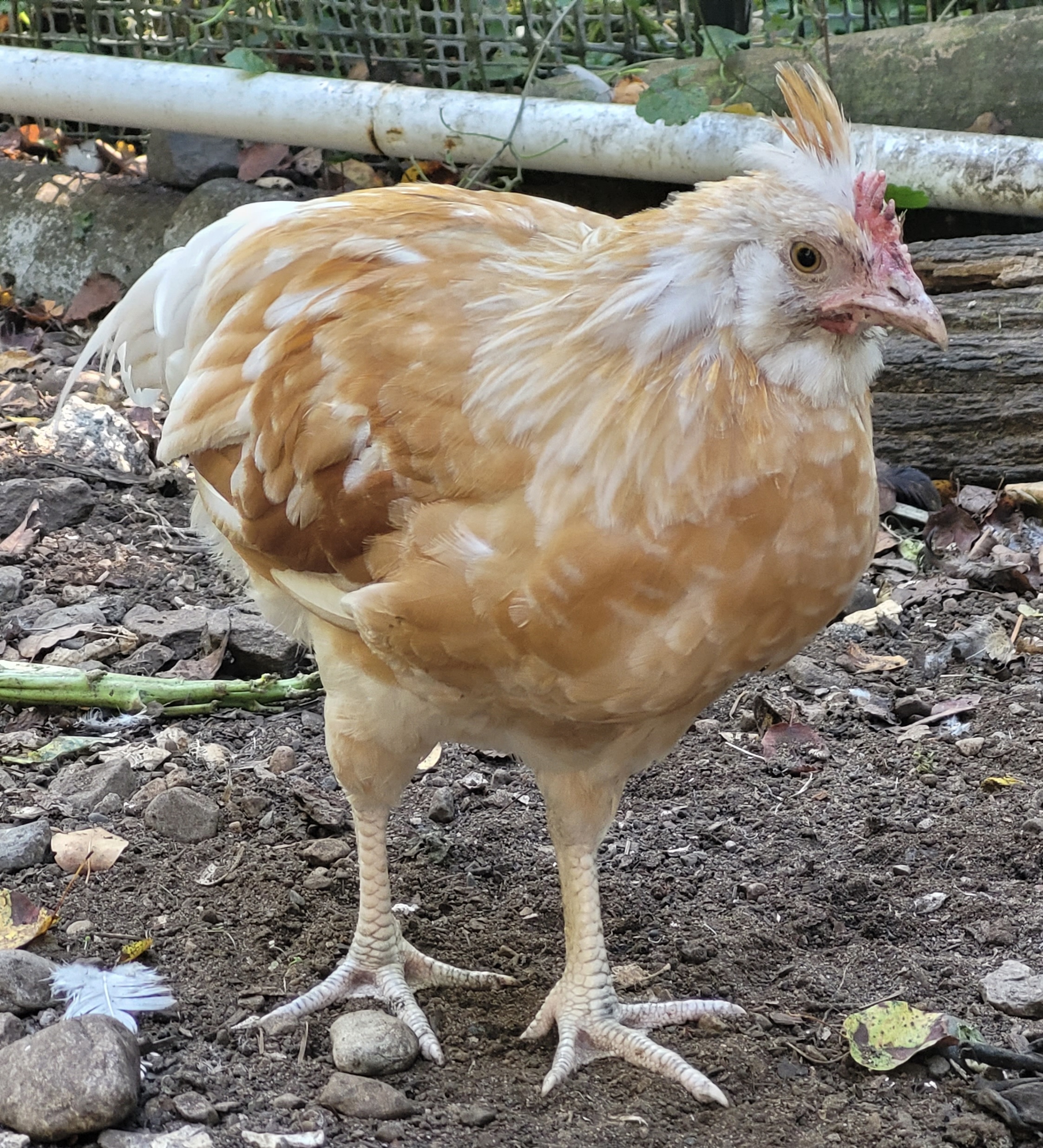
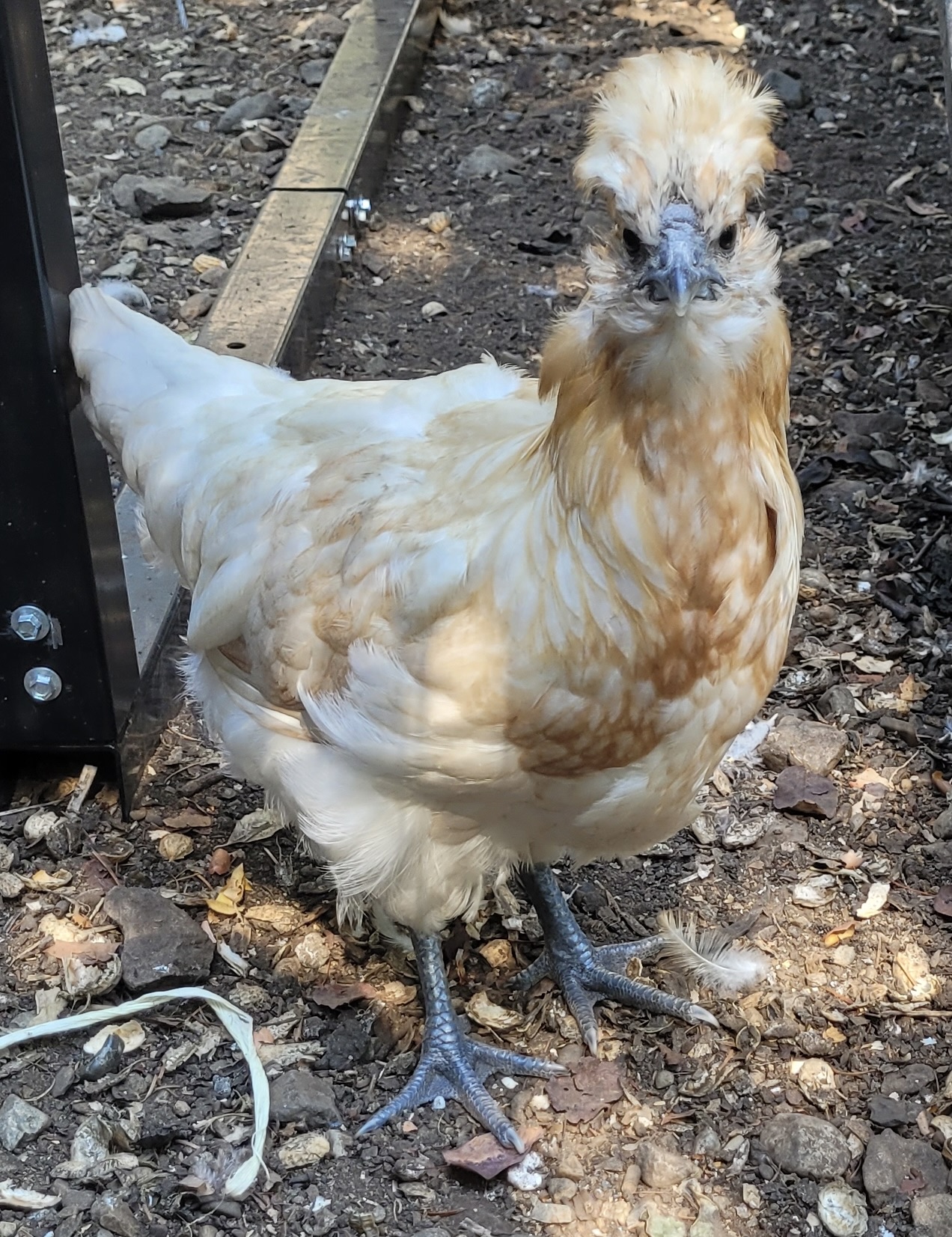
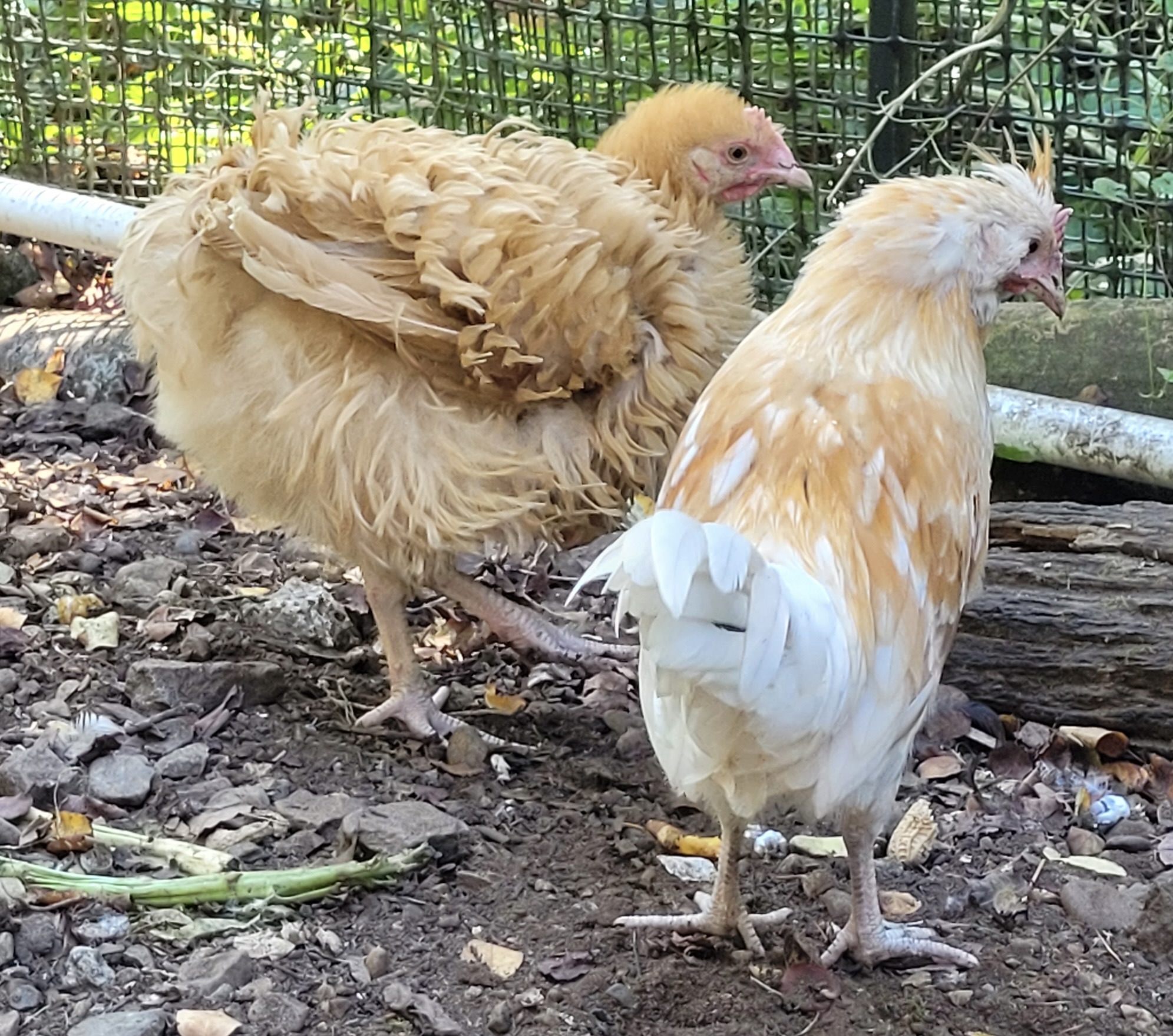
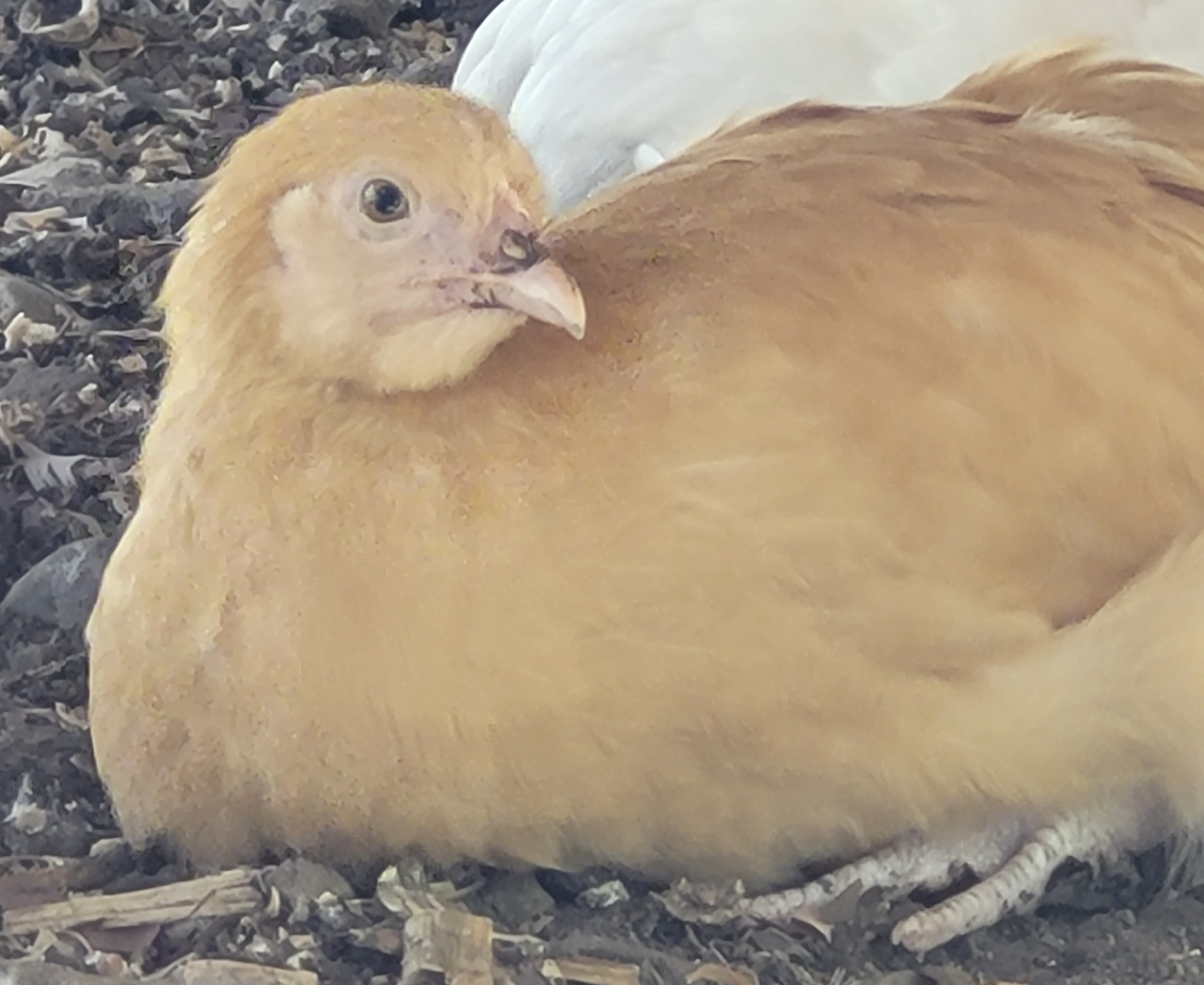
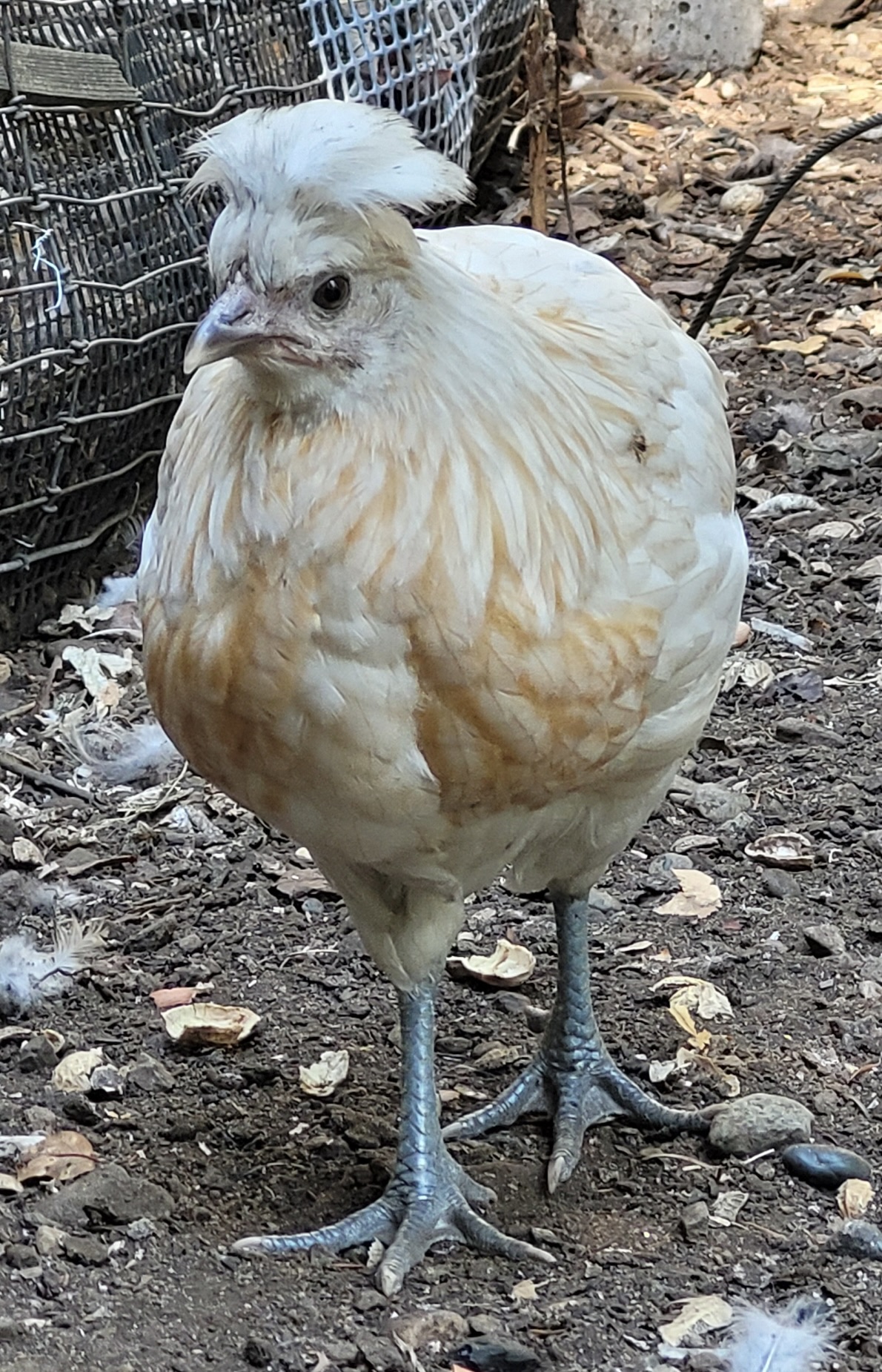
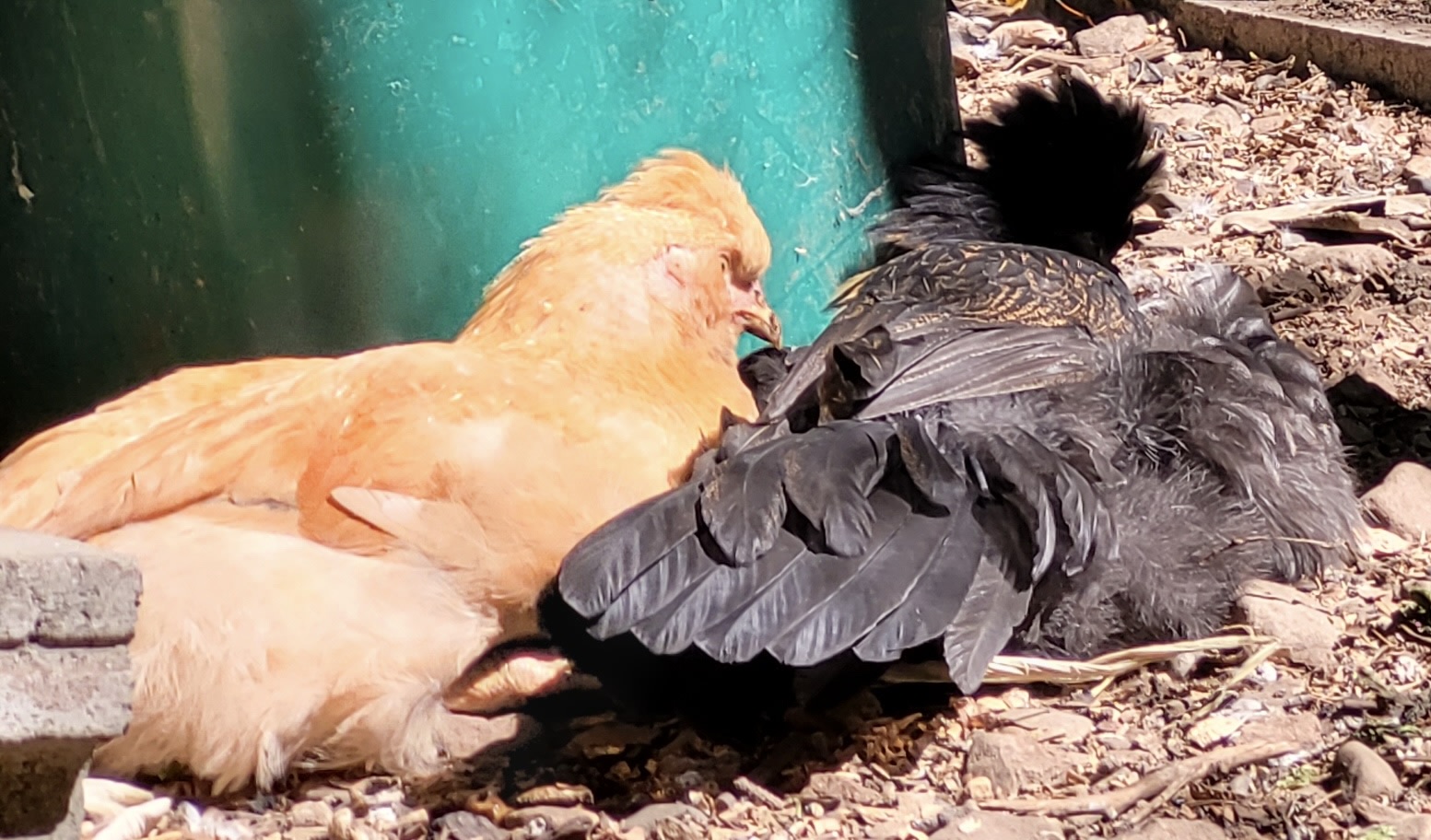
My fourth broody hen and her six chicks are living with my main flock. They were easier to identify as five of them came from my eggs and look similar to their dad – predominantly white. All have crests. One is frizzled and one buff.
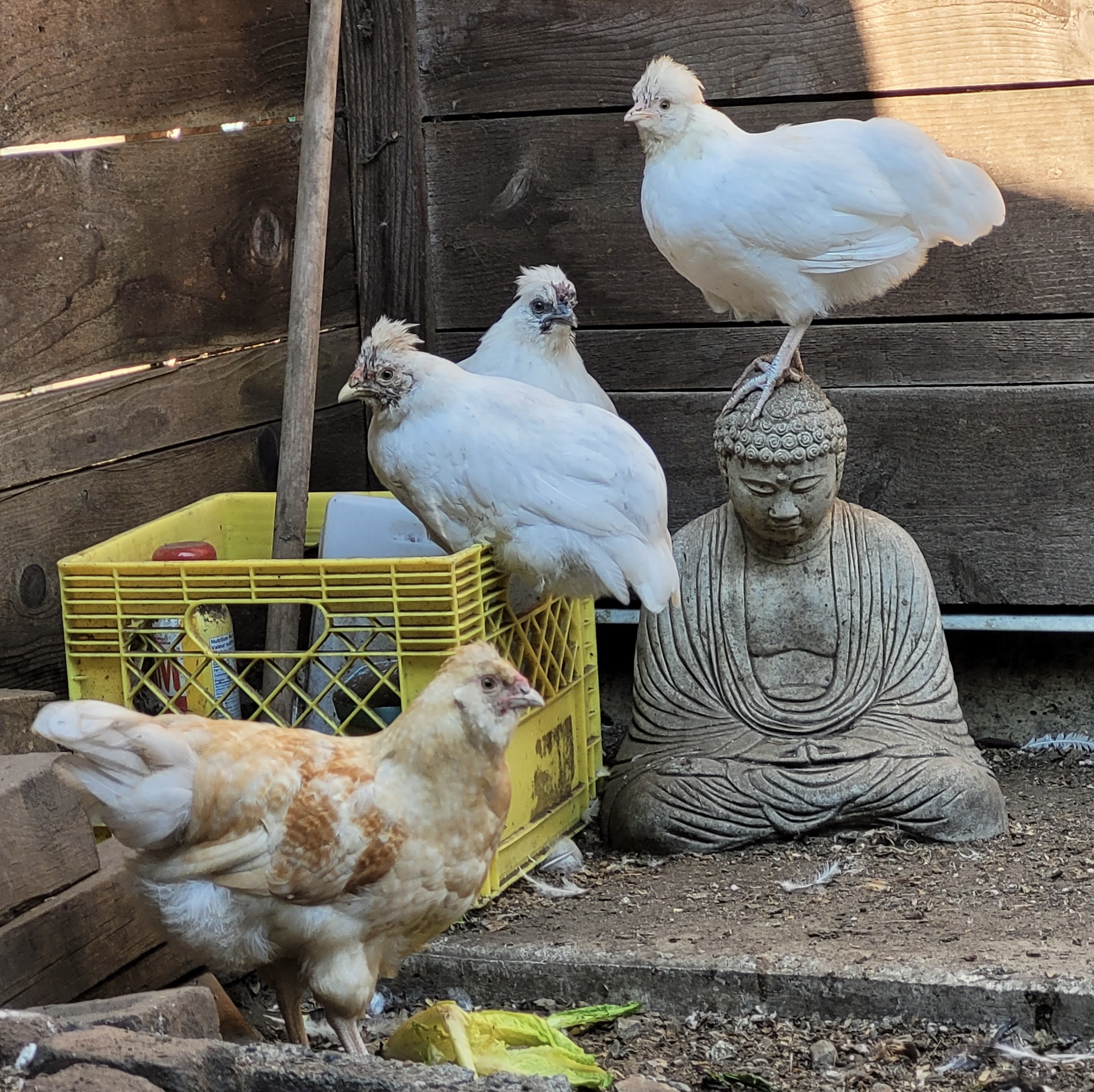
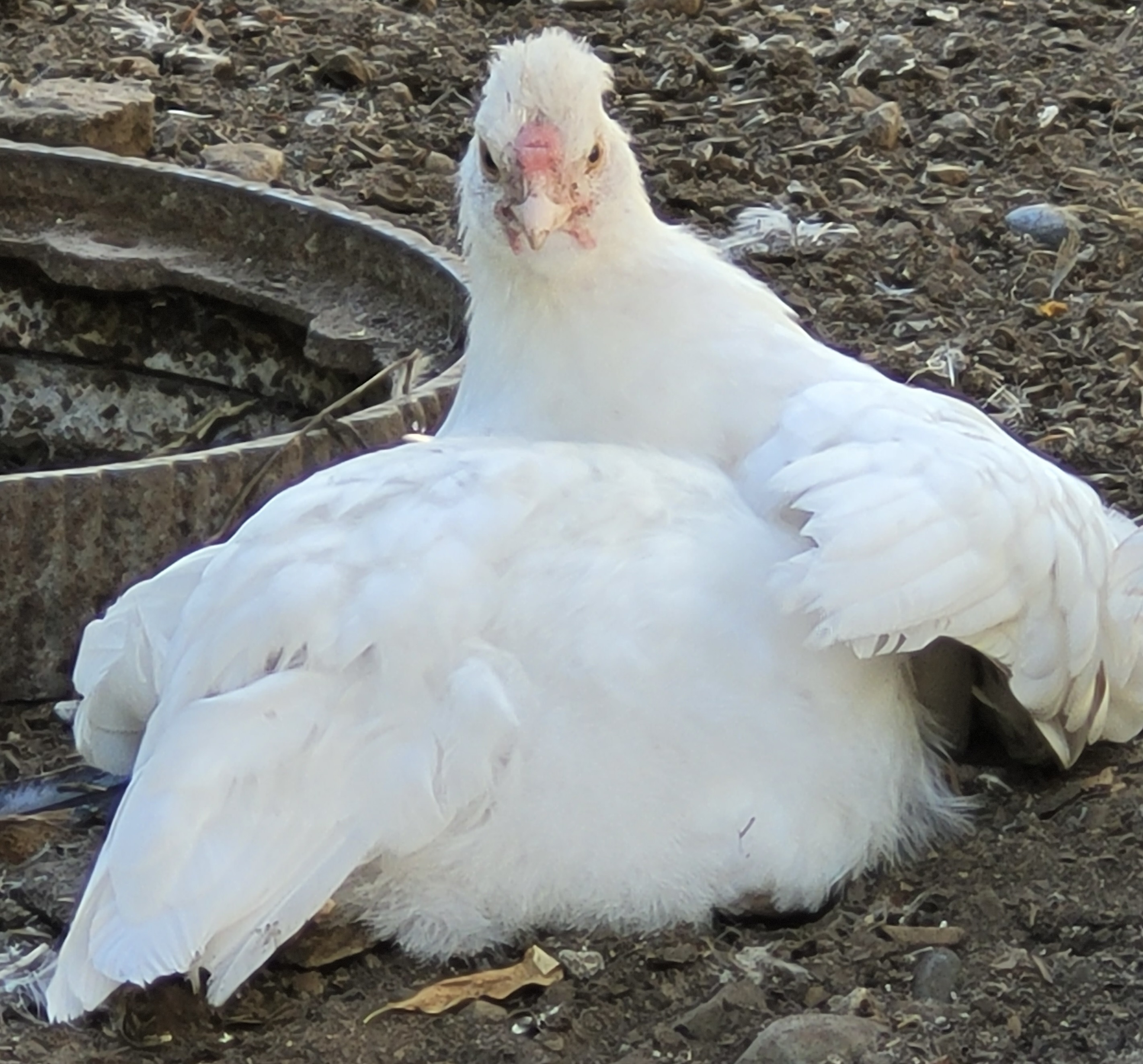
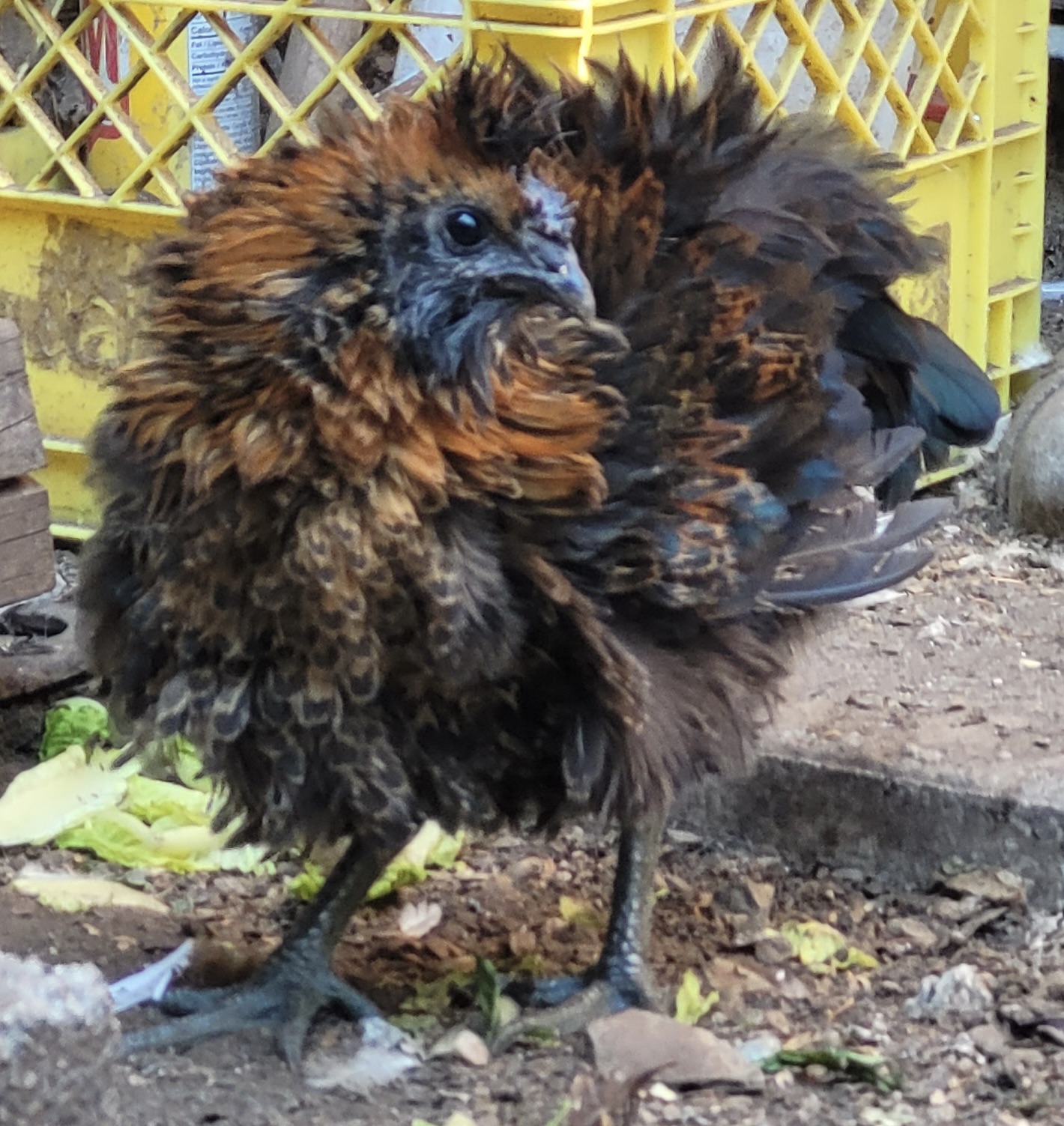
At ten weeks, the cockerels were coming into their own: lots of posturing, chest bumping, raising their hackles with each other. There was clearly one that was fathered by the bantam rooster who was small and slender. The largest one rivalled the size of some of my full-grown hens. Many were still in between. I watched and compared various features: size of body, feet and legs; comb development and colour; the presence of pointed (male) vs rounded (female) saddle and hackle feathers; the start of male crest streamers (thin, pointed feathers) in the Polish x birds. One day they appeared to be pullets and a short time later they had shot up and were acting like teenaged boys. By three months, it looks like just over half of the 16 are pullets and four of six in the main pen are cockerels.
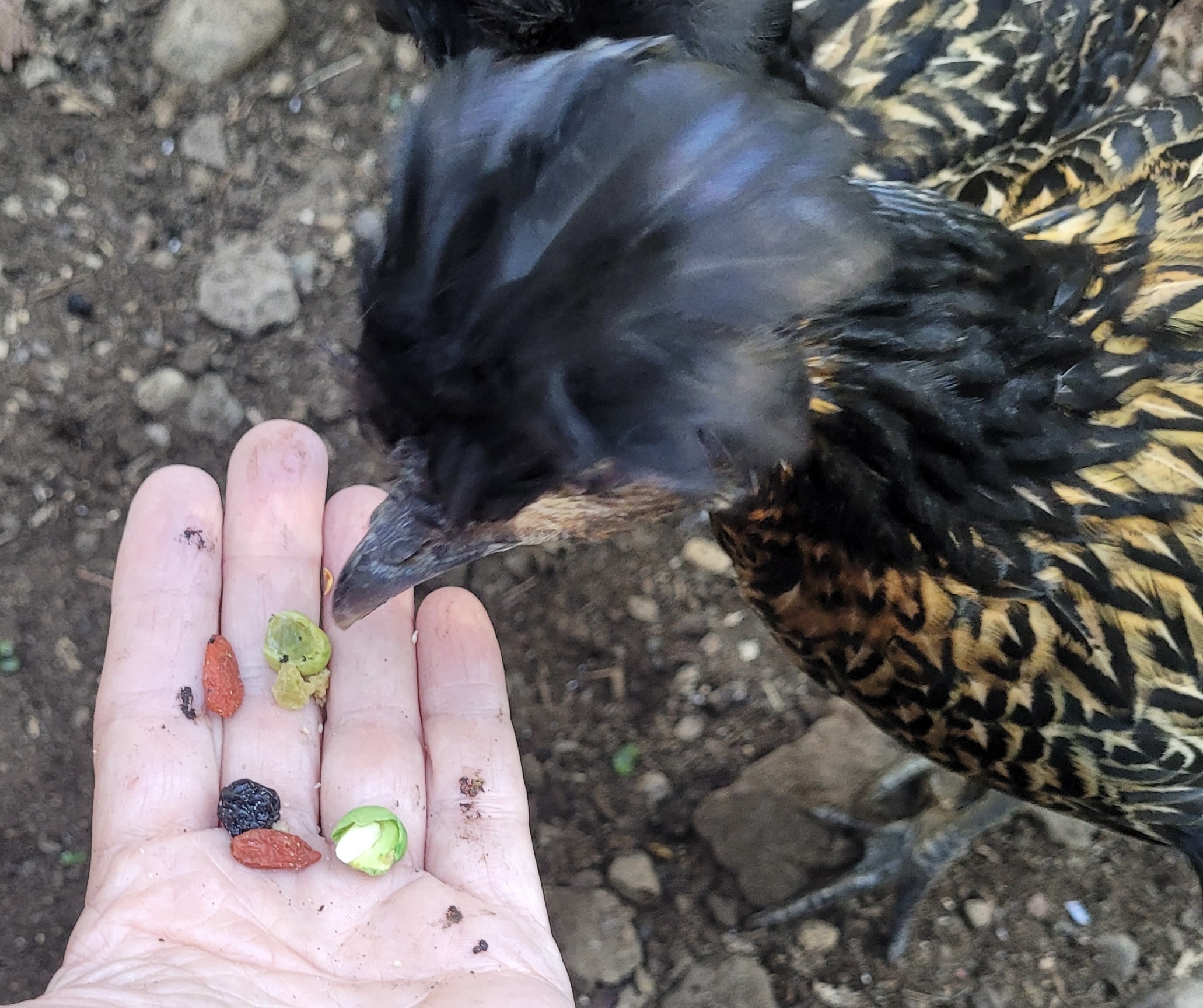
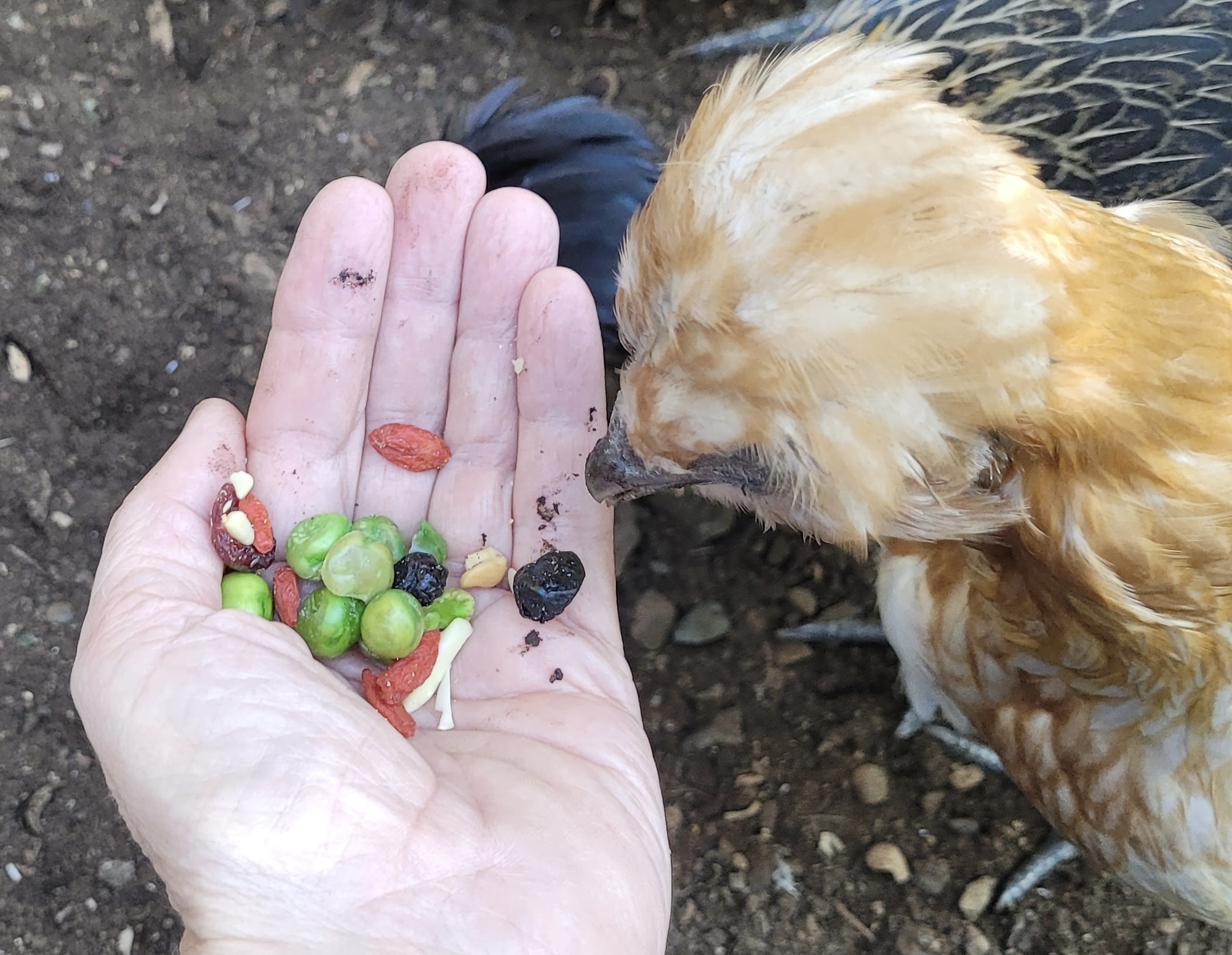
Sadly, the stash of peanuts came to an end so we’ve moved on to other healthy treats.
 Bitchin' Chickens
0 comments on “Spending Peanut Hour With My Chickens”