

I belong to a number of Facebook chicken groups and occasionally see posts from folks asking how to diagnose and deal with their disabled birds. I’ve even followed the online stories of blind chickens, Mumble and Poodle Roo. I’m glad there are chicken keepers willing to take on the additional learning and work load of caring for their special needs birds and, frankly, relieved that I haven’t had to deal with those issues (or at least, knock on wood, not yet).

Mumble As A Chick 
Mumble 
Mumble 
Poodle Roo
Causes
Blindness in chickens occurs in a number of ways: chicks can hatch blind or without eyes or birds can lose their sight due to injury or disease.
- Damage to the eye: predator attack; scratches, pecking and fighting injuries
- Vitamin A deficiency in chicks
- High ammonia levels caused by excessive poop accumulation in the coop without sufficient ventilation can cause the cornea in the eye to become damaged.
- Marek’s Disease can cause changes to the eye and partial or complete blindness
- Upper respiratory tract infections (e.g. chronic Sinusitis and Mycoplasma Gallisepticum) can lead to secondary infection of the eye.
- Cataracts, glaucoma
- Lead poisoning
- Rhode Island Red chickens can carry a congenital defect that prevents chicks from producing an enzyme essential for sight
- Crested birds (e.g. Polish) can have feathers grow into their eye


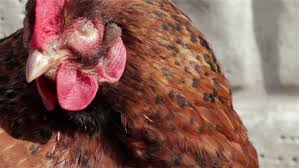
One’s first reaction when confronted with a blind chicken might be to euthanize it, feeling that it wouldn’t have a good quality of life, but there’s lots of evidence to the contrary. Being blind can be a challenge, but if accommodated chickens can live long happy, healthy lives. If you end up with a disabled chicken there are several online supports.
Symptoms
- Chicks: inability to find food and water, constant chirping
- Bumping into objects
- Confusion
- Pecking at air, missing target
- Clumsiness
- Depression
- Reduced activity
- Enlarged or irregular-shaped pupils
- Cloudiness or discoloration of the eyes
- Limited reaction to external stimuli
Diagnosis
A simple test to check whether a chicken’s sight is impaired is to slowly move your finger towards, or back and forth in front of, the affected eye. A chicken’s instinct is to blink, move out of the way or to follow the movement of your finger. You can also shine a flashlight in their eyes to see if their pupils constrict or not. Blindness may be partial or complete and can affect one or both eyes. The onset can be sudden or gradual.
Care
Just like with blindness in people, there’s a difference between once being sighted and then losing it and not ever having it. A chick that is born blind will have no memory of its environment, but an adult that has mapped its territory may adjust more easily. Disabled chickens often fare well when they are paired with a friend who takes on the role of guardian and guide.
- Don’t let sight impaired chickens free range as they are at risk of predator attacks.
- Keep birds confined within a limited, predator proof area.
- Make sure that food and water are in a consistent location.
- Be aware of flock dynamics to ensure that the special needs birds are not bullied or pecked.
- Monitor food and water intake, weight and output (poop) to ensure there are no changes.
Credit: Poultry DVM; Poultry World, BYC, Mumble The Chicken & Apricot Lane Farm.
 Bitchin' Chickens
what do you do if the blind chicken is being picked on? is there any way to discourage this?
LikeLiked by 1 person
Unfortunately chickens find the weak and the sick and do pick on them. If possible can you put that bird in it’s own run and coop with a docile friend or two? Silkies are great for that.
LikeLike
Can these diseases attack turkeys too.
LikeLiked by 1 person
Unfortunately I don’t have any firsthand experience with other species of poultry. I do know that there are pathogens that spread between chickens and turkeys, but i’m not knowledgeable enough to advise you about them.
LikeLike
Thank you so much for writing this! My rooster was attacked by a predator (I hadn’t got him down yet from the tree that night, we suspected it was a strange cat, we have a friendly neighbourhood cat walking around, the week after he was attacked we found a strange cat which we had not seen before fighting with our friendly neighbourhood cat next to our chicken coop). Three weeks later he started to look like he was not picking up any food from the ground even though he was doing the movement (of picking up food and water), and then he started to bump into my legs or trees when he was walking around. He went really sick for the next two weeks and the first time he woke up (from some kind of coma, he has been taking antibiotics and worms cure) and looked panicky, he bent his head low and moving leftwards in circles constantly, jumped in the air and tried to lift up his leg and test the ground in front of him, and making anxious sounds. After a couple of days of repeated behaviours, he is now way calmer but still moving with his head low and walking in circles, sometimes he explores a bit further but he keeps walking into bushes or walls. He is now still with the other four hens and luckily they just leave him alone (they have been together for three years now). He is still very weak, eats very little and sleeps a lot, but the thought of him going blind really worries me as I thought as a prey animal he might not be able to continue having a happy life without the eye sight. I just want to thank you because now I really see the possibility for him to still be a happy chicken despite his disability.
LikeLiked by 1 person
What were some of the things you did to help when you realized it? Our hens just got attacked, and we didn’t have any roosters to defend them, so we lost the out of seven and one of the four left has been blinded. She does have another hen taking care of her, but she’s also having issues with depression, I think, because she just lost her sister. I’ve been able to syringe water into her mouth, including some oatmeal water, but I’m not sure what to do for food.
LikeLike
I have a seeing impaired hen now, although she’s not totally blind. I keep the feeders and waterers in the same place so she knows where they are. I wouldn’t use a syringe to hydrate her due to the risk of aspiration – just dip her beak into a bowl of water. You can try some wet mash for food for now. The key is consistency as chickens can map their territory and memorize it. So long as she’s with other gentle hens she would do ok. Does she have any other injuries? How did the eye heal?
LikeLike
Wow, I never even thought of the possibility of blindness in chickens. I’ll have to give the matter some serious thought, while I hope I never have to deal with it.
But you know, I rescued a blind dog once. He got around just fine by listening to my voice. After a short time, he was walking around in the house all on his own. He seemed to rely on his other senses much more than normal. Hearing, smell, etc….. I wonder if it’s the same in chickens. Surely they have the capacity to adapt to their new circumstance?
Anyway, great post!
LikeLiked by 1 person
They are territorial and even as small chicks plot out where food, water, doors, etc are quite quickly, so if folks have a blind chicken and keep everything in the same place they often do just fine. The big issue is the pecking order and injuries inflicted by the flock.
LikeLike
Good point. I can see how that could be a problem.
LikeLike
Our chicken has suddenly gone blind practically overnight and is not eating at all. We have syringe watered her and have a vets visit tomorrow. I am so worried she won’t be able to feed and drink unaided.
LikeLiked by 1 person
It will help if you keep their food and water in the same place? Does she have any vision? Is she being picked on?
LikeLike