
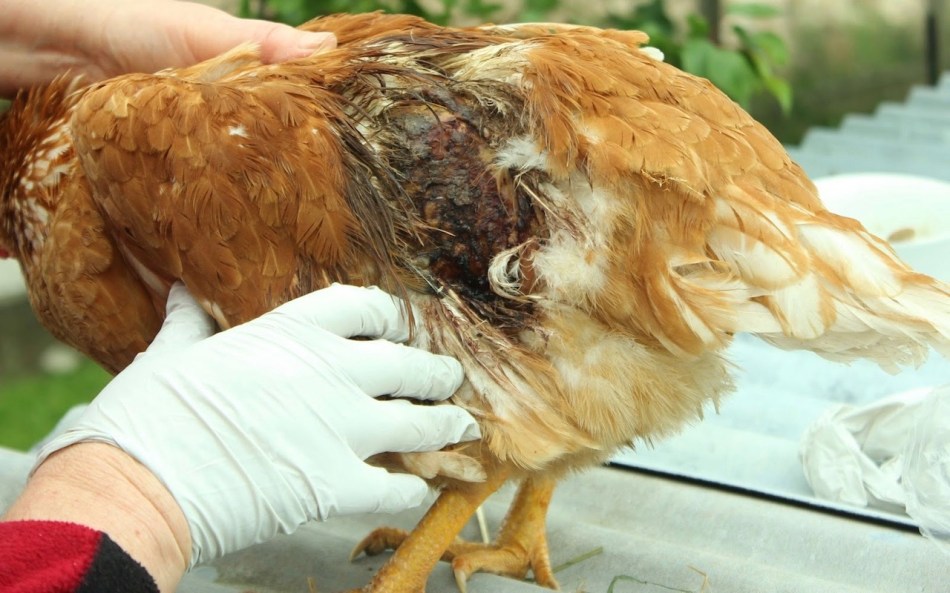
I belong to several Facebook chicken groups and routinely see posts related to rooster-caused mating injuries. Some are relatively minor, but others are quite severe, requiring medical treatment.
If you know about rooster sexual anatomy you’re aware they don’t have a penis, so I’m not talking about that kind of injury.
You might see your rooster dancing around, dragging his wings on the ground in front of a hen. She will squat, preparing herself for him hopping on board. To keep his balance he will often grab a hold of a beakful of feathers on her neck or the back of her head. If your hen is missing those feathers now you know why.
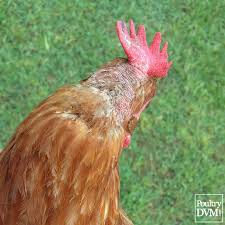
Missing Feathers (Poultry DVM) 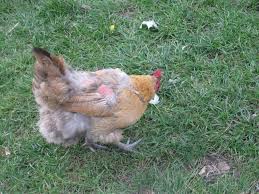
Missing Feathers (BYC)
He then tries to balance himself by stepping up and down, called ‘treading’.
Once the rooster is in place sperm is transferred quickly without penetration: the cloaca of both partners touch and sperm is exchanged in what is coyly termed ‘a cloacal kiss’.
My rooster, Simon, is just over three years old and I have to concede he’s lost a bit of his mojo. I don’t think he’s ever been highly motivated to mate and my hens are happier for it.
When I see photos of hens missing swathes of feathers with raw patches or worse, lacerations caused by spurs I’m glad my hens have never had to endure that treatment. I’ve never see so much as a feather out of place.
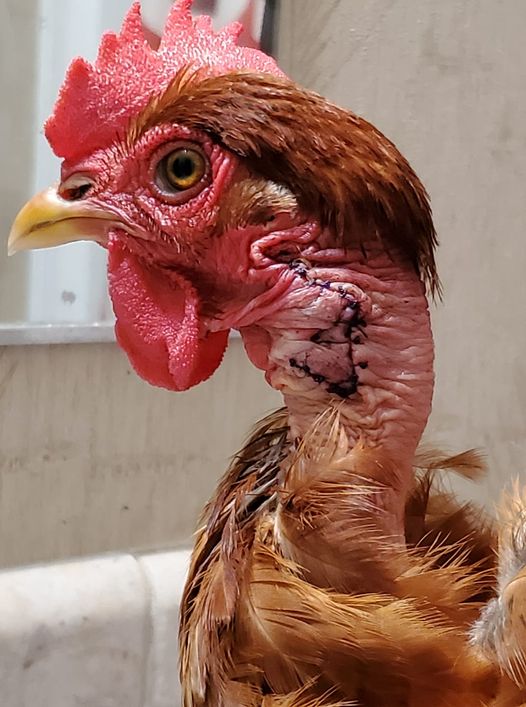
Neck Laceration (Ashley Reed Fitzpatrick) 
Neck Laceration (Mitzi McFarlane) 
Spur Damage (Julie Germyn)
Simon only started developing spurs last year – they are several inches long, but not particularly sharp. If you’ve got a rooster with problematic spurs you might want to trim them down with a dremel or file.
If your hens are missing feathers from their lower backs it is often a sign of over-mating. Either a particular hen is a rooster’s favourite or your ratio of hens to roosters is off.
I have one rooster and about twenty hens. If you want to ensure your eggs are fertilized a ratio of one rooster to ten hens is suggested. Most of us don’t care if all our eggs are fertilized. If that’s the case I suggest fewer roosters: there is less competition between the males, less crowing and the hens are less likely to be over-mated. Applying a cloth saddle can protect that area from injury and feather loss.

Missing Back Feathers (BYC) 
Hen Saddle (Sewing Machines Plus)
Simon went through a very short, but aggressive-towards-the-hens phase. Virtually overnight puberty hit and he grabbed the hens by their feathers and even tried mating with one on the roost bars. I posted in a chicken group for advice and most folks suggested I cull him with the belief that ‘once aggressive, always aggressive’.
I’m glad I was patient because soon after he went back to normal. Simon has turned out to be gentle with people as well as the hens – not all roosters are. If you have a persistently aggressive rooster (and not just a teenager going through puberty) I’d suggest you find a more compatible match in order to protect your hens.
Some breeds are more aggressive than others, including meat or broiler birds (i.e. Cornish x).
Signs Of Mating Injuries
- Missing feathers from a hen’s lower back or back of the neck and head.
- Abrasions, lacerations.
- Hen avoids or runs away from the rooster.
Treatment
- Treat wounds with Chlorohexidine, betadine, iodine, Vetericyn spray, unpasteurized honey, polysporin triple antibiotic or bacitracin ointment.
- Separate hen until her injuries have healed.
- Apply a chicken saddle to protect her back.
- Give Hen Healer or Feather Fixer and feed high protein foods to encourage the regrowth of feathers.
Prevention
- Make sure there isn’t a considerable size or weight difference between your rooster and hens. I had a bantam rooster for four years in a flock of standard hens. He mated with them and was able to fertilize some of their eggs, and of course, never caused them any damage. A large rooster in a flock of smaller hens can be problematic.
- Trim (rather than remove) rooster spurs.
- Make sure your ratio of roosters to hens is at least 1:10+. Less than that is likely to contribute to over mating of your hens.
- If your rooster is aggressive towards the hens then re-home or cull him. There are loads of gentle roosters looking for good homes and your hens deserve better.
A Note About Drakes
If you keep ducks you might have noticed that your drakes do have a penis and a funky one at that. Their penis is tucked neatly in an internal sack and during sex ejects outside the body. An erect penis can reach 20 cm, or a whopping 42cm, in the case of the Argentine Lake Duck. If that wasn’t interesting enough, a duck penis is corkscrew-shaped, with ridges and backward pointing fleshy spines.
I’ve never had ducks, but from what I’ve heard males are not particularly picky about who they mate with, including other species. As you can imagine, if a drake tries to mate with a hen it can, and often does, result in considerable damage.
This hen had to be euthanized due to irreparable injuries caused by a drake trying to mate with her.
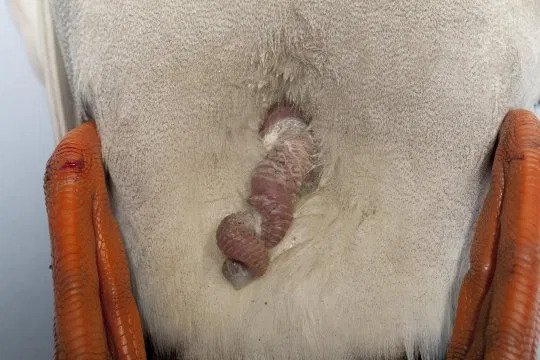
Drake Penis (Getty) 
Hen Damaged By Drake 
Hen Damaged By Drake
Featured Photo: Holistic Hen
 Bitchin' Chickens
well that’s interesting.
LikeLiked by 2 people
Thanks for your info and so sad to see that photo of the damaged hen 😢
LikeLiked by 1 person
Thank you so much for the information. Our hens have had missing feathers on their backs for a while. As the flock matured we found out there was a rooster in the bunch. Because his personality was somewhat sweet and he was the most beautiful rooster we had ever seen we kept him. He is however twice as big as all the hens. The hen he mounts the most has gaping open wounds that I don’t know if she can bounce back from. Underneath her wing is so torn through I don’t even know where to begin on treatment. And she still will lay down for him. We have never killed our chickens. We have lost some to predators and old age. This is our 1st rooster and will be hard for us to handle. Prayers the severe wounds will heal on our sweet hens.
LikeLiked by 1 person
Separate her and treat her wounds (check out my post called ‘wound care’ by typing that into the search box). You can use cloth saddles to protect your hens in future. I would also recommend that you trim his spurs using a file or large dog nail clippers. Good luck. Feel free to contact me directly (press the ‘contact’ button on my homepage) for more advice.
LikeLike
I’m glad I never wanted ducks. Even if I had, those last few pics would have cured me of the desire!
LikeLiked by 1 person
Vet here – prevent bloody wounds on hens by separating the aggressive rooster from the hens. While you’ve allowed time to “adjust”, it’s not an sub-optimal outcome for the hens.
LikeLiked by 1 person
I have a hen that has missing feathers and what looks like a bumpy irritation about the size of a plum. I know she is my rooster favorite but she is running from him. I have separated her from the rest of the hens to let her rest. My question is do I need to treat the area with anything since the skin is not broken any where? And how long does it take for her feathers come back? She is still laying eggs but has had a few mishaps like laying an egg with no shell. We have finally stabilized her calcium so I think that’s ok. But I don’t want her to be in pain if I should be treating the wound. I have purchased a saddle for her and the other hens. But I don’t know if i should put it on her until the place has healed,I have also clipped his nails. Any suggestions would be helpful. My rooster is very social and approachable by humans. I hatched my flock in my classroom and my school has allowed me to have a coop, so they are my class pets. My kids pet them everyday and they are all fed from our hands at times. So I really want them to thrive.
Thank you for your time,
Kim Wages
LikeLiked by 1 person
How many hens do you have for your one rooster? You can use Polysporin or Vetericyn spray on the irritated area and I would use the saddle now. Keeping his nails and spurs trimmed should help as well.
LikeLike
Can you make a post about hen saddles, similar to the post you have about chicken diapers? That is the level of detail I am seeking.
LikeLike
Sure can. I will add it to my list of things to post. Thanks for the feedback.
LikeLike