

Over the last two years I’ve gotten together with Dr Vicki Bowes, avian vet/pathologist on a regular basis to pore over files in my memory stick loaded with interesting chicken health issues that I’ve collected for her expert opinion. She refers to it as ‘Show and Tell’ or ‘Best Guess’ and has done a good job at making diagnoses given the information we have at hand, usually only a short paragraph from the chicken’s owner. My job is to write them up to share with my readers as a form of skills building for chicken keepers.
Fungal Infection
We just took in a “hospice hen”, a very old bantam, whose owners were afraid she wouldn’t survive another winter in the barn. She has quite a bit of yellow crusty stuff on her head and it seems to be pulling her eyelids up. This isn’t new for her, but I’m wondering if it’s fungal or something that can be treated at home to bring her more comfort. Other than not being able to see very well, I assume from the eyelids being pulled so high, she seems to be healthy. – Emily Hardman
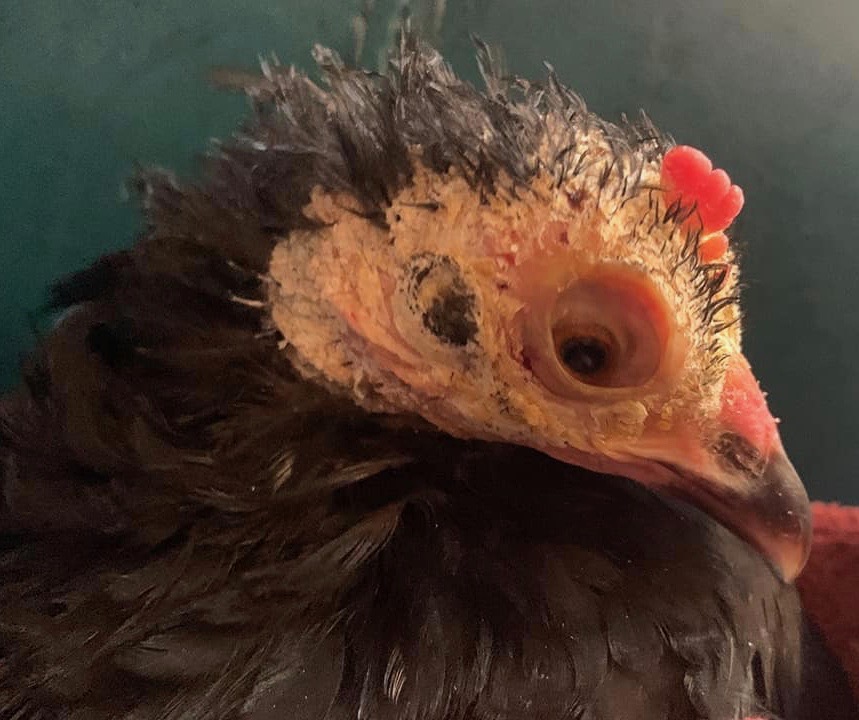
Dr Bowes: It appears to be a fungal infection like favus, where the crusty proliferative stuff is affecting the eyes’ ability to close. I would recommend a protective ophthalmic ointment (not drops) for her eyes and treat her skin with an over-the-counter topical fungicide such as Miconazole, Tresaderm, Panalog, Betadine powder, ointment, or cream applied topically to the affected areas.
Bee Stings
My brother’s chickens were attacked by bees last night. He thinks killer bees; they were highly aggressive and stung them over and over in the face. He’s lost four already. Is there anything we can do? – Jessica Ostrasinski

Dr Bowes: Treat with an oral antihistamine like Benadryl and Meloxicam for pain.
This is an Ayam Cemani hen’s feet. She was eating and drinking and died shortly the owner noticed them. – Amy Sweeting


Dr Bowes: Those knobbly joints are a sign of chronic ongoing gout. She would have experienced considerable pain walking. Had the hen not died naturally I would have recommended euthanasia.
Bruise
What is this? – Sarah Mink

Dr Bowes: This is the normal result of an injury. Bruises start as red, then as the blood deposits are broken down they turn green, and then yellow. As long as bacteria did not cause the breakdown, it’s fine.
Bump On Beak

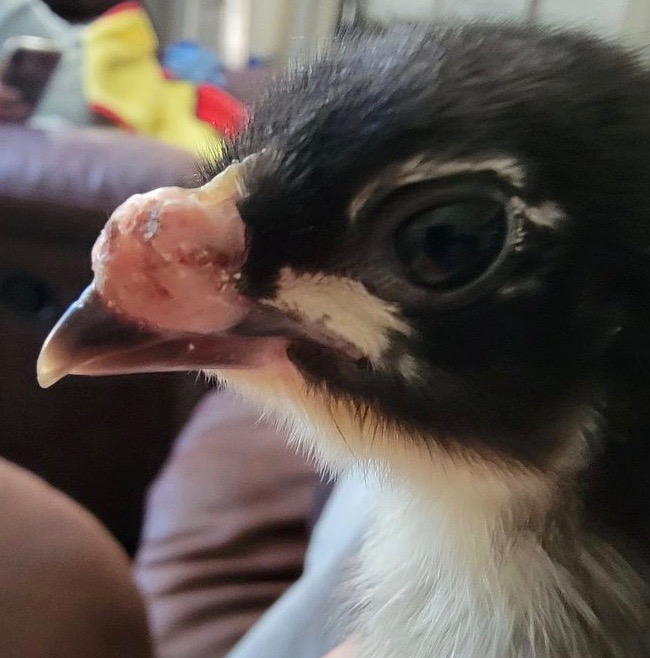
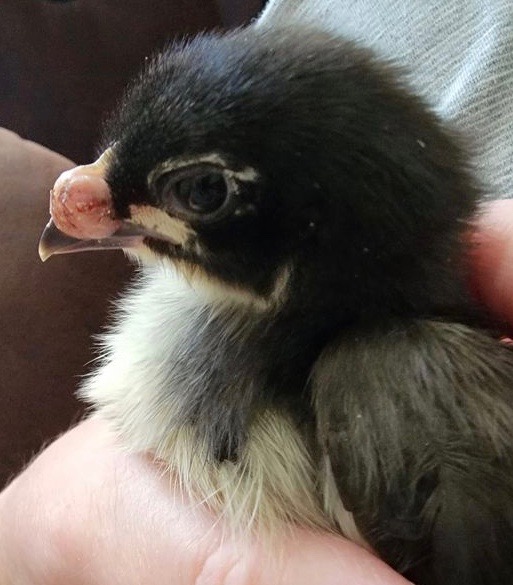
Dr Bowes: This could be congenital, or an injury resulting in a post-traumatic cartilage tumour, called a chondroma. Monitor it’s growth and to see if the nare (nostril) becomes obstructed. If the nare closes that can lead to open mouth breathing, which bypasses the filtering system and can make the bird vulnerable to respiratory issues. You can try treating it topically with iodine.
Gangrenous Growth
My husband found one of hens limping and this is what was found between her toes. What is it? I wrapped her foot so she wouldn’t pick at it. She had been because it was bleeding. – EJ Zierman

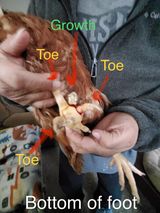
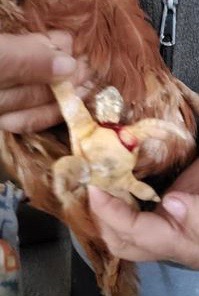
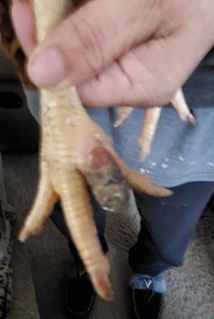
Bitchin’ Chickens: At first Dr Bowes and I struggled to see this growth as being between, but not part of, the toes. The growth is atypical in that it is tubular shaped.
Dr Bowes: You can treat it by cleaning and applying topical antibiotics, like Clavaseptin. It’s a gangrenous growth with an abnormal blood supply, which ideally would be amputated and resected by a vet.
Botulism (Limber Neck)
Bitchin’ Chickens: I found this case in an online chicken group. Both birds came from the same owner and presented like this at the same time. I was the only one who posted that they should treat for limber neck, probably caused by botulism poisoning. Every other response diagnosed wryneck and suggested vitamin E and selenium as the treatment. I asked Dr Bowes for her opinion.
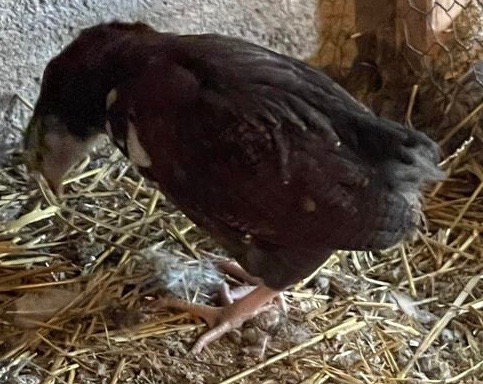
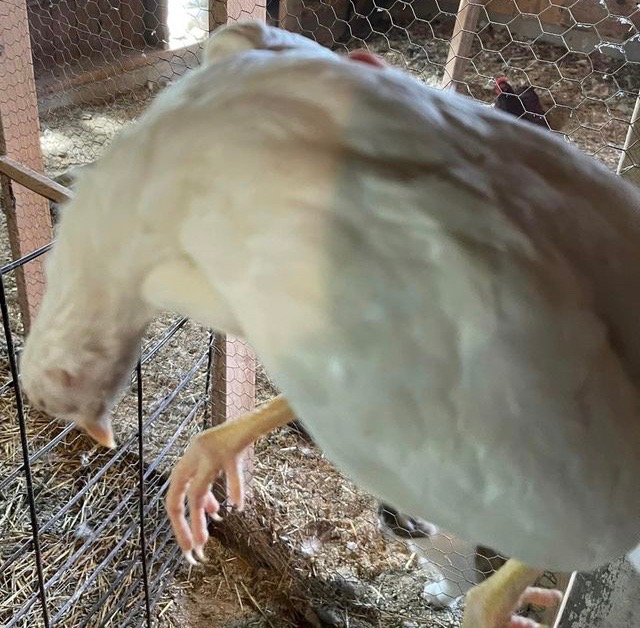
Dr Bowes: This stance can be seen in Marek’s Disease and botulism. I concur with you and think it’s the latter in this case, especially since both birds presented like this at the same time. The owners need to eliminate the source of the problem and to offer supportive care.
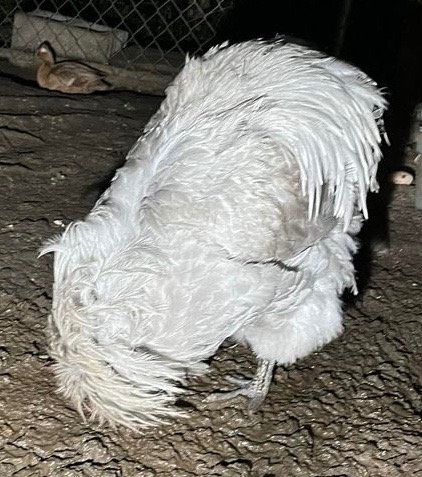
Bitchin’ Chickens: I asked Dr Bowes if this case could also be limber neck and she said that his posture was inconsistent with that diagnosis and was more likely neurological (brain lesions).
My appreciation goes out to Dr Bowes for stepping up to share her expertise in order to improve the care of small flock poultry.
If you’ve got a case you’d like to share or need help with, drop me a line by using the ‘contact’ button on my homepage.
 Bitchin' Chickens
About the botulism or wry neck question: I had two chick in the brooder, 5 weeks old that (first one, two days later the other) were standing like that with their heads down in the bedding. Hours later they were lying down unable to get up. One of them got so bad she was completely flat on her side with only her eyes moving. I treated with Vitamin e and multivitamin including b vitamins, also syringe fed diluted feed. (after I found out the “fresh” chick starter bag I was sold was already six months old) Both made a complete recovery, getting back to walking, eating, drinking unassisted within a couple of days. Head shaking persisted for 7-10 days, went away with continued vitamin support. So if you were accidentally feeding stale feed, it could be wry neck.
LikeLiked by 1 person
Wry neck tends to present as a twisted neck (up, down, sideways) but not the other symptoms your chicks had. I am curious if the feed was contaminated and that could point to botulism.
LikeLike
No, the feed was clean and dry, fed directly from the bag. No treats given at all, brooder was indoors, clean. Also I think botulism would not have been cured with vitamin e within 24-48 hours.
LikeLiked by 1 person
Thanks for the clarification. Those were pretty severe symptoms for wry neck.
LikeLike
An update: I have since found out that there is a version of Marek’s, the transient neurological type, that is also called pseudo-botulism. I am now thinking that is what my chicks were afflicted with. I didn’t know I had Marek’s in my flock. I got unvaccinated chicks for the first time last year, they were fine. Then this year I got 2 unvaccinated and six vaccinated ones. Only the unvaccinated ones were affected by the mysterious illness. I have since lost one of them to Marek’s (the classic symptoms of leg paralysis and gasping). So, pseudo botulism – something to keep in mind…
LikeLiked by 1 person
I’ve never heard to it. I’ll ask Dr Bowes for an explanation.
LikeLike
Good info here. I don’t like to think of chickens getting hurt, but the bruising is really a pretty color.
LikeLiked by 1 person