
Over the last two years I’ve gotten together with Dr Vicki Bowes, avian vet/pathologist on a regular basis to pore over files in my memory stick loaded with interesting chicken health issues that I’ve collected for her expert opinion. She refers to it as ‘Show and Tell’ or ‘Best Guess’ and has done a good job at making diagnoses given the information we have at hand, usually only a short paragraph from the chicken’s owner. My job is to write them up to share with my readers as a form of skills building for chicken keepers.
Belly Spot (photo: Maribel Ortiz)

Dr Bowes: It’s hard to tell from that photo what is going on. Cleaning the area would help get a clearer idea. I’d like to know if that is egg remnants attached to the chick and if not, what is it?
Abdominal Hernia
This is two-month-old Game Fowl chick from my last incubator hatch.
I just noticed this yesterday. The pictures were taken after today’s bath. It is walking normally but just not as active as it usually is. The vent is below the squishy When breathing I can see the spot contracting. – Latoya Lynn Montgomery


Dr Bowes: It appears to be an abdominal hernia or weakness in the abdominal wall. To diagnose that all you have to do is push that bulge in – it will pop back out, but if it goes in easily it’s a hernia. Where is its navel? Something that pulled on that area at hatch can cause an umbilical hernia. It’s a good thing the area is so large because it shouldn’t cause bowel constriction. My concern is the bulge would become so large as to drag on the ground and get abraded.
FYI: The chick is also suffering from foot erosion due to wet litter and unsanitary conditions in the brooder/coop. Ensure that you clean the bedding often and make sure that water doesn’t spill creating moisture.
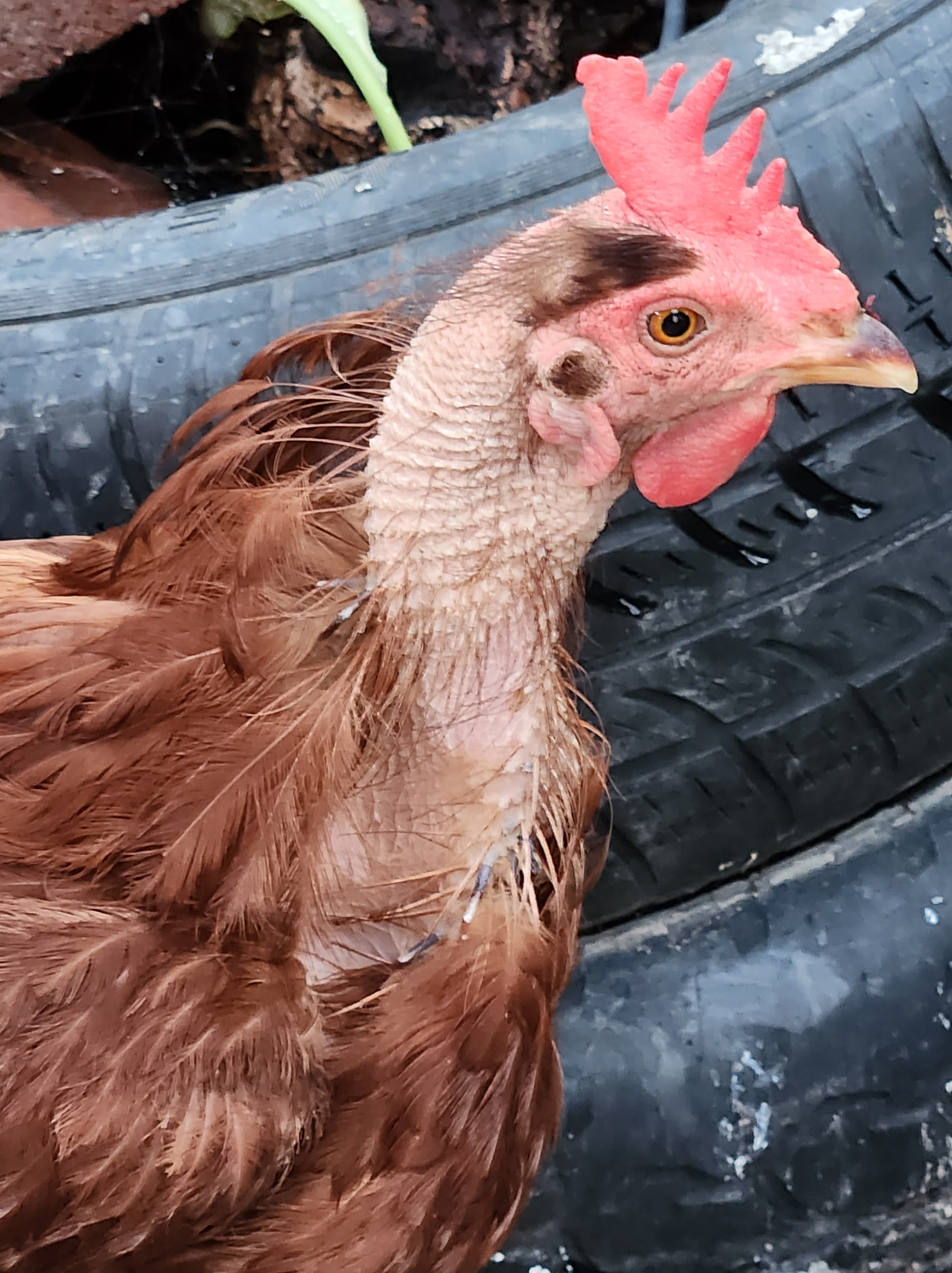
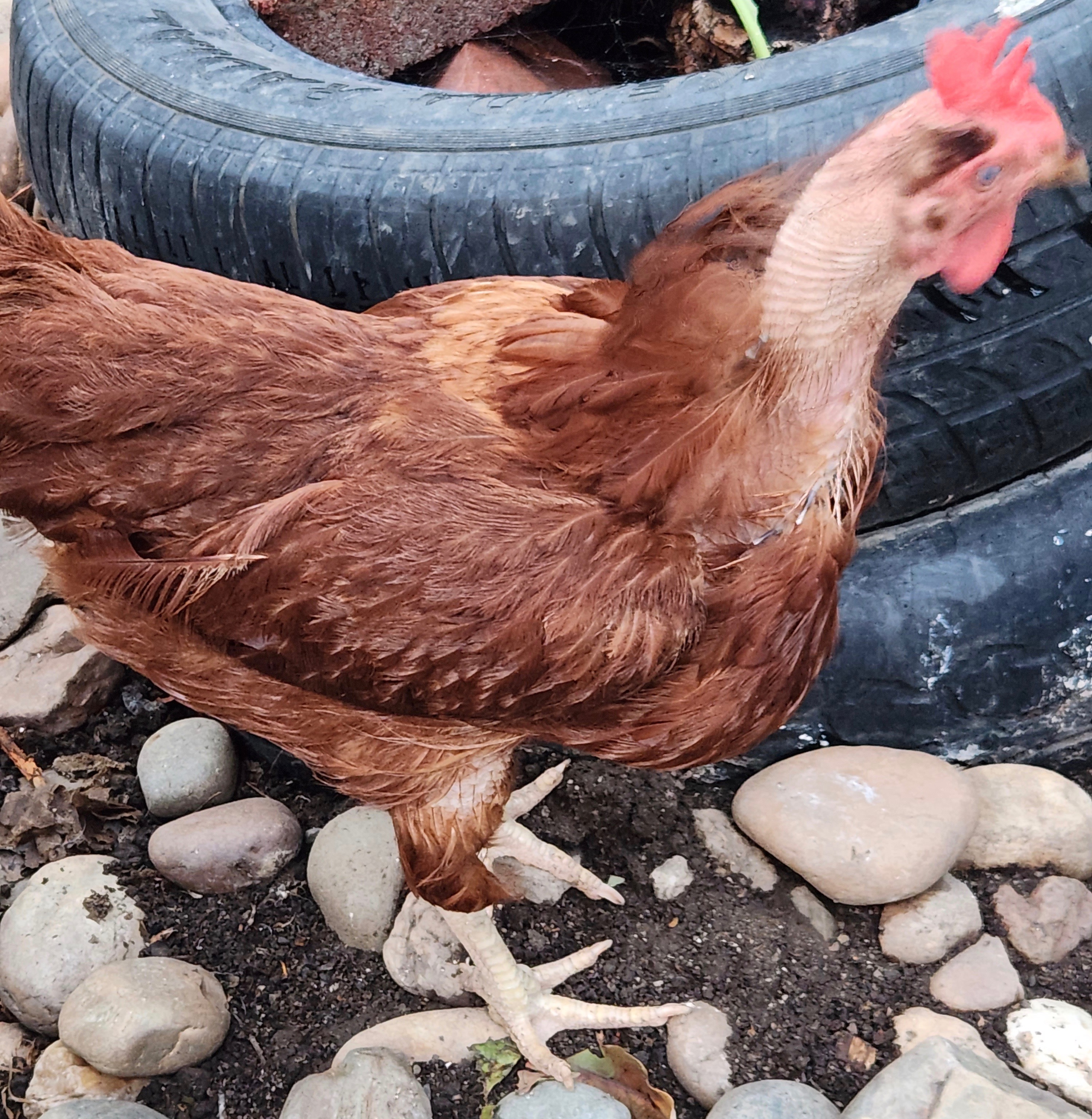
Feather Loss (photo: Pam Passon)
Feather Follicle Cyst
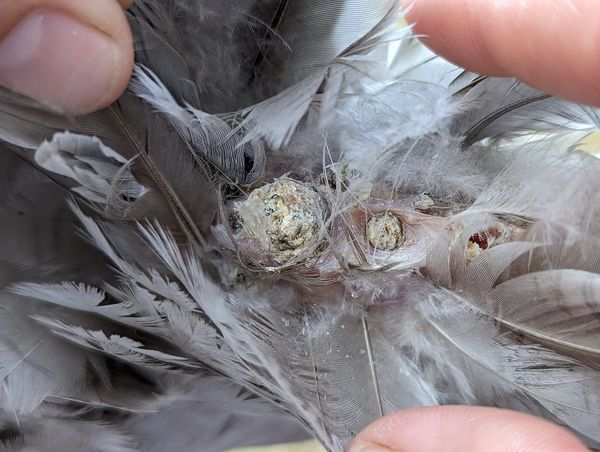

Dr Bowes: This is a feather follicle cyst. Treat as an abscess by using an antibacterial soap and Polysporin as well as providing pain relief (Meloxicam).
Bitchin’ Chickens: If you’ve ever had an ingrown hair you’ll remember that it’s a hair which instead of growing normally, curls back into the skin forming a small irritated bump. Think of feather follicle cysts as being the bird equivalent involving feathers instead of hair and because feathers are so much larger than hair so are the resulting cysts.
Gape Worm
Bitchin’ Chickens: This case was presented as suspected gapeworm. (photo: Martin Gretter)
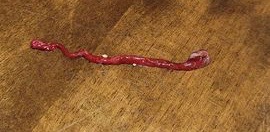
Dr Bowes: This is not a worm, but muco-hemmorhagic exudate. I’d like to know more of the bird’s history, if she had any respiratory symptoms and the size of the exudate. If it was coughed up from the trachea I would suspect Infectious Laryngotracheitis (ILT).
Obstruction
My one year old Easter Egger hen isn’t eating, is lethargic, and has copious mucous in her mouth, which I noticed about a week ago.
Yesterday she was lethargic, not eating and by the end of the day had an empty crop. I checked down her throat for gapeworm, since I read that can cause it, but I saw nothing. I gave her VetRx, rubbing it on her comb, nostrils, wattles, under her wings, and tried to put a drop in her mouth. I got a tablespoon filled with Greek yogurt, garlic, two drops of Nutridench, and a drop of the VetRx. She barely ate it. I pulled off a ton of thick mucous from her beak and the back of her mouth. – Samantha Stanton
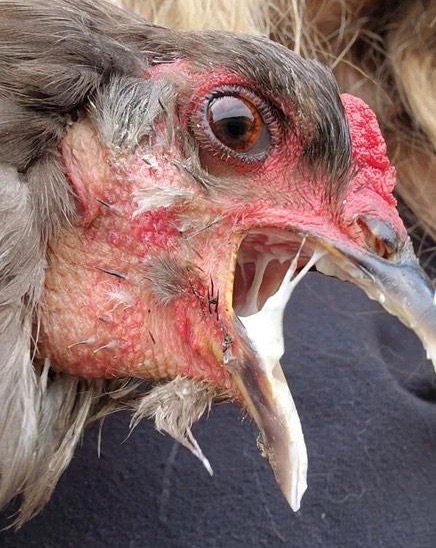
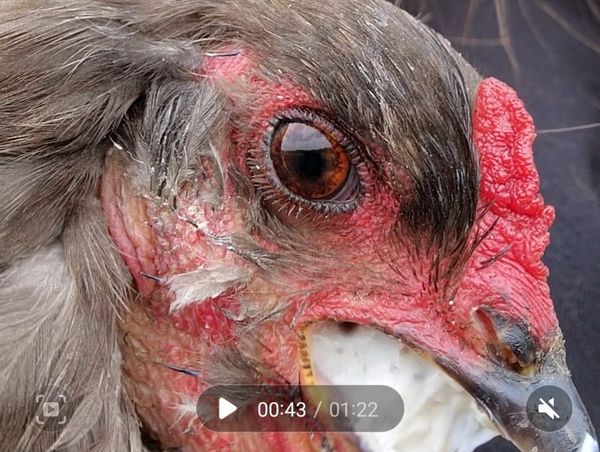
Dr Bowes: The mucous is indicative that she is not swallowing due to an obstruction in her esophagus or, more likely, her throat. It could be a piece of string or a mass caused by an infection.
This hard growth appeared suddenly and has been the same for almost a month. It does not appear to be particularly painful, her eyesight is not affected, but she cannot see over it and mostly turns her head to use her other eye. It is ball-shaped and about 3/8” in diameter. No respiratory symptoms.
A chicken savvy neighbor attempted to lance it early on, but couldn’t get anything. My vet has offered to remove it, but is leery because of her lack of experience with chickens. My thought from the beginning has been abscess, but there’s no spot to target.
Under the vet’s (and the county extension agent’s) guidance, I treated her for two weeks with water soluble oxytetracycline hydrochloride and didn’t see any improvement. Do you recommend that I give her another round of antibiotics? My vet is willing to remove it, but I’m reluctant to cause Willie Mae that pain if it’s not necessary. – Shirley Rose Glisson
Dr Bowes: This is a case of sinusitis. A vet could excise it, pop out the hard core and flush it out. Injectible antibiotics would have been recommended, as oral ones can’t reach the core of the infection.
Update: My vet agreed to do the small surgical procedure of just what you described. She recognizes the growing need for medical care for backyard chicken flocks and is taking steps to fill that need. My hen, Willie Mae, is doing well. She never quit eating or being her bossy but sweet self. Dissolving sutures were used. She has a little bag under her eye, which is slowly resolving, but it has not bothered her or attracted unwanted attention from the other hens. Thank you so much for sharing with Dr. Bowes and for reaching out with her diagnosis and recommendation. – Shirley Rose Glisson
Once again, my appreciation goes out to Dr Bowes for indulging my passion in the weird and wonderful, and along the way learning more about chickens with the intention of passing that on to my readers.
If you’ve got a case you’d like to share or need help with, drop me a line by using the ‘contact’ button on my homepage.
 Bitchin' Chickens
It must be rewarding to see the positive impact this blog has on other open-minded vets!
LikeLiked by 1 person
It is, but helping small flock chicken keepers is my real goal.
LikeLike
Yes! And getting more vets to treat chickens is a very important part of that!!!
LikeLiked by 1 person
Agreed. Dr Bowes does workshops for small animal vets on poultry health issues.
LikeLike