

For more than two years I’ve gotten together with Dr Vicki Bowes, avian vet/pathologist on a regular basis to pore over files in my memory stick loaded with interesting chicken health issues that I’ve collected for her expert opinion. She refers to it as ‘Show and Tell’ or ‘Best Guess’ and has done a good job at making diagnoses given the information we have at hand, usually only a short paragraph from the chicken’s owner. My job is to write them up to share with my readers as a form of skills building for chicken keepers.
I noticed this morning what looks like a strand of grass stuck by his eye. If I pull it continues to come out and appears fleshy. What is this and what can I do? I don’t want pull it and end up taking his eye with it. – Vickey L Bills


Bitchin’ Chickens: When I suggested to Dr Bowes that this might be a case of an eyeworm she dismissed the idea. When I reminded her we had previously seen a case and showed her the photo she warmed to my diagnosis. We did a quick internet search of more images and information and came across a veterinary site that explained what we were looking at:
Vetspace: “Eyeworms (Oxyspirura mansoni) cause trouble only in warm climates, such as the southeastern United States, where the particular cockroach host lives. The parasite burrows under the third eyelid of chickens and other birds, causing eye to swell shut. As you can imagine, it’s irritating, and the bird does additional damage by scratching at the eye.”


“Adult eyeworms live on, and in, the structures that surround the bird’s eyes: on the cornea, under the third eyelid, in spaces next to the eyeball that are not visible (the conjunctival sac), in the lacrimal duct that conveys tears to the nose, adjacent to the lacrimal gland that produces tears and adjacent to the harderian gland (a gland probably associated with eye immunity but whose functions are not fully understood). The harderian gland is a rich source of food for eyeworms. It is also located close to the bird’s optic nerve, a key element for proper vision. Eyeworms have also been found in the sinus spaces that permeate the bird’s skull.”
“These parasites have teeth, and, in the process of feeding on the bird’s tissue and blood, they are capable of causing considerable damage. That is particularly true if many are present. Once inside a bird, they can move freely from eye to eye through the sinus passages. When disturbed, they are known to evade capture by moving deeper into the structure of the eye.”
Bitchin’ Chickens: We were both grossed out by a tiny worm having teeth, but I was glad we found the probable diagnosis and also a bit stoked that I was able to present something new to my mentor, who is always up for a challenge and open to learning.
Eye Tissue
This pullet has had an eye issue since we got her as a three-day-old chick. We treated with Vetericyn and Terramycin and (unnamed) antibiotics for six days. Our vet advised discontinuing all meds and said nothing was wrong with her eye. After the second vet visit she has white discharge and bubbles in eye. She is smaller than the other chicks and is now lethargic. – Kersten Falk


Dr Bowes: Can you remove and debride that tissue? It doesn’t appear to be a systemic issue, but I wonder why she is now lethargic. I’m concerned about the cornea. Can she close her eye properly? Can you gently pull on that tissue with tweezers to see how it is attached? I would rinse and flush her eye. It requires an ophthalmic exam for an accurate diagnosis.
Papilloma (Warts)

Dr Bowes: I have never seen anything like this before. They appear to be cavities or craters, perhaps a papilloma.
Bitchin’ Chickens: Again, this was something new for both Dr Bowes and me, so off to the internet we went. I work in the field of sexual health and thought they looked a bit like genital warts (Human Papilloma Virus) in people. As it turns out, both of us were correct when leaning towards a papilloma.
Pet Place: “Papillomas, or warts, are caused when a papilloma virus infects the outer most cells of the skin. Once the papilloma virus takes over a cell, it causes the cell to undergo changes resulting in a thickening of the skin and development of a mass.
While many papilloma viruses have a preference for the skin, the papilloma virus associated with the formation of warts on the skin of birds is considered to be a type of benign tumor.”
“Papillomas of the skin caused by a papilloma virus should be differentiated from papillomatosis, which is a wart-like lesion that can occur on the surface of the cloaca or along the gastrointestinal tract in birds. Recent research suggests that papillomatosis is probably caused by a virus. Generally, papillomas on the skin of birds do not need to be treated unless they are causing specific problems. Some lesions can be debilitating if they are damaged, allowing secondary infections to occur, if they inhibit a bird’s ability to move or interfere with eating.”
“Mild lesions can be observed for changes that would necessitate their removal. Severe lesions can be removed surgically or cauterized to make a bird more comfortable.”
Bitchin’ Chickens: Our search didn’t find any information suggesting that the location of cloacal papillomas might be sexually transmitted, like they are in people. My concern would be mating could irritate the warts, causing them to bleed and shed virus that would be carried to the rooster and potentially to other hens in the flock. If anyone has the answer to that query I’d love to hear it.
Internally Broken Egg (photos: Alicia Bishop)
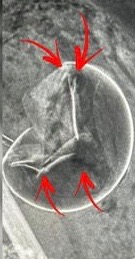

Dr Bowes: I can’t tell if the broken egg is in the oviduct or not. If so, it can lead to egg yolk peritonitis. The egg is abnormally large and an unusual shape (more circular). It appears to be freshly broken as the margins are crisp. Removing the egg by digital manipulation is difficult. I would isolate her in a crate and give her additional calcium in the form of crushed Tums in her water which might help her pass it.
‘Cooked’ Egg (photo: Brittany Harper)
I found this image in an online chicken group. The poster had found this freshly laid egg which appeared to be ‘cooked’. Another group member posted her explanation as: “Coagulation caused by coagulase producing bacteria; basically it’s a chemical reaction that causes chemical “cooking”.
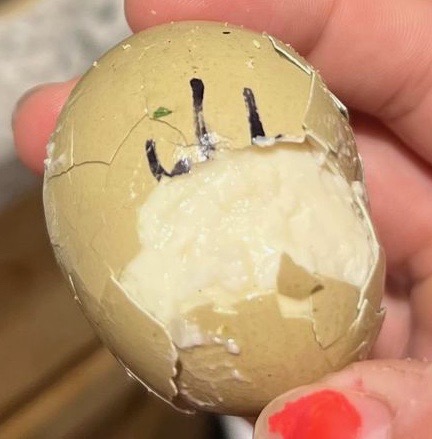
Dr Bowes: I disagree that this is the result of coagulase – which is different than coagulation. I’d be curious if the yolk was cooked as well. Fowl Cholera can cause fever which can curdle the yolks on the ovaries. I’ve never seen a case, but it’s possible there were bacteria (such as Staphylococcus) within the egg that might have caused this. Since this might be a sign of illness I would monitor that hen to see if she has any other symptoms.
Well, that wraps up another edition of Show & Tell With Bitchin’ Chickens and Dr Bowes. I hope that it’s been a learning experience for you.
If you’d like help with a case drop me a line using the ‘contact’ button on my home page. Remember to wear gloves, take good close up photos from several angles and supply us with plenty of information (e.g. timelines, symptoms, medications, general flock health, etc) so we’re able to more accurately pinpoint what’s going on.
Thanks again to Dr Vicki Bowes for her willingness to share her wealth of knowledge and experience to build capacity and skills in small flock keepers.
Credit: Pet Place; Vetspace
 Bitchin' Chickens
If there was this gross eye worm, could the owner pull it out? This kind of stuff is really disgusting, but extremely valuable to know.Thank you for sharing. Jackie Windess
LikeLiked by 1 person
If it isn’t attached I would pull it out otherwise the recommendation is to use Ivermectin topically (not on the eye).
LikeLike
Very interesting cases!
LikeLiked by 1 person