

For more than three years I’ve gotten together with Dr Vicki Bowes, vet/avian pathologist on a regular basis to pore over files on my memory stick loaded with interesting chicken health issues that I’ve collected for her expert opinion. She refers to it as ‘Show and Tell’, ‘Best Guess’ or, more recently, ‘Gorefest’ and has done a good job at making diagnoses given the information we have at hand. Sometimes all we are provided with is a short paragraph from the chicken’s owner, other times nothing more than a photograph.
My job is to write them up to share with my readers as a form of skills building for small flock keepers.
We met up recently to look at almost 60 cases. I’ve attempted to curate them according to the area of the body affected. These ones are grouped together as they all involve things that have come out of a chicken’s cloaca.
Black Poop
I had a sick 7-week-old chick a few days ago. I found her belly up in the coop, lethargic and close to dying. She had very black, watery poop but no red blood. I treated the whole flock with Corid (used to treat coccidiosis) which seemed to help for a couple of days. She’s now weak and off balance. – Stephanie Baker

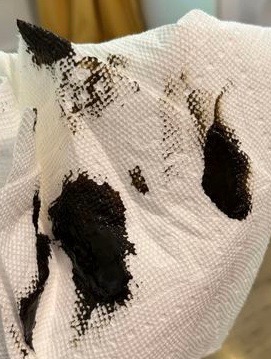
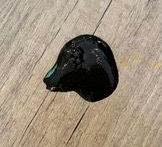
Dr Bowes: Generally black poop is indicative of digested blood, which could be the result of an upper GI tract ulcer or foreign body. I would not diagnose this as coccidiosis. It’s good that you put the sample on an absorbent towel to give us an idea about the colour and consistency. To get a better idea of what’s going on would require a test of the sample to verify the presence of blood. Further diagnostics and treatment might include an X-ray and surgery.
Green Poop (Diane Dempster Kuczkowski)


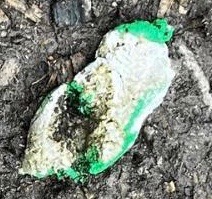
Dr Bowes: This pigment is not normal avian physiology. It might be caused by ingestion of a plant.
More Green Poop (Jolene Mark)

Dr Bowes: It is well formed which is a good sign. When did it start? Is it transient? Other symptoms? It is not typical of the green staining of an anorexic bird.
And Even More Green Poop

Bitchin’ Chickens: Don’t be fooled; this is a normal green poop from my flock. If you notice the formation is as expected, complete with the ‘frosting’ urates on top. The pigment is the result of what they ate: cabbage. It just goes to show that not everything that looks a little weird is cause for alarm. (FYI: it’s actually quite bright green in person)
Hanging From Vent (Colleen Rusk Neal)

Bitchin’ Chickens: Dr Bowes and I disagreed on this one. She thought the lower right quadrant appeared to be a roundworm, but I think it appears to be pinkish and attached to the main ‘blob’. If anyone has some suggestions as to what it is we’d love to hear them.
Blood Clot (LeeAnn Boland)

Bitchin’ Chickens: We were given no information except this poop was 8″ in diameter.
Dr Bowes: This is a tubular blood clot indicative of a low GI tract bleed. It’s not coccidiosis. The yellowish urates are a sign of liver disease.
Prolapsed Vent
My 4-year-old hen had a broken egg hanging out of her this morning. I soaked her and very carefully got all the pieces of shell out that I could see and this is what’s left. Are those spots tumors? Or do they look like salpingitis (lash egg) infection was starting?
Can this even be fixed? She’s still pushing hard, but I couldn’t feel an egg when I tried to put it back in. I cleaned her up twice yesterday and applied white sugar and Manuka honey. I started her on Cephalexin (antibiotic) and am trying to figure out some sort of pain management. I don’t want her to suffer more than she already has, especially if those are tumors. – Katy Tripp

Dr Bowes: The yellow spots are caseous exudate. Continue to treat this as a vent prolapse in the same way you’re already doing.
Prolapse #2 (Rochelle Robinson)
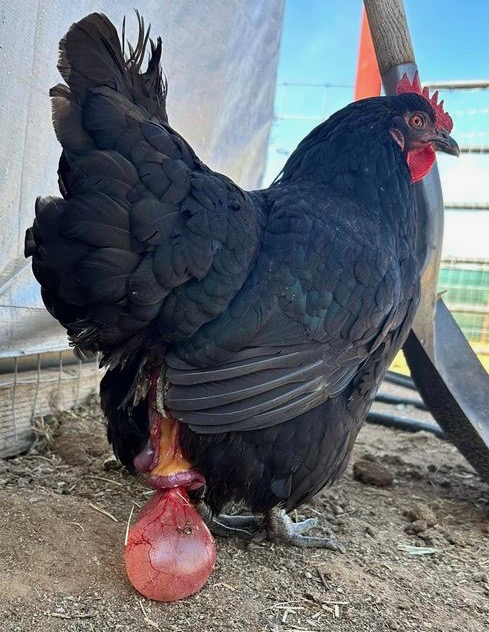
Dr Bowes: This appears to be a prolapse of the vestigial right oviduct as well as the intestines. There is no coming back from this. Recommendation: Humane euthanasia
Prolapse #3 (Jennifer Kelly)

Dr Bowes: This appears to be a prolapsed cystic oviduct. Recommendation: humane euthanasia
Unknown Object
What am I dealing with here? I saw this stuck to my hen’s butt. Is this a worm? If so, what kind and how do I treat it? – Sabrina Perner
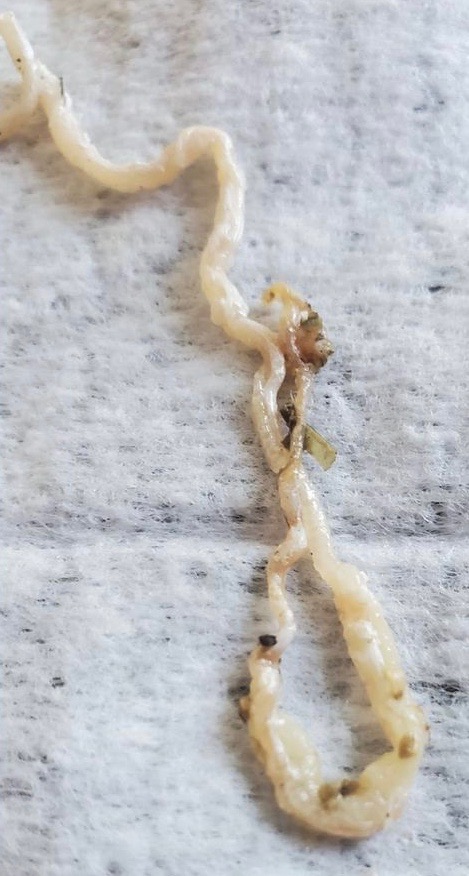
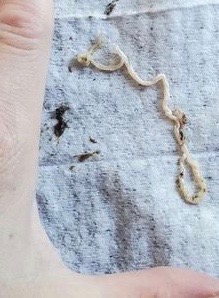
Bitchin’ Chickens: Dr Bowes and I weren’t in agreement here. She thought it might be a dead roundworm. The colour is consistent with that diagnosis but roundworms present as uniformly smooth and this object is lumpy. Dr Bowes then suggested it might be exudate from an immature oviduct.
Weird Stuff Found In Eggs
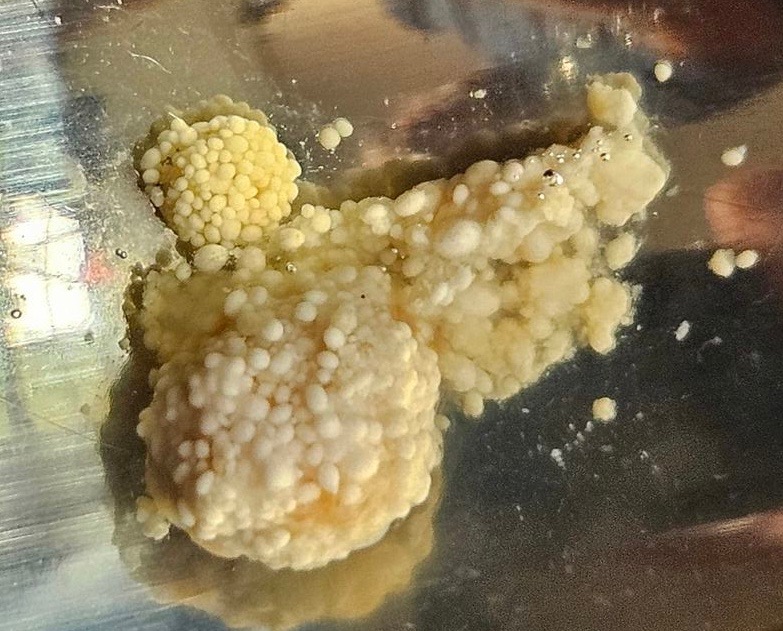
#1 Close Up Photo Taken Of Albumen Contents In A Spoon (Victoria Foster)
#2 (Anonymous)

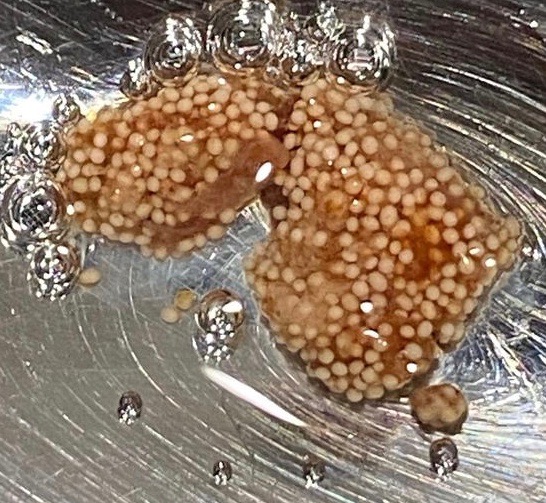
#2 (Stephanie Shemin Feingold)

My kids got this egg from the coop this morning, it was a little cracked (we have an egg pecker) and they started peeling the shell. The membrane remained intact and when we move the egg around these hexagonal white things appear! What are they? – Stephanie Shemin Feingold
Bitchin’ Chickens: Both Dr Bowes and I were stumped on these ones. She thought the top and middle cases might be a cluster of cancer cells: ovarian tumour cells that might have become detached and incorporated into the developing eggs. Her guess for the bottom image was bacterial gas. If anyone has any suggestions about what was going on with those eggs feel free to leave us a comment.
Glossary
Caseous: cheeselike, especially in appearance, smell, or consistency
Exudate: a mass of cells and fluid that has seeped out of blood vessels or an organ, especially in inflammation
Well, that wraps up another edition of Show & Tell With Bitchin’ Chickens and Dr Bowes. I hope that it’s been a learning experience for you.
If you’d like help with a case drop me a line using the ‘contact’ button on my home page. Remember to wear gloves, take good close up photos from several angles and supply us with plenty of information (e.g. timelines, symptoms, medications, general flock health, etc) so we’re able to more accurately pinpoint what’s going on.
Thanks again to Dr Vicki Bowes for her willingness to share her wealth of knowledge and experience to build capacity and skills in small flock keepers.
Featured photo credit: Erica Cler
 Bitchin' Chickens
Wow. Great, somewhat disturbing and perplexing cases.
LikeLiked by 1 person
Stay tuned, there are more like that to come
LikeLike
Nice post. I subscribed. Have a happy day
LikeLike