

For more than three years I’ve gotten together with Dr Vicki Bowes, vet/avian pathologist on a regular basis to pore over files in my memory stick loaded with interesting chicken health issues that I’ve collected for her expert opinion. She refers to it as ‘Show and Tell’, ‘Best Guess’ or, more recently, ‘Gorefest’ and has done a good job at making diagnoses given the information we have at hand. Sometimes all we are provided with is a short paragraph from the chicken’s owner, other times nothing more than a photograph.
My job is to write them up to share with my readers as a form of skills building for small flock keepers.
We met up recently to look at almost 60 cases. I’ve attempted to curate them according to the area of the body affected. These ones are grouped together as they all involve the head and face.
Comb Infection
I have a wonderful rooster with a spot on his comb. It’s on both sides and has just started in the last few days. Do you think bacterial or yeast? How do I treat it? – Laura Militello Makowski

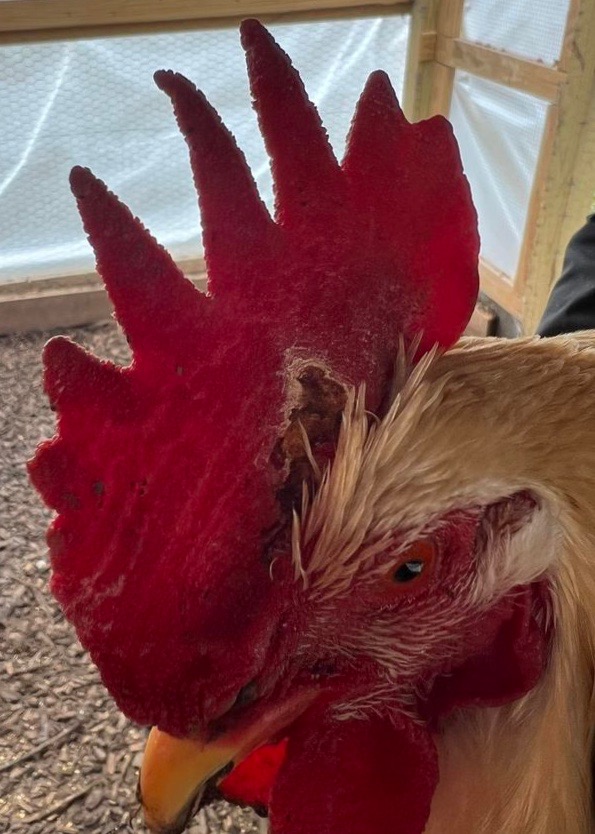
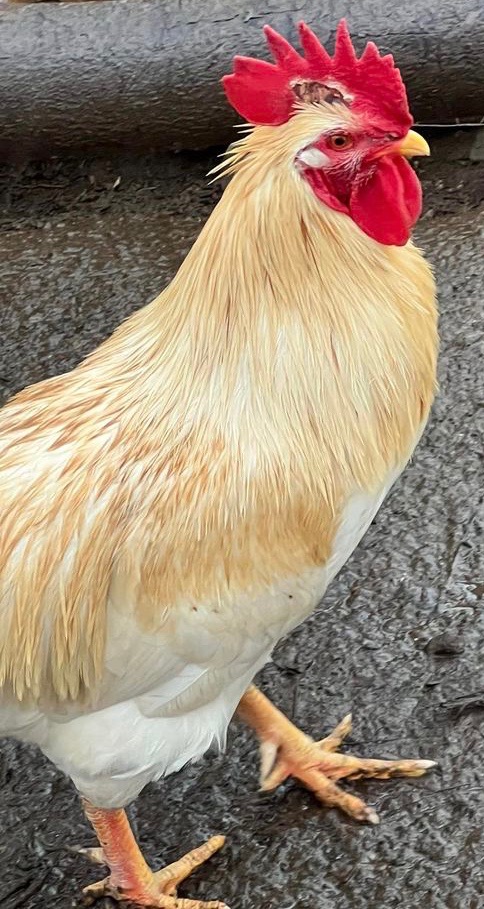
Dr Bowes: That’s an area of necrosis due to compromised blood supply. Keep it clean and apply an antibacterial ointment. It should heal but the margins may not close and can leave a hole at the base of the comb.
Eye Issue
At first, we thought it was just a growth, but now we are thinking it’s a third eye. What can we do to fix this? It doesn’t seem to hurt the chick, but we are extremely concerned. – Jenna Hatfield
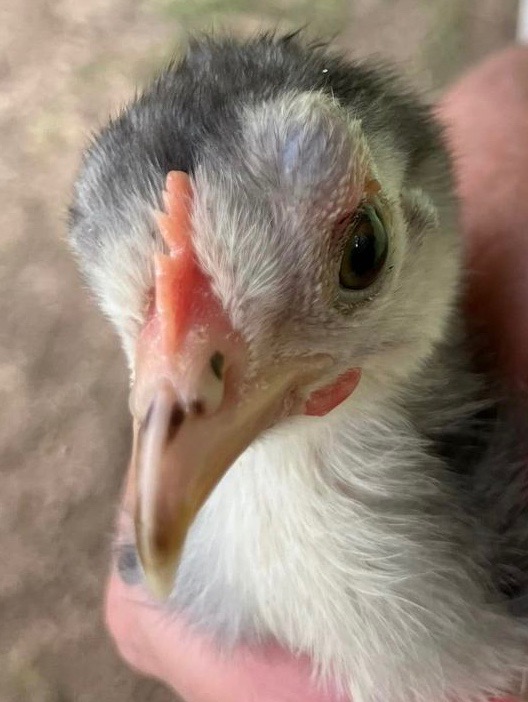

Dr Bowes: Why does the eye appear normal in the first photo and definitely abnormal in the second? It seems that the intraorbital sinus has deflated. Is the chick having trouble breathing? If so, that could be the result of an abscess. It’s not a third eye.
Eye Tumour
She has been on oral antibiotics for ten days, but seems to be getting worse. It started bleeding tonight when I put slight pressure on it. She is separated from the flock and is eating and acting normal, but I don’t want to prolong this if it’s hopeless. – Ashley Phillips Fikes

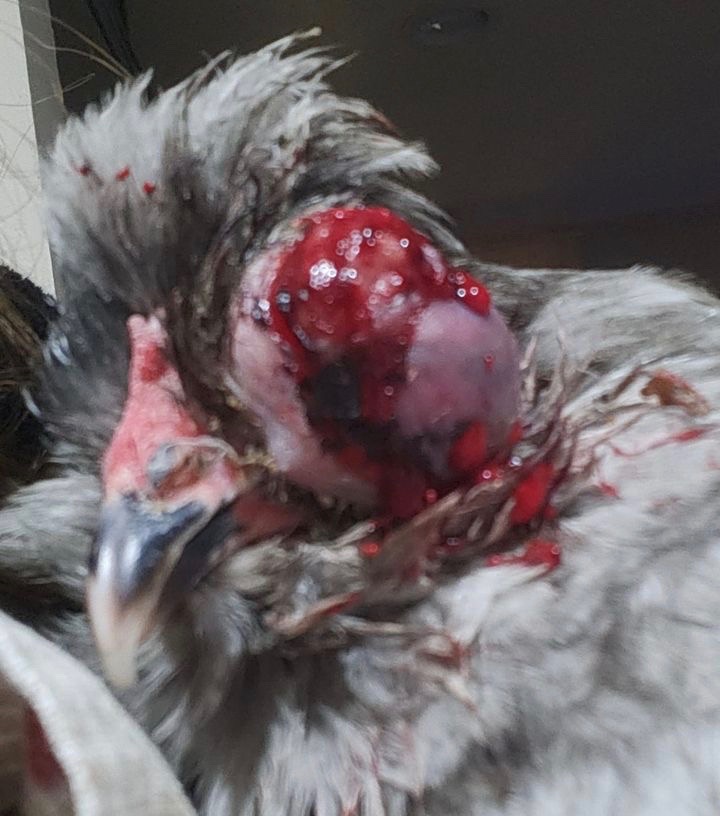
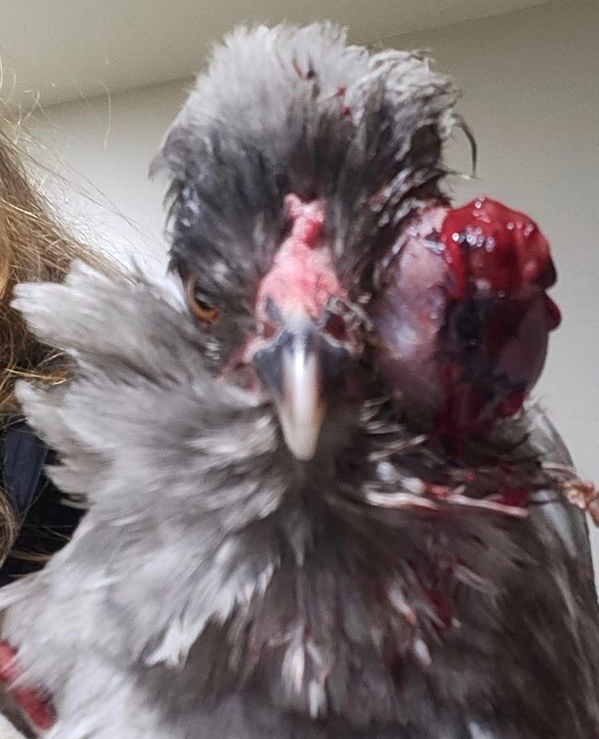
Dr Bowes: This is a vascularized mass that might be squamous cell carcinoma. The significant amount of inflammation would be painful. I would recommend humane euthanasia.
Beak Injury (Bethann Paige)

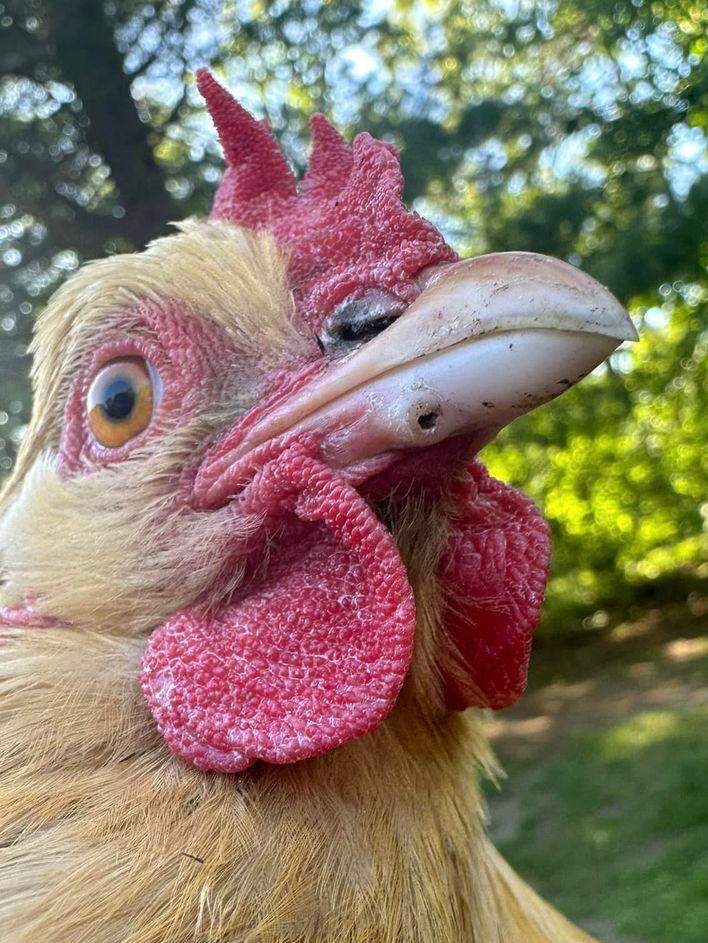
Dr Bowes: It appears to be an injury in the horny part of the beak. Look inside the mouth for any damage. Monitor the hole for any changes in size or weeping.
Cellulitis
This is a rescue hen that was the victim of a pecking injury in which her skin over her skull was degloved. The vet sutured her up. I have her in my garage and have been applying Neo-Predef as needed because she’s scratching at it. I’ve tried Terramycin and Veterycin spray. We removed the sutures yesterday and all these holes are forming. I’m assuming the tissue is necrotic. – Kait Cerf
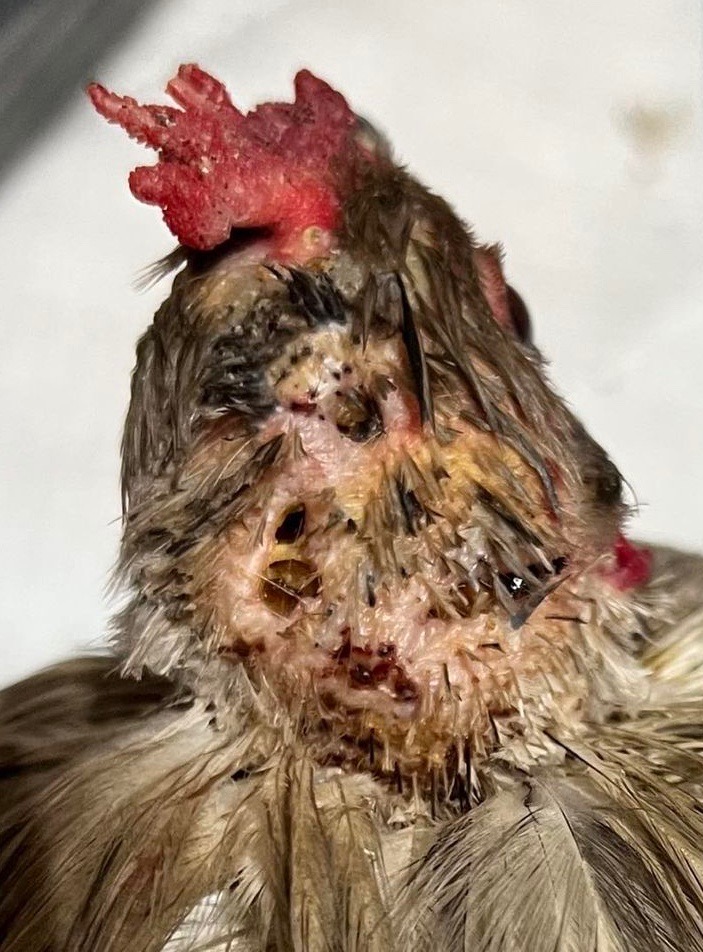
Dr Bowes: That’s cellulitis. Keep the area clean and apply an antiseptic wash/ointment. It will heal. Terramycin is an antibiotic suitable for respiratory infections, not this wound. Clavaseptin (penicillin) would be more appropriate.
Corneal Rupture
Our hen started having issues with one of her eyes a while ago when we noticed she was keeping one eye closed and it seems to have little bubbles/foam on it. We started cleaning it with saline then putting Vetericyn antimicrobial eye gel on it a few times a day thinking she maybe got pecked and it needed some help healing. Then her eye started to bulge and turned completely gray/cloudy but didn’t seem to bother her. Today I noticed it’s bulging more and has a red spot on it. Is there any more we can do? – Brooke Esselman

Dr Bowes: This is a corneal rupture, which might be the result of an injury leading to bacterial pseudomonas. It’s a painful condition, which will require antibiotics and pain management. I don’t think the swelling will get bigger.
The top part of the beak somehow went down through the soft tissue in the middle of her lower beak. It didn’t puncture the skin, just pushed the tissue outward and created a bump. I couldn’t find her beak so I pushed on the bump. I could then tell the bump was the missing beak. So I gently pushed it up and out. – Christy Bubenheim


Before and after photos
Bitchin’ Chickens: Since this is our 50th post in the series I wanted to find some interesting cases for Dr Bowes. She declared this one a winner. We both marveled at the force required to push the upper beak into the mouth without puncturing skin. The greater mystery is how the owner was able to pop it back into place without any damage. It does appear an anatomical impossibility.
Glossary
Cellulitis: deep infection of the skin caused by bacteria
Deglove: when a part of the skin, with or without the underlying soft tissue, becomes wholly or partially detached from the body, like a glove stripped off a hand
Necrosis: death of body tissue, which occurs when too little blood flows to the tissue. Necrosis cannot be reversed. When large areas of tissue die due to a lack of blood supply, the condition is called gangrene
Neo-Predef: a topical anti-inflammatory, antibiotic, and anesthetic medication that treats specific ear and skin conditions in horses, dogs, and cats
Vascular: relating to, affecting, or consisting of a vessel or vessels, especially those which carry blood
Well, that wraps up another edition of Show & Tell With Bitchin’ Chickens and Dr Bowes. I hope that it’s been a learning experience for you.
If you’d like help with a case drop me a line using the ‘contact’ button on my home page. Remember to wear gloves, take good close up photos from several angles and supply us with plenty of information (e.g. timelines, symptoms, medications, general flock health, etc) so we’re able to more accurately pinpoint what’s going on.
Thanks again to Dr Vicki Bowes for her willingness to share her wealth of knowledge and experience to build capacity and skills in small flock keepers.
Featured photo credit: Cassie Goodwin-Crossley
 Bitchin' Chickens
I admit, the last case also baffles me on how it was corrected. Thank you both for bringing these cases forth for educational purposes.
LikeLiked by 1 person
I’ve seen this once before in which the owner used the eraser end of a pencil to push the lower beak back into place. It’s a miracle the beaks were intact and no damage occurred. I’m curious what kind of injury did they sustain for that to happen. Where is video when you need it?
LikeLike