
For more than three years I’ve gotten together with Dr Vicki Bowes, vet/ avian pathologist on a regular basis to pore over files in my memory stick loaded with interesting chicken health issues that I’ve collected for her expert opinion. She refers to it as ‘Show and Tell’, ‘Best Guess’ or, more recently, ‘Gorefest’ and has done a good job at making diagnoses given the information we have at hand. Sometimes all we are provided with is a short paragraph from the chicken’s owner, other times nothing more than a photograph.
My job is to write them up to share with my readers as a form of skills building for small flock keepers.
We met up recently to look at almost 60 cases. I’ve attempted to curate them according to the area of the body affected. These ones are grouped together as they all involve the head and face.
Squamous Cell Carcinoma
Is this fowl pox? I figured it was so I put toothpaste on her. It’s my first time seeing a big wart like that, my others had black scabs. – Victoria Mule Boudreaux
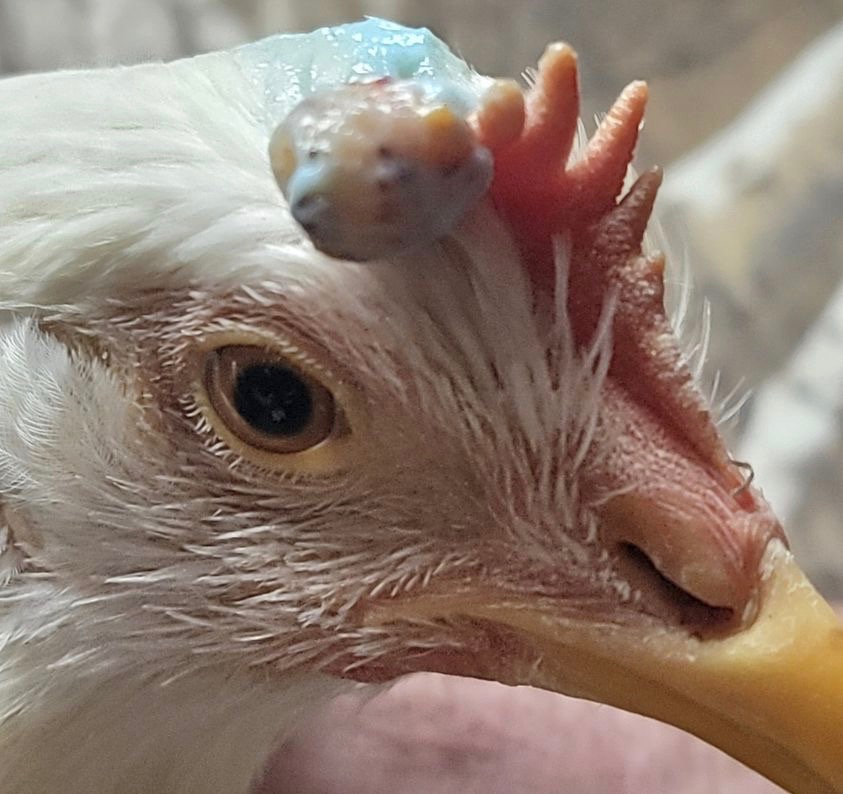
Bitchin’ Chickens: I had to explain to Dr Bowes that a popular home remedy for treating fowl pox was to cover the scabs with toothpaste, something she had never heard of and didn’t believe there was any therapeutic use for it. We figured that folks were using toothpaste, not for any medical benefits, but because it easily adheres to, and covers, the scabs which are highly infectious. Our recommendation is to treat it using Betadine or diluted Iodine.
Dr Bowes: Pox is crumbly and dry, while this is a singular fleshy lump. My diagnosis would be squamous cell carcinoma, which would be easy for a vet to remove.
Skin Growth
My two year old Leghorn has had these little bubbles for a really long time. He’s otherwise healthy as are all my hens are healthy so nothing has been transmitted to them. The bubbles keep growing and now they’re interfering with his eyesight. The scabs are on both earlobes. Is that an infection? – Melissa Grzybowski

Dr Bowes: The bumps are proliferative, not inflammatory, sebaceous cysts or Fowl Pox. I think it’s a benign skin growth but you’d need a biopsy to confirm its origin.
Trichomonosis (Canker)
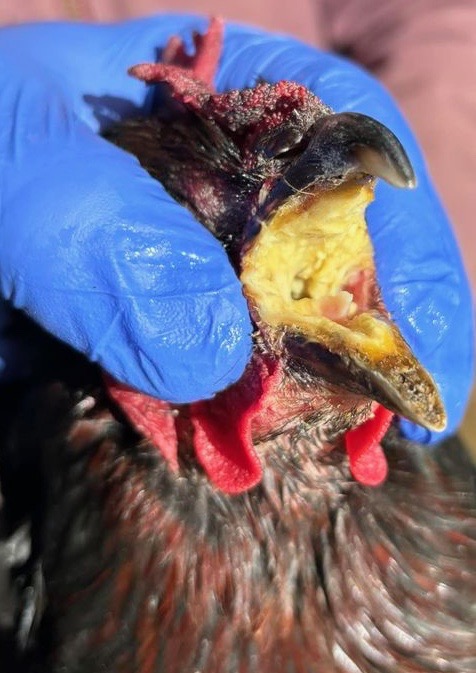
Dr Bowes: This is the worst case scenario of trichomonosis (canker). It’s an invasive infection that can remove tissue lining the mouth. There is no treatment at this point when the bird is no longer be able to eat or breathe properly. Recommendation: humane euthanasia
Yellow Skin
Why is my hen’s face yellow? – Kristin Welker

Dr Bowes: Is this a mutation? Is it normal for this bird or a recent change? What colour are her shanks? Yellow coloured skin is often associated with issues concerning the liver. The structure of this bird’s skin look fine, the sclera of the eye is white, which is normal and not a sign of jaundice.
Suspected Bacterial Infection (Theresa Fitch)

Dr Bowes: It’s difficult to see if it involves the ear. Clean the area, remove what you can and monitor what is beneath it. Explore the origin, which might be an infection.
Head Swelling (Jonni Machado)


Dr Bowes: I’d like to know how long it took for that to develop. It doesn’t appear to be a tumour, but more likely to be a traumatic hematoma that should resolve itself. Keep it clean and monitor for infection.
Beak Injury
This appeared one day and was gone the next. I am assuming it was pus build up but what was on the end I have no clue. It just looks like blood on her nostril now. I don’t know how long it was there but couldn’t have been more than a day or two. – Jenna Spadafore
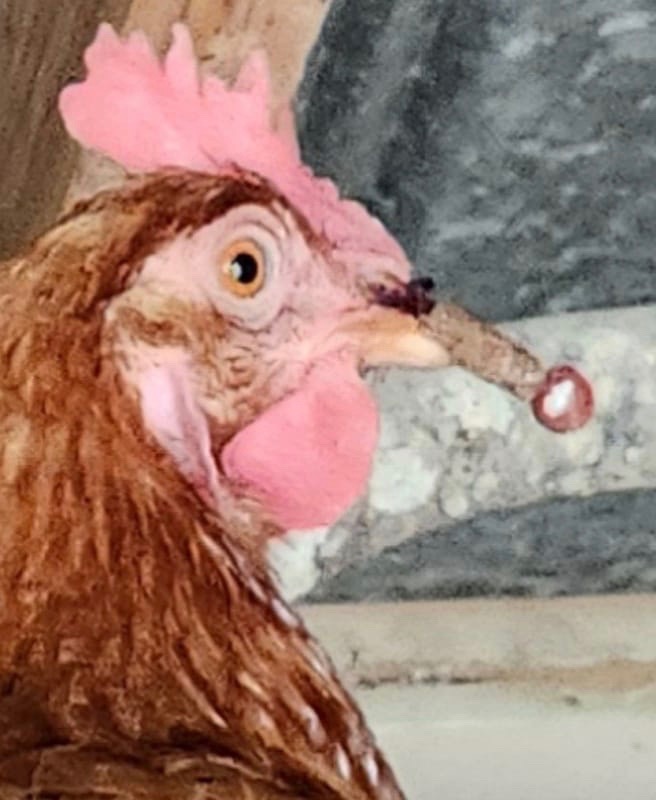

Dr Bowes: I’m wondering in this was a nosebleed caused by an injury. It appears to have clotted, then fallen off on its own.
What are these black dots between my hen’s wattles? How do I treat them? – Lauren Noelle Hardesty
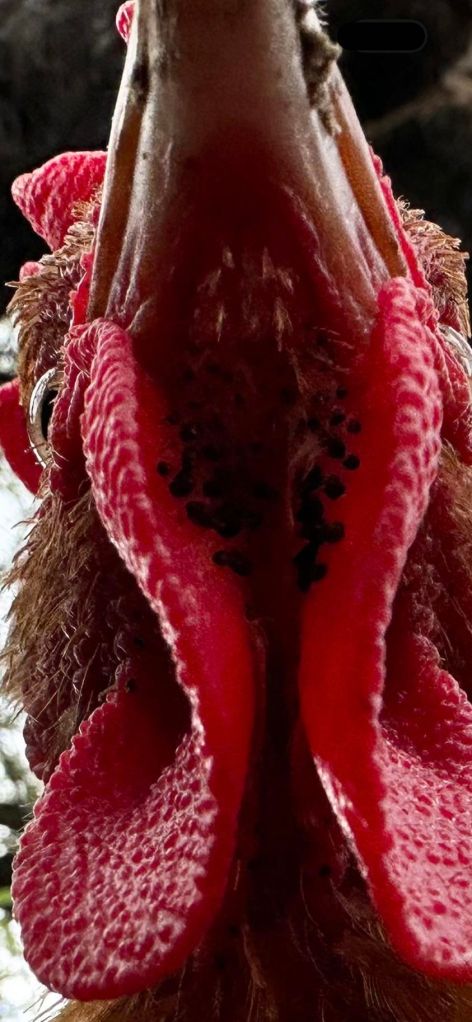
Dr Bowes: They appear raised and symmetrical like insects. I’ve never seen anything like it.
Well, that wraps up another edition of Show & Tell With Bitchin’ Chickens and Dr Bowes. I hope that it’s been a learning experience for you.
If you’d like help with a case drop me a line using the ‘contact’ button on my home page. Remember to wear gloves, take good close up photos from several angles and supply us with plenty of information (e.g. timelines, symptoms, medications, general flock health, etc) so we’re able to more accurately pinpoint what’s going on.
Thanks again to Dr Vicki Bowes for her willingness to share her wealth of knowledge and experience to build capacity and skills in small flock keepers.
Featured photo credit: istock
 Bitchin' Chickens
thank you so much x
LikeLiked by 1 person
Very informative. Thank you 🙂
LikeLiked by 1 person