
For more than three years I’ve gotten together with Dr Vicki Bowes, vet/ avian pathologist on a regular basis to pore over files in my memory stick loaded with interesting chicken health issues that I’ve collected for her expert opinion. She refers to it as ‘Show and Tell’, ‘Best Guess’ or, more recently, ‘Gorefest’ and has done a good job at making diagnoses given the information we have at hand. Sometimes all we are provided with is a short paragraph from the chicken’s owner, other times nothing more than a photograph.
My job is to write them up to share with my readers as a form of skills building for small flock keepers.
We met up recently to look at almost 60 cases. I’ve attempted to curate them according to the area of the body affected. These ones are grouped together as they veer towards the gory part of our work.
Dog Attack
This chicken was attacked by a dog about a week ago. Is this healing? Infected? – Sarah Rachel

Bitchin’ Chickens: This is an interesting one, not because of the case but a response to it in an online group. I was curious to hear Dr Bowes opinion on the poster’s advice. We read the text together before looking at the photo. Dr Bowes was quite impressed with the suggestion; that is, until she saw the photo. At which point, she let out a series of ever louder “No!”.
“That’s called an eschar. It is a scab that is covering the wound with the tissue healing under it. It is a biological dressing. Don’t remove it. Don’t debride it. It is not infected. No need for antibiotic ointment. Vetericyn spray at most. It is doing exactly what you want it to do. It will fall off when it’s ready”. – name withheld
Dr Bowes: This is NOT an eschar, there is no skin covering the area. It’s a critical injury and should be covered with a burn dressing. Investigate the depth of the wound. It might not have been possible to have sutured it at the time of the injury due to lack of skin, but at this point what skin there is has become tacked down leaving a large area exposed.
Abdominal Hernia
I just discovered this below my hen’s vent tonight. I’ve never seen water belly (if that’s what it is) look like this. Any helpful tips or suggestions on what to do (or not to do) will be helpful. – Ellen Elisa Emery
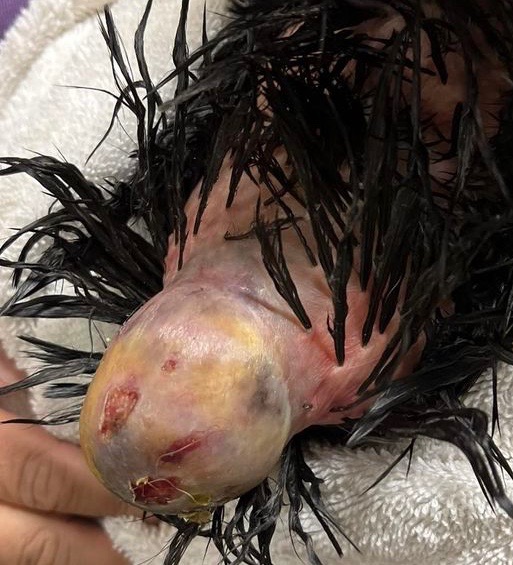
Dr Bowes: I’d like to know what is inside that mass? Judging from the empty space above the mass it appears to be an abdominal hernia that has ulcerated from dragging it on the ground. Can you gently push it in? (If so, that would support the diagnosis of a hernia). The longterm solution would be surgery to insert mesh that would support the abdominal wall. Without veterinary intervention the risk is the area would continue to ulcerate, introducing dirt and bacteria into the body, leading to peritonitis.
Squamous Cell Carcinoma
I went into the coop and found the bloody roost bar and one of our hens like this. It is not a hole in her chest. It appears as a blueberry-sized mass on top of her skin. The mass itself, which is hard and immobile, burst open and bled. There is a pus colored scab attached to it. We have cleaned it and treated it with Vetericyn spray. We did not try to remove any scabbing/pus or clean it further to avoid it bleeding more.
Unfortunately, she’s not even a year old, so if it’s a cancerous tumor we may have to put her down. I’m hoping that’s not the case, and that it’s a breast blister or something similar/non-life threatening. – Alexxa Wartman


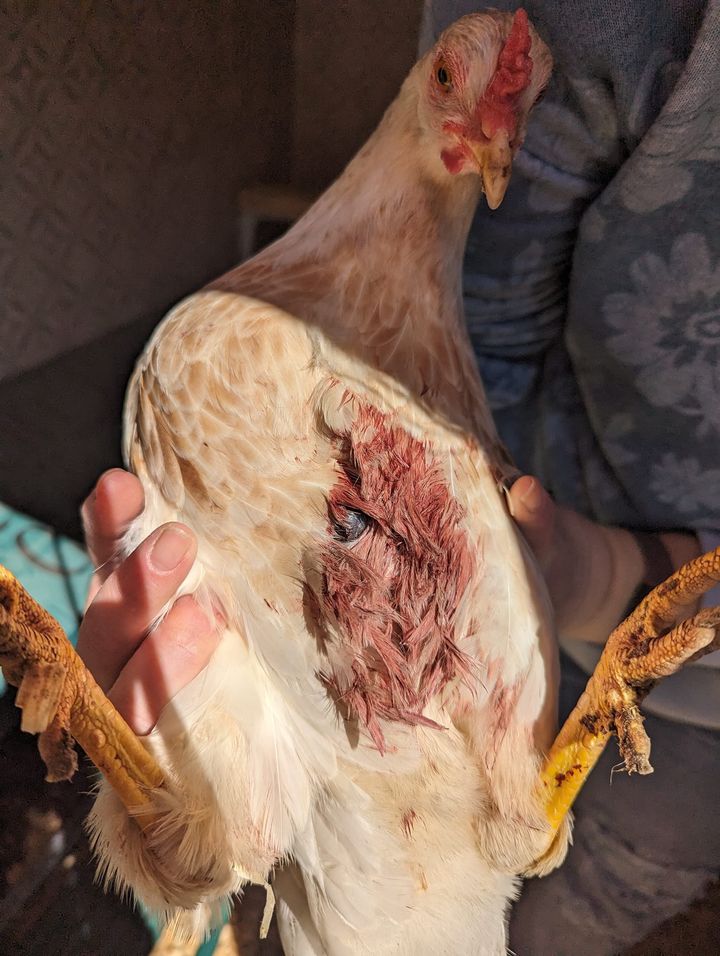

Dr Bowes: The area is vascular and the abrasion has caused bleeding. I would suggest this is squamous cell carcinoma, but you would need a biopsy to determine the diagnosis. Can you clean it and see if the scab comes off? Is there a foreign body inside? Continued bleeding will be the greatest risk in the short term.
Strangulated Toe
I’m not sure when this injury happened. I noticed my one-year old Lavender Orpington limping today. Upon inspection her left outer toe was nearly broken off and fell off in my fingers while examining it. How do I treat? – Alicia Marcum Johnson

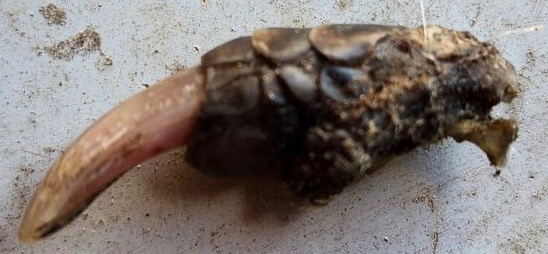
Dr Bowes: The toe appears to have been strangulated by something like monofilament, string or fishing line that got wrapped around it, cutting off the blood supply. Clean it up with an antiseptic wash, apply a topical antibiotic cream and monitor for infection around the footpad.
Tumour
I noticed my hen laying down today. This happened very fast; she was fine just a few days ago. It almost feels like a tumour. – Amanda Callaway
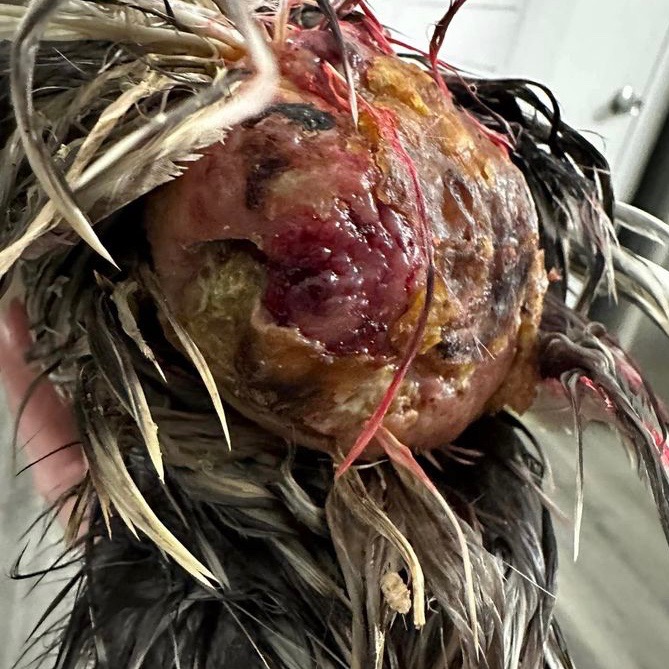

Dr Bowes: This mass has developed over a long duration. You can clean the area, administer antibiotics and monitor, but I think it is too large and will invite infection. Recommendation: humane euthanasia
Xanthomatosis
This hen is 3 or 4 years old. A year ago I noticed she had these small nodules at the 10:00 and 2:00 positions above her vent. I meant to go back and check but forgot. They were just skin colored and otherwise asymptomatic. Yesterday I noticed a large cyst near her tail. She had nasty feathers under her vent, some poop in the vent, and these two lumps are now much larger and look vascular.
We soaked her in a warm Epsom salt bath and when I got her vent area cleaned up, the top layer of skin slid right off the lumps, revealing this very red and almost bloody layer of skin. Initially I thought she had an infection but now I wonder if these could be cancerous.
I have no vet locally who sees chickens. I kept her inside overnight and today she’s chatty and acting fine so I let her go back out to free range with the others. What might this be and what I should do to treat it? – Elizabeth Ann
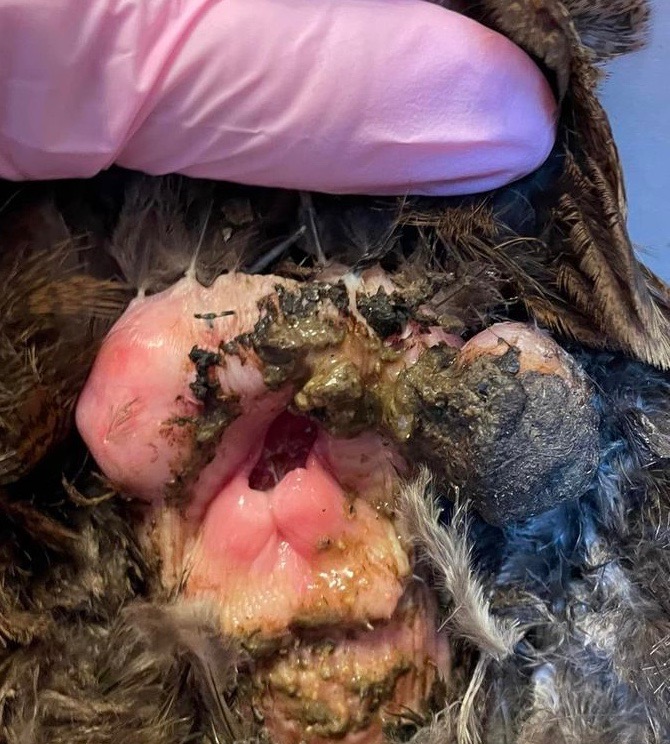
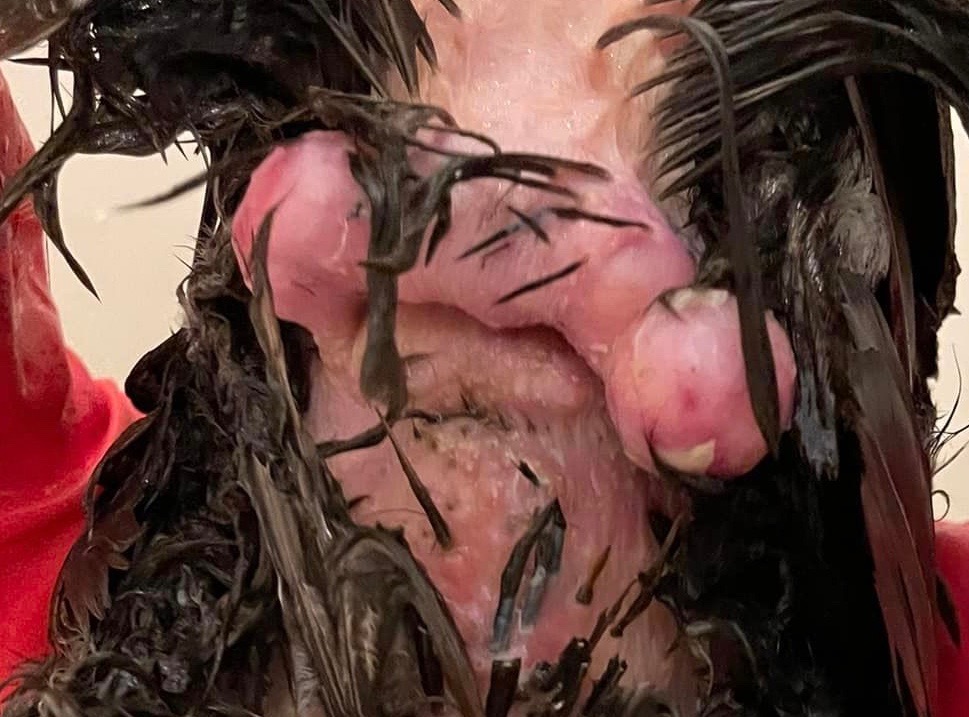


The pics are in order from unwashed to washed yesterday and then finally this morning.
Dr Bowes: This doesn’t involve the mucosa of the cloaca. It is smooth and nodular. This is feathered skin with raised proliferative lumps. They are probably firm, but not hard. Did the skin come off as a result of the bath? Their vascular nature will be problematic. A vet could remove them but they may grow back. I would diagnose this as a xanthoma, skin nodules containing cholesterol, that are sometimes seen in pet birds. Look for more lumps on other areas of the body.
Well, that wraps up another edition of Show & Tell With Bitchin’ Chickens and Dr Bowes. I hope that it’s been a learning experience for you.
If you’d like help with a case drop me a line using the ‘contact’ button on my home page. Remember to wear gloves, take good close up photos from several angles and supply us with plenty of information (e.g. timelines, symptoms, medications, general flock health, etc) so we’re able to more accurately pinpoint what’s going on.
Thanks again to Dr Vicki Bowes for her willingness to share her wealth of knowledge and experience to build capacity and skills in small flock keepers.
Featured photo credit: Getty Images


More great cases! Thanks Claire and Dr. Bowes.
LikeLiked by 1 person