

I get together with my mentor Dr Vicki Bowes, vet/avian pathologist throughout the year to look at chicken health issues that I’ve come across and store on a memory stick. She does her best to point out what’s going on with those birds and comes up with the most likely (and sometimes definitive) diagnosis. A couple of times I’ve mentioned having experienced a recent loss in my flock and each time she asked if I brought the body, or at least froze it, for her to look at. It feels a bit presumptuous to expect someone who works in the field to do a pro bono necropsy, but she assured me she was happy to provide the service as a learning experience for both my readers and me.
After that I started freezing specimens. I have a large food freezer and recently was hoping to divest myself of the four bodies taking up space. Two were from my flock and the other two came from friends Tracy and Keith’s birds.
As a bit of a backstory, Dr Bowes worked as an avian pathologist for the Ministry of Agriculture in the lower mainland of British Columbia for more than three decades. I live on a small island two ferry rides away; her future retirement home is here as well. We get together when she’s here, which sometimes makes me feel a bit like I’m cutting into her time off. As it turns out she really loves what she does and by the end of the day I felt like I should be charging her for the entertainment value my birds brought her. All kidding aside, we had a good time and again, I learned a lot just by watching her perform.
I’ll divide these posts into two cases each. I’ll start off with my own birds and then move on to Tracy’s in a separate post.
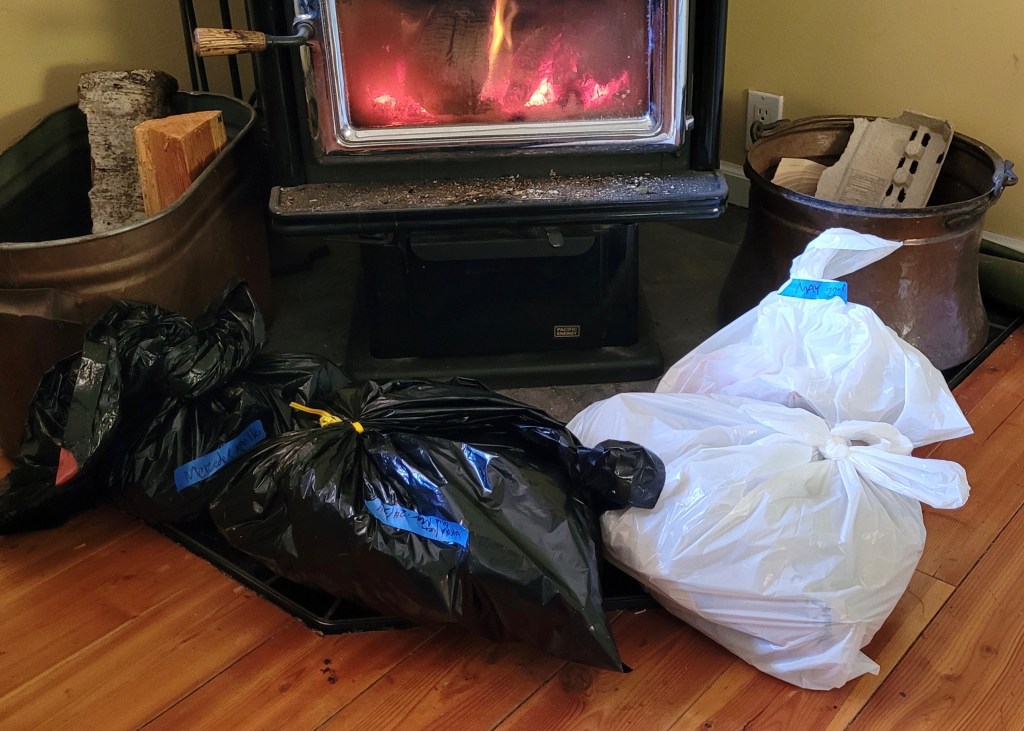
Here is how my day started: slowly thawing the cadavers in front of my woodstove.
Esme, Appenzeller Spitzhauben x, 6 years old
I noticed that my hen was squinting with one eye half closed. The next day her eye was unchanged and she went to roost earlier than usual. The following two days I was out of town. When I returned Esme seemed to be active and eating, her eyes looked better but she roosted early and was the last out of the coop. On day six she was pecking absently at her feed and her crop was empty. I contacted my friend Christy who euthanized her using the cervical dislocation method the next day.
She then sat in my freezer for six months until Dr Bowes was able to do the necropsy.
Dr Bowes’ findings included:
- Body condition was good
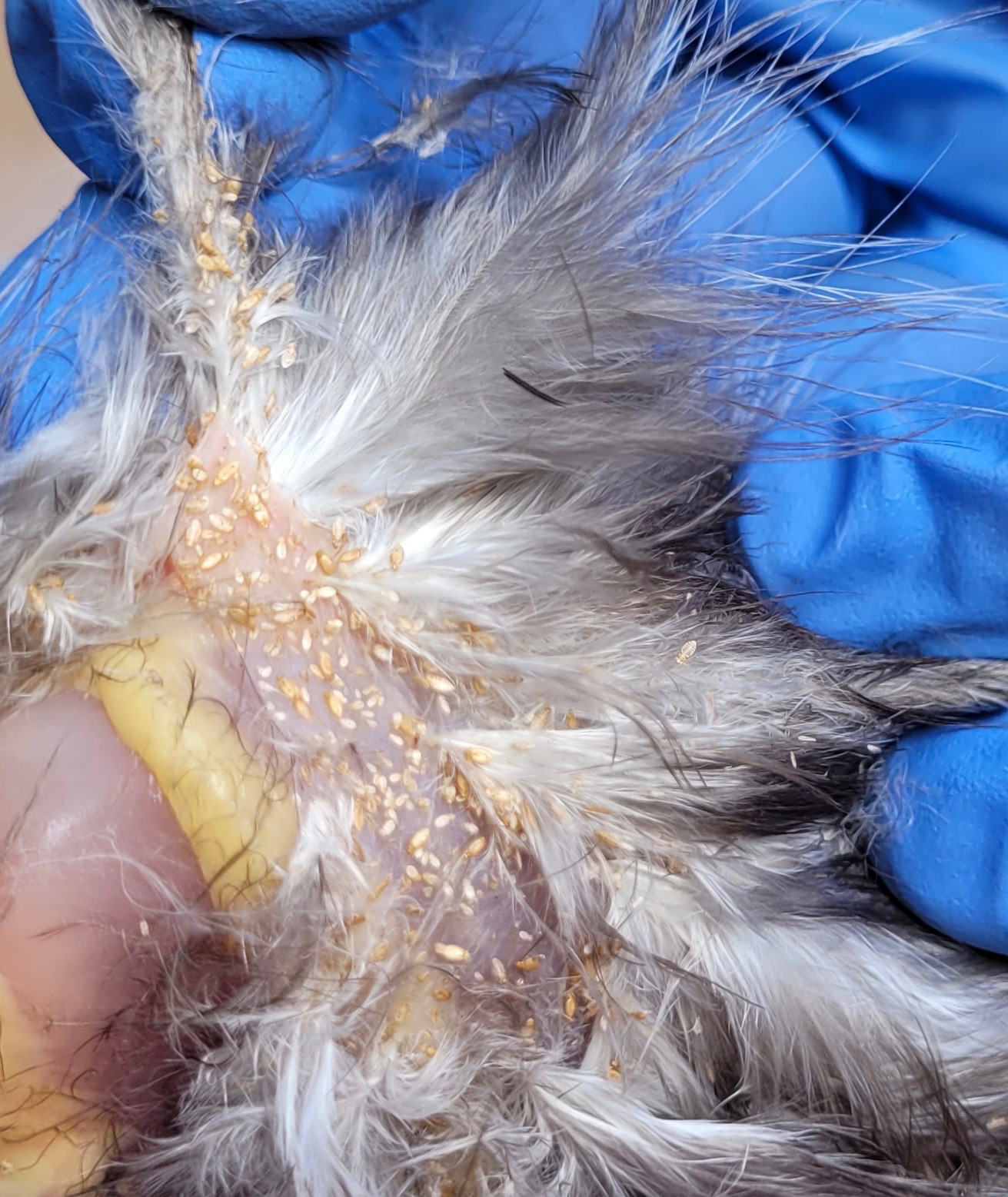
- Evidence of lice. Dr Bowes was excited to show me this, I was not so enthusiastic. This is often a sign that a sick bird is not dust bathing enough to keep external pests in check.

- Spleen, liver and lungs appeared normal
- Ovaries had regressed, indicating she was out of lay
- Kidneys looked good with no visible lesions
- Crop was clean
- There was a decided skunk-like smell that was unusual (origin unknown)
- The heart had pale edges and felt hard when cut, which was abnormal
- On cross-section there was no ventricular dilation at the heart
- Endocardium was pale with areas of necrosis which would cause problems with electrical conductivity
- Calcification and hardening of the aorta (atherosclerosis)

I was beginning to think that we wouldn’t find a cause of death since most of her internal organs appeared normal, save her heart. Dr Bowes’ protocol is to examine the exterior of the body before cutting open the patient and lifting off the sternum to examine all of the internal organs, first in situ, then remove them one by one to feel and look at them from all angles.
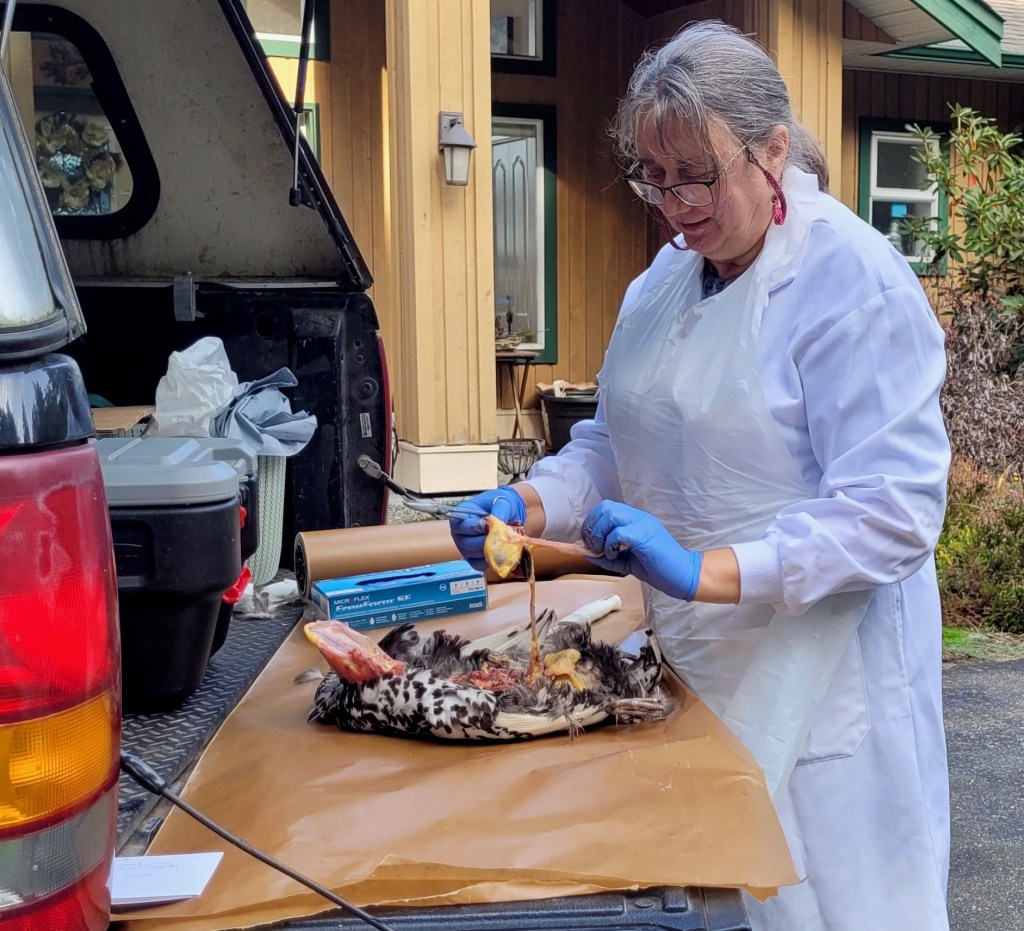
The last thing she does is look in the mouth and throat. And that’s when we hit upon the diagnosis.


A large amount of yellow stuff filled her mouth and had even eroded into her jaw, the telltale signs of trichonomosis (canker). The protozoal infection would have impacted her ability to eat and drink. Dr Bowes suggested that it would have taken three weeks or more for it to have developed to this stage.
Daisy, Barnyard Mix Hen, 26 months old
When you have a flock of a couple dozen birds it’s not always easy to spot subtle signs of illness. By the time I realized Daisy was sick she was on death’s door; in fact, she died overnight without me having time for any kind of intervention.
Physical exam found:
- Body condition was poor
- Scaly leg mites

- The liver and heart were normal
- The ovaries had regressed, indicating she was out of lay
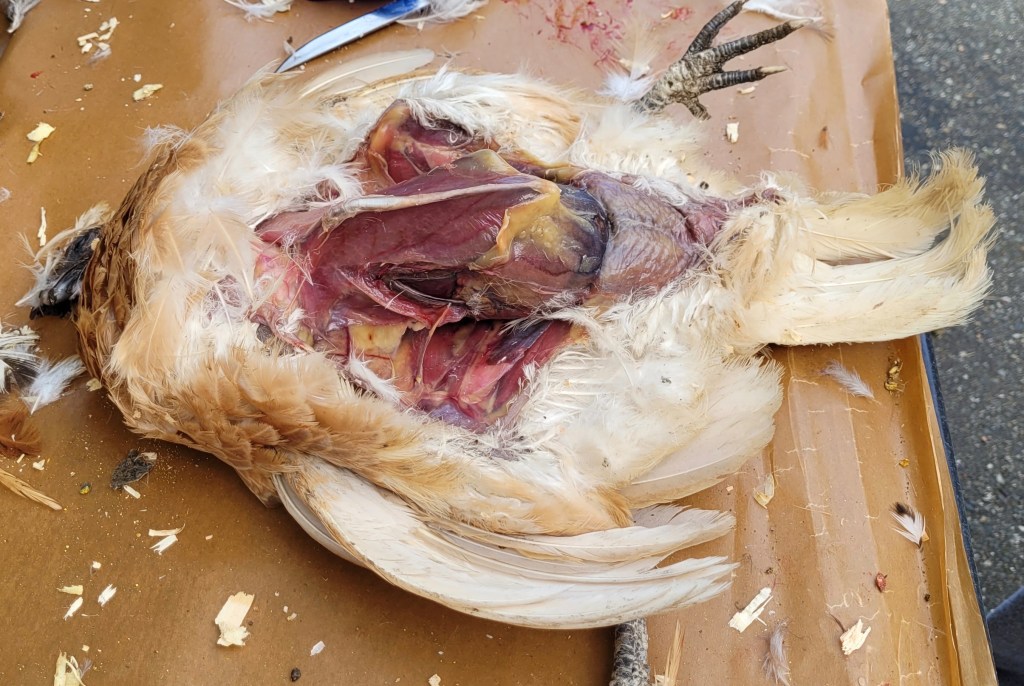
- Lots of evidence of salpingitis (bacterial infection of the oviduct) with peritonitis (inflammation of the peritoneum)
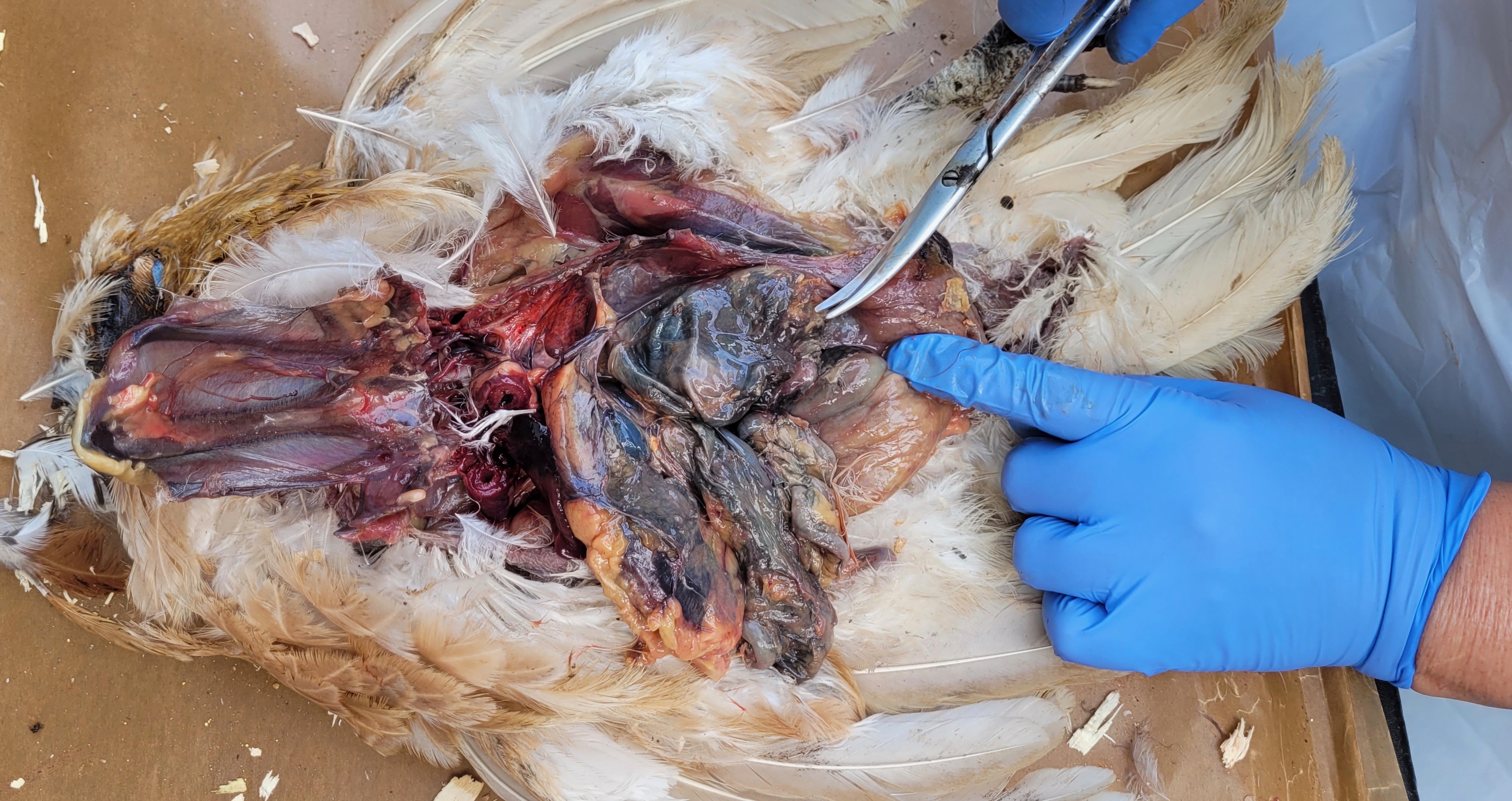


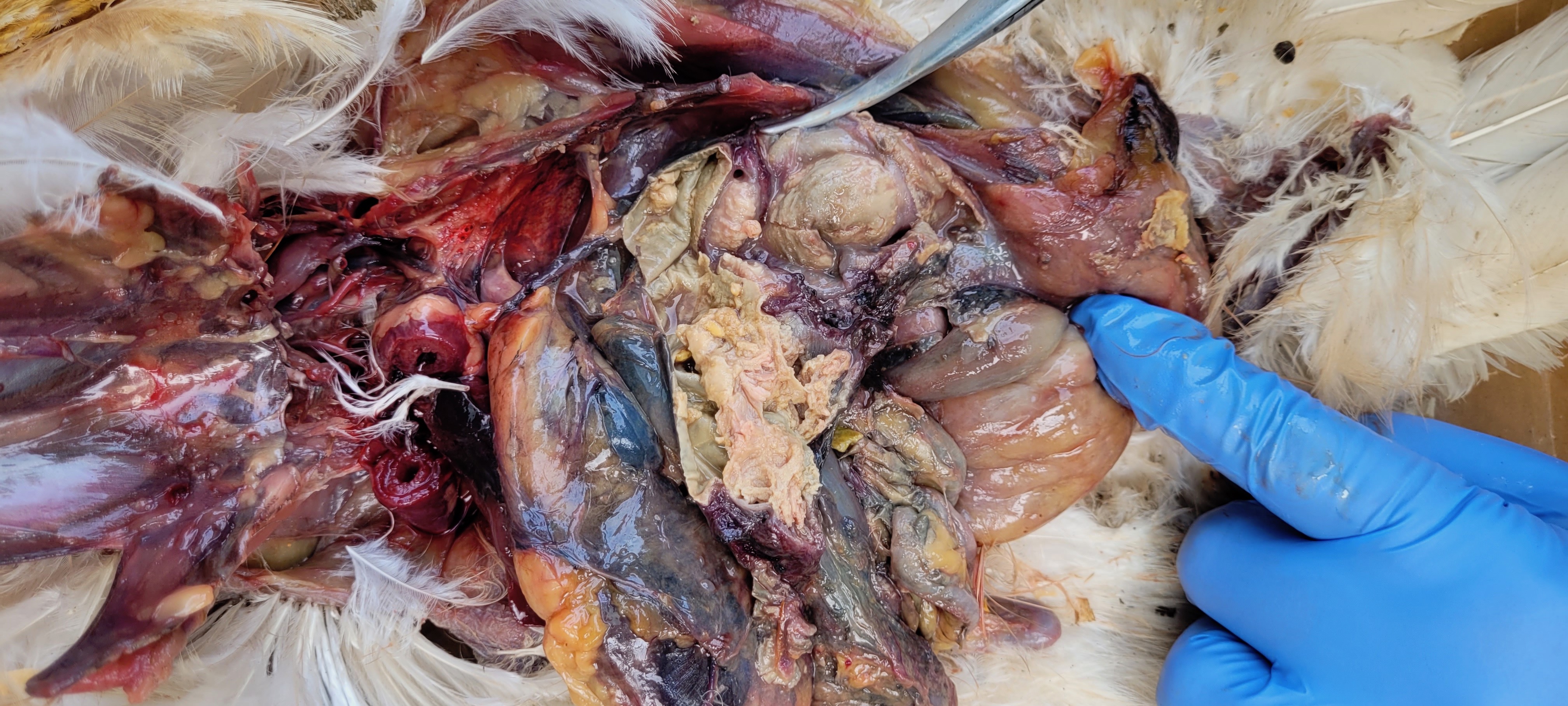
I’m used to seeing salpingitis involving laminations of bacterial infection and egg material. This appeared more diffuse and globular. Dr Bowes suggested that if Daisy had survived longer we may have seen a more typical presentation of ‘lash egg’.
FYI: Don’t be alarmed by her dark tissues, it is not a sign of illness. She was 25% Silkie, a fibromelanistic breed in which black or darkened skin and tissues is normal.
And here is how my day ended: I always put dead birds (and window strike birds and rats killed in snap traps) out for our resident ravens, eagles and vultures. It doesn’t take them long to strip a body clean. Dr Bowes removed the heads of the two birds that had canker (one of mine and Tracy’s rooster) to avoid any possible transmission to wild birds.

Once again, my appreciation goes out to Dr Bowes for generously sharing her time and expertise to further my knowledge of small flock health issues. I try to pass on everything I learn hoping to improve the overall health of small flocks everywhere.
 Bitchin' Chickens
I’m glad you mentioned Daisy had some silkie in her because I was waiting to read what may have caused what looked like necrosis. Thanks again for the interesting cases.
LikeLiked by 1 person
Kudos to you for looking out for necrosis. Stay tuned for more to come in the next few weeks.
LikeLike
Aw, it can be hard when we lose a bird. I’m sorry about that, but grateful you share with us so that we can learn.
I think it’s lovely that you give them back to the Earth and the wild creatures we share it with – Alicia
LikeLiked by 1 person
I know for some folks it may seem disrespectful giving my birds up for food, but it seems a waste to bury them. The ravens swing by daily to see if we’ve put anything out for them (cracked eggs, dead rats etc). We really enjoy that they’ve made our place part of their territory. We’ve also have had eagles and turkey vultures scavenge dead deer and chickens.
LikeLike
Thanks for posting. I wish I had such a wonderful teaching vet nearby. Very educational thank you both, Sue
LikeLiked by 1 person
I consider myself very fortunate that Dr Bowes has been so generous with her time and knowledge.
LikeLike
This site has really helped me out. I’m not a vet but have had many years of working with vets. Now that I’m working at a private homestead as a general manager, I care for about 30 chickens. I necropsy 95% of the ones that die and nothing is typical to me. So I research and find photos that match mine and based on those, I make a diagnosis. I am so happy to find you and now subscribe. It is very exciting that someone else considers necropsy so essential. Thank you!!!!
LikeLike
Thanks for the feedback. If you’re ever stuck on a diagnosis send me some photos and notes about symptoms and I’ll show them to Dr Bowes.
LikeLike