
I met Seleta over three years ago when she contacted me for advice about one of her sick hens. Unfortunately I wasn’t able to help, but that was the start of our online correspondence about small flock health issues.
If your memory needs jogging, Seleta hit the headlines in 2020 when her hen, Blue, became the first chicken in the world to undergo heart surgery for Patent Ductus Arteriosus. Never one to be shy about inviting folks to collaborate with me, I asked if we could present a case study featuring Blue. What followed were cases on one of her hens with pica eating disorder, another who was egg bound and required a spay surgery to save her life, as well as a hen with ILT. She even wrote a post about her great room turned into an aviary for her house chickens and her birds’ adverse side effects after being treated with Fenbendazole.
I enjoy hearing from her, but sometimes a bit of dread creeps in because despite Seleta’s best efforts her flock has experienced a number of health issues – many of them far from run-of-the-mill and often requiring expensive specialist care. This one doesn’t disappoint in that regard.
I doubt there are many chicken owners as dedicated as Seleta and her husband who have spent considerable amounts of time, money and energy to care for their flock.
What is Infectious Laryngotracheitis?
The virus was first identified in Canada in 1925 and was the first major avian viral disease to have a vaccine.
Like, Coryza, ILT is a highly contagious upper respiratory tract disease in chickens caused by the ILT virus (ILTV), also known as Gallid herpesvirus 1. The incubation period after exposure is 6-12 days, during which time it replicates in the mucous membranes of the eyes and trachea. The lining of the larynx and trachea are always affected, while the respiratory sinuses, air sacs and lung tissues may or may not be.
Moving Forward With An ILT-Infected Flock
I’ve been asked how things should be handled going forward with an ILT-infected flock. You will need to understand that your birds are effectively in a completely closed flock. No birds in, no birds out. No hatching new birds. Unfortunately, ILT is very contagious and it will be very important for you to practice good biosecurity to avoid spreading it from your flock into the community of other keepers. You must not allow anyone on your property who has birds of their own, nor should you take your birds out into the community. My veterinarian tries to make appointments for my birds at the end of the day or on days when they do not have any other poultry appointments scheduled. If you have to attend an event where other poultry people or their birds are present, it will be important to shower, put on clothes that have been freshly laundered, and shoes that have been laundered and disinfected before attending.
Hopefully, you are able to get the ILT into a manageable place where the birds are in latent carrier status and do not show signs of disease. It will be important to keep stressful events to a minimum as much as possible and support their health by using quality feed and potentially vitamin supplements during unavoidable stressors like moulting. With luck, you will get to enjoy your birds for many more years and they will pass away from some natural cause other than ILT. We were advised that once our entire flock is gone, we will need to deep clean and disinfect thoroughly to remove all dust, dander, feathers, and keep the property fallow of any additional birds for six months before attempting to start over with new birds. Obviously, even if you do everything correctly, there is still a risk of having another outbreak and having to start the whole process over again.
ILT Vaccines
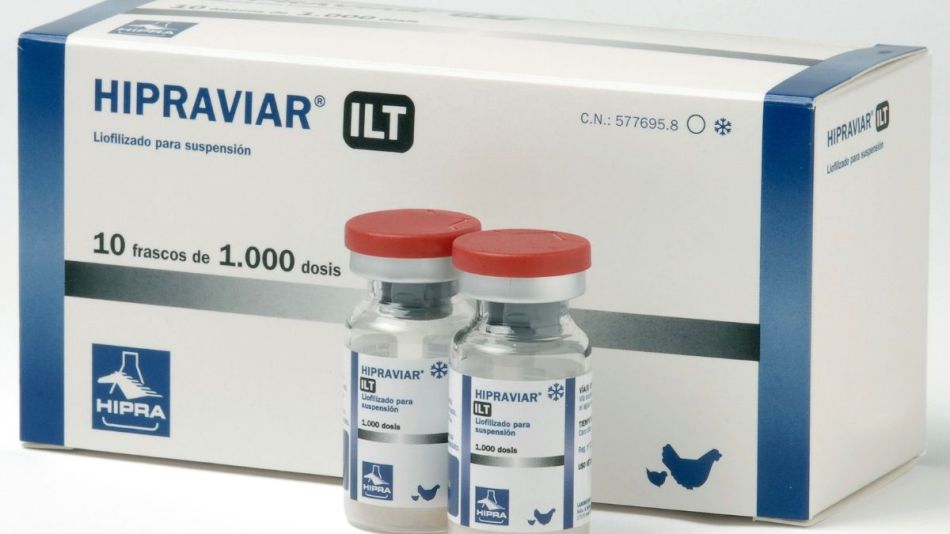
There are three main types of vaccine available for ILT; Tissue Culture Origin (TCO), Chicken Embryo Origin (CEO), and Recombinant Vectored of (rILT). TCO or CEO vaccines are live virus vaccines and will cause the vaccinated birds to shed virus and have the added risk of potentially reverting to virulence and causing the vaccinated birds to become very ill. There are currently two rILT vaccines on the market, the Vectormune FP LT +/-AE and the Innovax-ILT. The Innovax-ILT uses Marek’s disease as its vector and therefore vaccinates birds for both ILT and Marek’s, however it must be stored on nitrogen and is thus extremely difficult for the average person to store properly.
The vaccine I purchased was the Vectormune FP LT with AE. The Vectormune FP LT +/- AE vaccine uses fowl pox as the vector and vaccine can be purchased with or without the vaccine portion to protect against avian encephalomyelitis as well as fowl pox and ILT. It took me a very long time to even get a company representative to call me back. Once I did he confirmed that most distributors will not take time to speak with small flock owners because they feel it’s a waste of time. The majority of their business is commercial poultry operations that order hundreds of vials of vaccine. Regardless of who you are, they are unable to “break” a pack of vaccine to just sell one bottle. Each bottle has enough to vaccinate 1000 birds and each box contains ten vials, so I had to purchase enough vaccine for 10,000 birds to get my flock of 50 vaccine. Ugh.

Vectormune is lyophilized and can be properly stored in the refrigerator. Birds must be at least 8 weeks of age, never been exposed to, or had the symptoms of, fowl pox in order to receive the vaccine. It is administered by wing-web application. The company provided a few applicators but because I wanted to use a fresh, sharp applicator for each bird we ordered more online. Most retailers that had the wing-web applicators were overseas and it took several weeks to get them delivered. The kicker with this vaccine was that once you reconstitute a vial of vaccine, you have one hour to administer it to the birds before it starts losing stability. This is nearly impossible to do by yourself, so I had a team of me as a “holder”, my husband as a “runner”, and two of my veterinary technician friends as “stabbers”.
I had penned all the birds into small groups before my friends arrived because once we were on the clock, there would be no time to chase birds. Getting the applicator all the way through the wing web was especially tough on the roosters, even with a fresh applicator for each bird. Using an assembly line type strategy we were able to get all 51 birds vaccinated in roughly 40 minutes. The vaccine itself is bright blue and stains the feathers where the applicator was inserted. A week after vaccination, we checked for “takes” which looked like a small, raised bump where they were vaccinated which told us that the birds were experiencing an immune response.
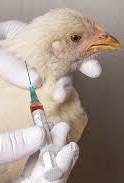
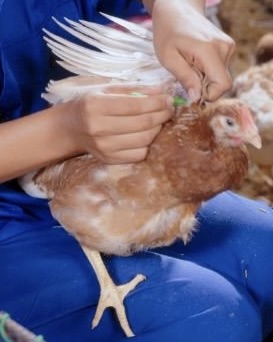
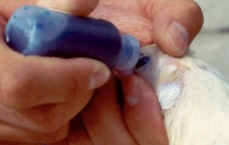
Application of ILT Vaccines (credits: Modern Poultry, unknown, University of Guelph)
Though the manufacturer only requires one vaccination to be protective, after speaking with a veterinarian, we decided to give all the birds a booster vaccine 6-8 weeks later since we were facing a current outbreak. Sadly, despite my efforts to get and administer a vaccine to everyone, we were unfortunately too late as they had all already been exposed and random testing revealed that even birds that had never been symptomatic were PCR positive for ILT.
I don’t necessarily think it was a totally wasted effort. Maybe it means that they won’t have symptoms that are as severe or maybe it will lower overall mortality. It is supposed to be protective three weeks after vaccination for ILT.
Seleta Nothnagel works nights in the Clinical Pathology Department at the Colorado State University Veterinary Teaching Hospital as a Medical Laboratory Scientist. They do blood work like chemistry panels and CBCs, urinalysis, coagulation studies and blood banking for all of the animals seen at the VTH. Before that she worked in the microbiology department in human medicine at a hospital for 10 years and in veterinary medicine as a Registered Veterinary Technician for 10 years.
Thanks to Seleta, for once again, sharing her story, used with permission.
 Bitchin' Chickens
0 comments on “Infectious Laryngotracheitis: Closed Flocks & Vaccines”