
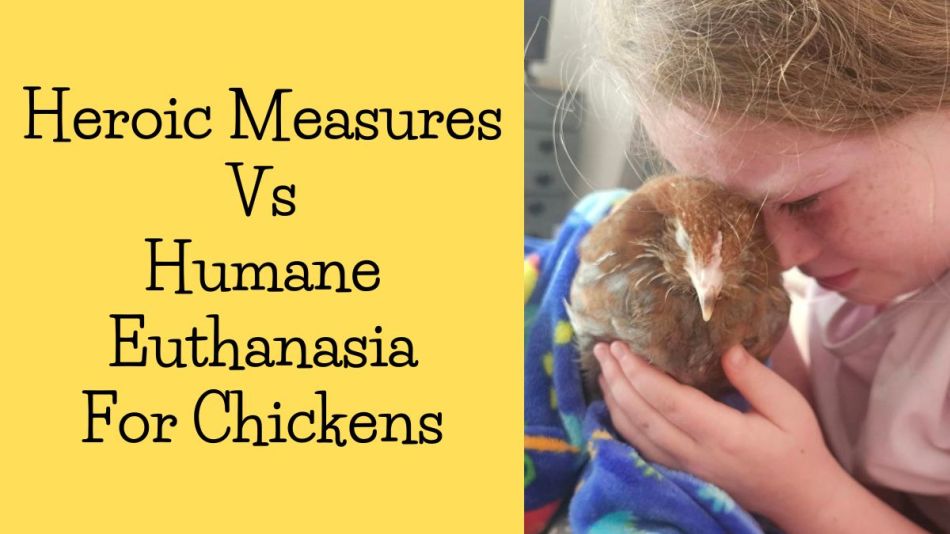
I’ve written about when to take your chicken to a vet, first aid measures and humane euthanasia before, and here I am again. It’s information that I think is important and bears repeating. I have to admit that as a small flock keeper it’s sometimes a fine line determining how much medical intervention is reasonable to administer based on the probability of the outcome.
Facebook chicken groups are full of posts, including some graphic photos, asking for advice about injured or sick birds. Here’s a sampling:
“Our naughty dog got to our baby chicks over the weekend and ripped a wing off this little girl and messed up her leg. She hobbles on her foot now but I worry she won’t be able to hold her weight as she grows. Could a one winged, one footed hen live a healthy life? She seems fine otherwise. Could she be suffering though?” (Name withheld)


Responses
#1: “It’s not the fact that she could survive and eventually heal. It’s the fact that the entire time she’s going be in agony and suffering in pain. Just because they will eventually heal at some point doesn’t mean they should have to. If you break your leg, you would eventually heal even if you never went to the doctor, but how are those months going to feel for you as it heals with no pain meds? Online chicken groups seem to miss this point when they spout stories of how they had dealt with horrific injuries that birds have recovered from.” (Name withheld)
#2: ‘Could she be suffering.’ “Are you serious? She’s been crippled and had a wing ripped off. Of course she’s suffering hugely. I can’t believe this was even a question.” (Name withheld)
Here’s another perspective from Hayy Farms:
Just because you can, doesn’t mean you should.
It’s become a common theme with homesteaders to want to fix everything: broken equipment, tattered fences, and most importantly – sick and injured animals. While veterinary medicine has come a long way in saving animals that would otherwise be a lost cause it’s equally important to make sure the animals you’re fixing have the quality of life to justify going through treatment.
Animals with severe wounds, shattered bones, serious genetic defects and organ damage are continuously being forced to undergo extreme procedures with no real quality of life on the other side, when all is said and done. They suffer through their injuries, make it through treatment and continue to suffer and struggle once the ‘healing’ is over and for what? An ego boost and the ability to say, “I did it”?
As a farmer focused primarily on welfare, this goes against everything we stand for. In order to determine whether or not an animal’s injuries or condition are too severe for a good quality of life, it’s important to use a series of standard reference points to get an unbiased perspective.
Here’s a list of official welfare criteria used by AAHA-accredited veterinary professionals from the Merck Veterinary Manual:
Pain
- showing signs of pain
- vocalizing more frequently than usual
- separating themselves from other animals
- showing tenderness in areas, limping, or otherwise standing in an odd posture
If so, are these things temporary and fixable? (If not, euthanasia is likely a kinder choice.)
Appetite
- avoiding or losing interest in food
- struggling to eat on their own
- require being hand-fed, force-fed, or tube-fed
If so, are these things temporary and fixable? (If not, euthanasia is likely a kinder choice.)
Hydration
- struggling to stay hydrated on their own
- difficulty drinking or swallowing
- require subcutaneous or IV fluids to sustain them
If so, are these things temporary and fixable? (If not, euthanasia is likely a kinder choice.)
Hygiene
- trouble defecating
- struggle to avoid sitting or lying in their own excrement
If so, are these things temporary and fixable? (If not, euthanasia is likely a kinder choice.)
Mobility
- struggles to get up and move around on their own
- lost control of their limbs or a portion of their body
- requires assistance to be mobile
- struggles to get to their food or water on their own
If so, are these things temporary and fixable? (If not, euthanasia is likely a kinder choice.)
Quality of Life
- struggles to enjoy life as they were once able to
- avoiding interacting with people or other animals
- no longer displays previously regular behaviour
- struggles to partake in species-appropriate activities
- struggles through more days than not
If so, are these things temporary and fixable? (If not, euthanasia is likely a kinder choice.)
Making The Determination
If your animal struggles with any of these issues and successful care is obtainable consider them treatable. However, if your chicken is struggling and treatment is either unrealistic or not likely to improve then humane euthanasia is the kindest option to maintain proper animal welfare standards.
While animals deserve to be treated with the utmost care, there are some situations where putting them through treatment can do a lot more harm than good.
The best practice is always to put your emotions aside, gauge the severity and longevity of medical intervention, evaluate the animal based on its realistic ability to live and enjoy life during treatment and afterwards, and don’t be afraid to put them out of their suffering if the situation requires.
After all, it’s not what’s easiest for us that matters. It’s what’s best for them.
Featured photo credit: Aubrey Laundry
 Bitchin' Chickens
Let me preface this by saying that I do not have chickens. I am a faithful follower of this website because I love everything about them and think the caregivers featured here are amazing people: kind, caring, devoted beyond sense or reason and super creative in the care of their beloved pets. However, I have been stunned at some of the care diaries following severe injuries that I have read about here and elsewhere. It is comforting to know that there is a sensible and humane way to assess the situation. Thank you for continuring my education. m
LikeLike
Aw, Claire. This is a tough one for so many people. I appreciate you including the criteria, especially on quality of life.
LikeLike