
One of the wonderful things about the internet is with the click of your mouse you can find the answers to your questions on innumerable topics. Or can you? It seems to me for each post I find espousing a particular point of view you can find an equal number suggesting the opposite. It becomes a bit of landmine navigating through all kinds of advice sending you in different directions. I find this to be true on chicken sites as well with articles purporting ‘the real truth about …’, ‘the shocking effects of …’, ‘why you should never – or always …’. I think lots of us read those articles and take them as the gospel without doing our own investigating. I have always heard that cedar shavings are toxic to chickens, which surprises me as I have used them for years with no ill effects. So that got me curious about the why of it all.

When I was a kid I kept hamsters, gerbils and guinea pigs and used cedar shavings. As I recall that was the only bedding available in pet stores and they are still marketed for those animals today. I know, I know – I shouldn’t be comparing small mammals to chickens because they have different respiratory systems. Of interest though, is when you wade through articles on chicken sites about the ‘toxicity’ of cedar shavings folks often use studies in people or rats to support their arguments about the so-called ‘dangers’ of aromatic woods. Why quote a study about workers in the lumber industry inhaling potentially carcinogenic wood dust and attempt to link it to chickens?
All woods release chemical emissions – the amount and type are influenced by species, which part of tree they came from (heartwood or sapwood), and growing location. Softwoods (coniferous trees) mostly emit terpenes and aldehydes, while hardwoods (deciduous trees) are known for carbonyl compounds and alcohols. Those emissions, known as volatile organic compounds (VOCs), refer to an organic (carbon) compound that evaporates readily to the atmosphere at room temperature.
Terpenes are aromatic compounds which create the characteristic scent of many plants, such as cedar, pine, herbs and citrus peels. In nature, those terpenes protect the plants from animal grazing or infectious germs by repelling predators or acting as antimicrobials. Aromatic hydrocarbons (phenols) are what gives wood their distinctive scents and are the reason why cedar is used to repel moths and other insects and pine is a common ingredient in disinfectants. Cedar has been used to make canoes and for woodworking because it is long-lasting due to the antifungal and antibacterial properties of cedrene (a type of terpene).

Pixie Inspecting Used Shavings 
Skye On The Mulch Pile
Is Cedar Really Toxic?
I found a lot of anecdotal evidence (much of it quoting the same sources), but nothing that definitively pointed to cedar being a toxic material for coop bedding. Here’s a synopsis of what I did find:
- It is that strong-smelling cedrene, which is thought to irritate the respiratory systems of birds. Of course, any environmental stressors are not good for your flock’s immune system, but do we know under what conditions cedar might be a problem, or not?
- Studies of lab rats have shown that cedar can irritate their respiratory systems. One of the differences I can see between rodents and chickens’ exposure to the off-gassing from shavings would be that rats live on, or in, their bedding 24/7. Chickens, on the other hand, are outside 8-16 hours/day depending on the time of year and usually sleep on roost bars raised off the coop floor during the night.
- Organic compounds decrease when wood is exposed to air and allowed to dry. Most manufactured shavings are a by-product of the lumber industry which would air dry or heat treat those shavings prior to sale. And once a package is opened and shavings are spread around the floor of the coop the VOCs will further lose their potency.
- Almost all sources that declared cedar was toxic suggested using pine shavings as an alternative. The reality is pine also releases VOCs (pinene) and there is no clear data on whether it is a safe material for chicken bedding or not.
- In an article published in The Chicken Whisperer Magazine, Dr Brigid McCrea, Associate Professor and Poultry Specialist at Delaware State University recommended cedar shavings for coop bedding.
- I did find one study that concluded, “Wood-based bedding materials do not negatively affect the production potential of poultry. In addition, the antimicrobial potential of wood may help to counter the load of certain pathogens in environment of birds.” Unfortunately they didn’t clearly state whether cedar – or pine for that matter – were considered problematic or not.
- In studies in people, terpenes have been connected to psychological and physiological benefits. “Exposure to cedar wood oil was found to enhance natural killer cells’ activity in the immune system, increased parasympathetic nervous activity and decreased sympathetic activity, strongly suggesting that cedrol elicits a relaxant effect.”
My Experience
I am someone who isn’t just interested in anecdotal stories, but the science that backs our position. I see far too many folks saying “I’ve always done it this way, therefore …”. In doing an internet search I wasn’t able to come to the conclusion that cedar was toxic and should never be used as bedding.
I live on a small island off the west coast of Canada. I’m surrounded by a temperate rainforest, largely made up of Red Cedar and Douglas Fir trees. I’ve kept chickens for more than 11 years. I started off buying shavings at the local feed store: sometimes pine and other times a mix of hemlock, spruce, fir and pine. Several years ago, I reached out to local woodworkers and asked if I could have their planer shavings for my birds. I’m not picky: as long as the wood is untreated and dry I take whatever they offer: arbutus, maple, alder, fir, and yes, red cedar and lots of it.

Hens With Chicks 
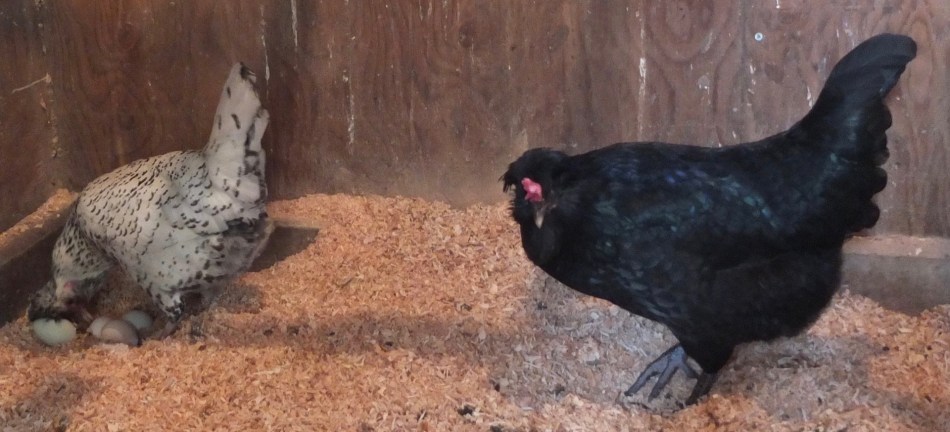
Hens In The Nest Boxes 
Sawdust On Droppings Board
I haven’t bought shavings for several years and have worked out a strategy for how I use them:
- My coop is well ventilated with 4 opening windows, some of which stay open (to some degree) year round.
- The shavings usually don’t come from freshly cut wood, but that which has been air, or kiln, dried.
- I use cedar in the nest boxes in an attempt to repel external parasites like mites and lice.
- I don’t use cedar with young chicks.
- I’m not keen on sawdust as a bedding material so that is reserved for the droppings board, which is easy to clean with a large kitty litter scoop.
- I generally try to mix cedar with another type of shavings if possible.
- I’ve never had birds with respiratory infections, but I wouldn’t advise using cedar in that instance.
Credits: Tuomas Alapeiti et al; Cambridge University Press; Chicken Whisperer Magazine; LittleChickenRacing Team.
All Photos: Bitchin’ Chickens
 Bitchin' Chickens
Thanks Claire, very informative information. Really appreciate your knowledge!
LikeLiked by 1 person
I love this post. I too, have always been told to avoid cedar and pine shavings. In an open, well ventilated area, I imagine these would be ok. I keep snakes and can’t risk them as they’re completely enclosed, I use aspen.
LikeLiked by 1 person
What kind of snakes? I’m posting a profile as part of my series ‘Having Chickens Is A Great Way To Meet Your Neighbours’ on Monday. Val used to run a reptile rescue and currently has Ball Pythons and a Rat Snakes (their photos will be in the post). Thanks for the feedback.
LikeLike
Great article! I agree. As long as there no treated chemicals in these types of woods you’re good. I’ve seen almost all used commercially and at home chicken houses which most all are well ventilated anyway, or should be in most cases. The biggest reason why it’s recommended or most folks stay away from the Cedar & Pine shavings is because in many cases the ainure may eventually be used as fertilizer, or put in composts for gardens and these woods could be harmful to a lot of different plants and vegetables.
LikeLike
Came across this and since I just moved to Gambier island, I am wondering which island off the west coast of Canada are you raising chickens on??
LikeLiked by 1 person
I’ve been on Gabriola for 21 years.
LikeLike
Honestly, it depends on the Genus of the Tree. Western Red Cedar is NOT a true Cedar, it is a Thuja. True Cedars originate from Asia and Europe and have a different chemical makeup. But you are buying Local and that’s good in your case as Western Red Cedar is used as Grilling Planks. But if you are buying bags from say Amazon where their source is unknown could be a different story. In fact, I’m researching this right now as a family member posted a story where a family lost a herd of cows to eating from a pile of cut-down cedar. The vet said they had heart attacks. (but the species of cedar is unconfirmed as is the whole story, honestly but there’s pictures so I tend to believe it).
LikeLiked by 1 person
Thanks for the clarification.
LikeLike
Wilting leaves from many trees are toxic to bovines. A good rule of thumb is, never let your bovines close to any tree trimmings, fallen branches, or felled trees till the leaves are dead.
LikeLiked by 1 person
I don’t know anything about cows but chickens seem to be able to eat lots of different plants without negative side effects.
LikeLike
Thanks, very helpful. I am a beginner in the chicken world, just setting up my coop. I have 7 cedar trees in my backyard. My coop is pine, situated under the trees, my shavings are also pine, but under the trees we have used cedar playground chips to keep the mud at bay for 20 years as nothing grows under them. I am worried about how it will affect the chickens. They will be in the coop or in the portable run in the grass, not free roaming due to my other pets and I also live on a small property on the edge of the city.
LikeLiked by 1 person
They will be fine. Your chips are outside and the area is well ventilated.
LikeLike
Came here and read it all including the comments… One thing that popped in my head was cedar construction of chicken coops. I live in the Pacific North West. Western red cedar is ubiquitous.
Found some interesting information… “Don’t confuse western red cedar lumber with eastern white cedar (aromatic cedar) shavings. Western Red Cedar Lumber is absolutely, 100%, NOT DANGEROUS TO CHICKS or FULL GROWN HENS.” https://roostandroot.com/blog/build-chicken-coops-cedar/
Enjoy.
LikeLiked by 1 person
Agreed. I live in the same region and cedar is the most common building material for houses, decks, fences and coops.
LikeLike
This is so incredibly helpful! We live on 2 acres and our kids are getting eaten alive by chiggers! We have kids, cats, dogs, and chickens. I knew I needed something safe for all, so bought Cedarcide. The site is very informative about how the spray is safe around chicks. But there’s nothing specific about the granules and we were debating not spreading them in the lawn. This makes me feel so much better. THANK YOU!!
LikeLiked by 1 person
I was told not to use Cedar in chicken coop and or in the chicken yard as it would cause Bumble foot. It hasn’t.
LikeLiked by 1 person
I’ve also used cedar with my chicks and chickens for years and have not had any issues. However, a friend that I gifted chicks to this year informed me that they all died and the vet said it was from the cedar chips. I use them to keep parasites and bugs from making a home in my coop. Again, I personally have not had an issue and my girls are happy layers.
LikeLiked by 1 person
plicatic acid?
LikeLiked by 1 person
It’s true that Western Red Cedar releases plicatic acid when cut or milled. The health issues for people seem to be associated with breathing in the dust over the longterm causing asthma. Many coops in my area (west coast of Canada) are made of cedar and people use a variety of shavings including cedar. I contend that if coops are well ventilated there is no more risk of using cedar shaving vs pine shavings (which is one of the most commonly available commercial products here.
LikeLike
Thank you for your actual research not just saying its bad because so and so said it was. I have had a hard time keeping my chickens from destroying the nest so I changed to cedar that has been dried. The first thing I noticed was they didn’t tear the nest up as quickly, they actually seemed content in them. From my experience since I live in a very rainy environment most of the year, the cedar helps to keep the eggs cleaner and I have not had any issues with my chickens. One thing I find amusing is I actually get eggs year round with only 13 hens. They do slow down a little in the winter but I get enough eggs year round for our use.
Thank you John from NC USA
LikeLike
Thanks for the feedback. I’m glad you found it useful.
LikeLike
My brother gave me a couple of bags of cedar shavings that he had shaved off while wood working. I put them in my nesting boxes and my chickens laid substantially more eggs when I used the cedar shavings compared to pine shavings. When I found articles saying that cedar shavings were toxic for chickens, I found that very interesting. My coop is a very large, ventilated, chicken tractor (movable). Anyway, very interesting article, thank you for the research.
LikeLike