
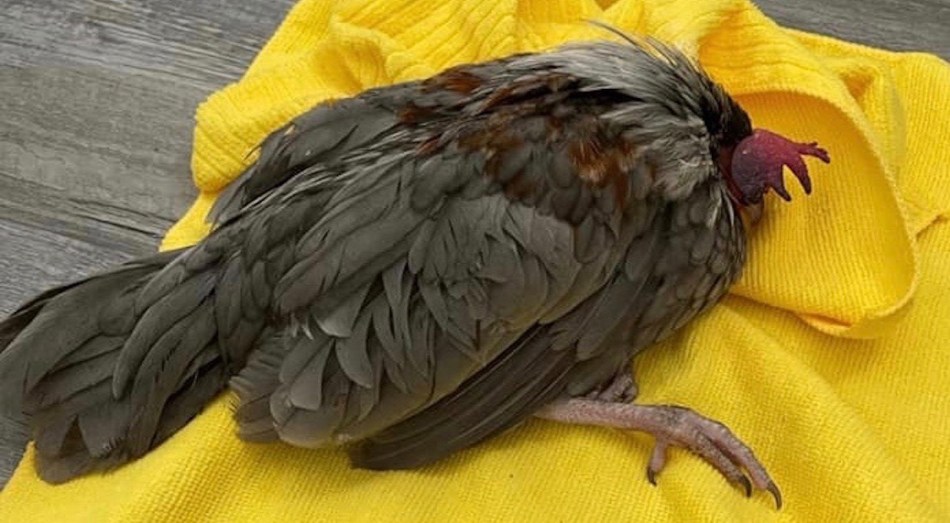
Online chicken groups are filled with requests from owners looking for help with health issues. I often see folks post videos to demonstrate what’s going on for their birds, usually accompanied by some encouraging the bird to walk in order to replicate its symptoms. Or keeping them with the flock hoping they’ll just get better on their own. If I was hit by a car or attacked by a bear the last thing I’d want is for a first responder to push and prod me and I’d definitely require some TLC.
We often think of shock as an emotional or psychological state – that is, we have experienced or witnessed something that caused extreme surprise, distress or fear. We may suffer repercussions later, but usually they are not life threatening.
On the other hand, physiological forms of shock – those that affect the body – can be critical when there is a sudden drop in blood flow. The heart is a muscle whose job is not only to circulate blood, but also oxygen, around the body. When a chicken is in shock, their organs aren’t getting enough blood or oxygen.
If you’re advised to treat a bird for shock it doesn’t mean just addressing their psychological needs, but requires dealing with their physical signs. If your bird has experienced a trauma the first hours afterwards are critical in dealing with shock. If not, it can lead to unnecessary death.
Causes:
- Predator Attack
- Injury or trauma
- Heat stroke
- Blood loss
- Severe infection
- Poisoning
- Burns and smoke inhalation
Symptoms:
- Pale wattles and comb
- Low blood pressure
- Open mouthed breathing; panting
- Cold, clammy skin
- Rapid, weak pulse
- Limp or weak
- Disoriented
Treatment:
- Always have a well stocked first aid kit
- Immediately separate your bird from the flock to avoid further injury
- Keep the patient warm and quiet
- Confine in a sick bay to prevent them from moving. The goal is to restore blood and oxygen flow to the brain and internal organs. This also allows you to monitor their intake (water and food) and output (poop)
- Deal with blood loss, injury, wounds and fractures
- Offer pain medications, if applicable
- Put electrolytes in their water. Do not force them to drink. Read this post on how to safely give oral medications/water.
- Do not feed until they are alert
Some birds may recuperate in a few hours; others may take a couple of days. Shock is the result of another condition and often accompanied by other issues such as wounds or burns. You’ll have to treat those and monitor for infection that may complicate your bird’s recovery.
Featured Photo Credit: Sandy Weightman
 Bitchin' Chickens
Under symptoms you have low blood pressure & rapid, weak pulse. Makes sense, but how do I check for those things in a chicken ? Do you have a post on those ?
LikeLiked by 1 person
The comb starts to turn blue, a sign of cyanosis- the heart not pushing enough oxygen throughout the body. Other symptoms would be dizziness or weakness.
LikeLike
Oh, I see now. That makes perfect sense. Just like people with heart failure often have bluish lips & finger tips. Gotcha. Thanks!
LikeLiked by 1 person
j’ai une de mes poules qui est rester la nuit dehors, et il gelais, le matin quand j’ai été ouvrir l’enclos et le poulailler, je l’ai retrouver coucher. Et tels en état de choc? Ou de stress? Elle ne se plains de rien, et n’a pas l’air blessée
LikeLiked by 1 person
Translation: I have one of my chickens that stayed outside the night, and it was freezing, in the morning when I went to open the enclosure and the chicken coop, I found her sleeping. And such in a state of shock? Or stress? She does not complain of anything, and does not seem injured
Is she eating and drinking? Any damage from frostbite to her comb, wattles or toes? If not, then both she and you are lucky.
LikeLike
One of my hens was left out at night in cold. She is lethargic and eyes half shut. I have her in coop with food and sugar water and on a heating pad. Anything else I should do?
LikeLiked by 1 person
She is suffering shock. Can you bring her in the house and keep her in a warm and quiet place?
LikeLike
One of my chickens was attacked by a hawk. There’s only a small visible wound. I treated for shock immediately (thank you for the advice!). It’s only been about 22 hours and she’s standing and going potty but she’s still seems detached and has a tic where she’s moving her head back and forth in a jerky manner and she’s keeping her eyes closed. It’s this part of the shock/trauma or is it more likely neurological damage? Thank you for any help and advice.
LikeLiked by 1 person
Hawks have very sharp talons that can pierce the skin. Can you find any small puncture wounds? They also squeeze with those feet so, you’re right, she may have some nerve damage. I’d keep her in a quiet dark place, make sure she’s drinking and monitor to see if her symptoms persist or change. She had a near death experience so her behaviour isn’t abnormal.
LikeLike