
More than two years ago, I formed a partnership with Dr Vicki Bowes, avian vet/ pathologist in which we get together on a regular basis to look at cases that I collect and present to her for a diagnosis, or sometimes ‘best guess’ based on the limitations we’re dealing with. Regardless of the results I always learn a lot and hope that you do as well.
Bumps On Comb
I discovered these white bumps on my 1½-year-old Silkie rooster’s comb today. Tell me it’s not fowl pox. No other symptoms; the rest of the flock is fine. – Jennifer Kennedy Arrington
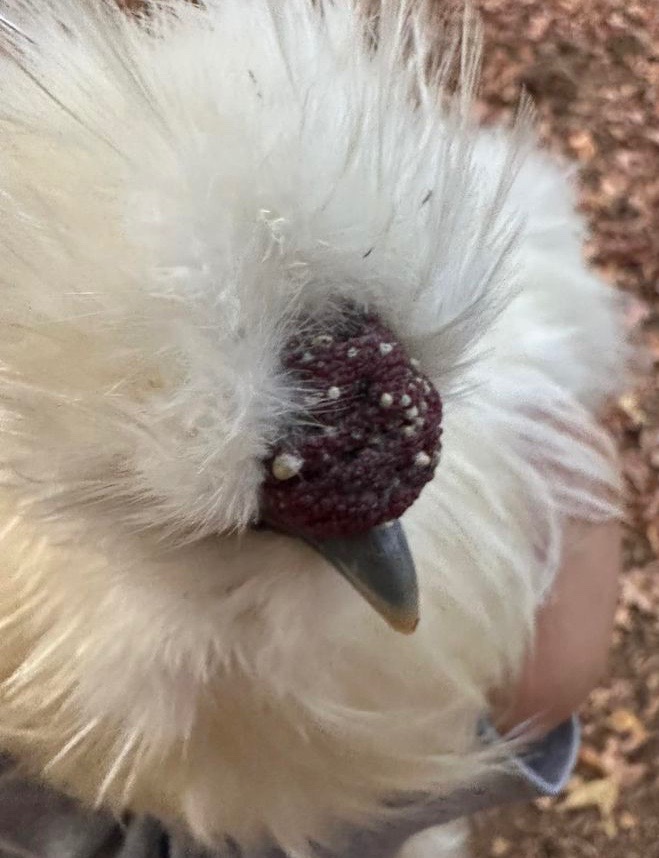
Dr Bowes: It’s not fowl pox, which usually appears as dark lesions. These are white, discrete spots that appear fungal in nature. I would treat with an antiseptic wash and an ointment with antifungal agents (i.e. Tresaderm, Panalog). If it has not improved within 7-10 days you could take him to a vet for diagnosis. Take a photo every other day to see if the spots change in size.
Misdiagnosed CRD
Meet my $1,000 chicken! She has Chronic Respiratory Disease (CRD), not contagious. She got sick in October 2022 (almost one year ago) and is still alive, much to the surprise of my vet and myself. She coughs constantly and her comb turns purple after running/high activity. Otherwise, she is happy, eating, dust bathing and is not picked on by her flockmates. No one else in my flock is sick.
To list everything in detail I have tried would take paragraphs, so I will sum it up. She has been to the vet four times and had three chest x-rays (lung x-rays are cloudy, not improved); three rounds of Denagard; two rounds of antibiotics (Clavamox 375mg bid); two rounds of antifungal (2 weeks first round and 1 month second round of Intraconozole). She did have depluming mites treated with Ivermectin. My main concern is her lung issue.
She cannot handle cold weather below 20F degrees, so she came inside overnight last winter and will likely have to continue this winter.
I think this could be permanent not treatable/curable for her. Other chickens I’ve seen with her respiratory issues don’t seem to live long, but she is happy and obviously still kicking. – Stacy Patton

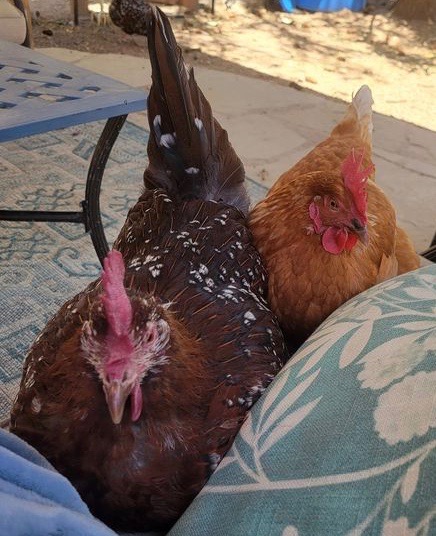
Dr Bowes: This is a classic example of shotgun treatment (i.e. throwing everything but the kitchen sink at the patient). Medications like Intraconozole are not only expensive but as an antifungal, contain toxic chemicals, which are hard on the patient.
If she had CRD – a mycoplasma infection complicated by E.coli – she would have succumbed by now. Unfortunately the X-ray is not crisp enough to read properly. Pneumonia usually doesn’t affect both lungs, just specific areas within a lung. The bronchi look clear. Her abdomen is not full of fluids. Is this a functional issue as a result of a resolved infection that has resulted in scar tissue of the pericardial sac? Heart issues can cause cyanosis (purple comb) and coughing. Pulmonary congestion can also result in fluid in the lungs (appearing as cloudy on the X-ray). I would stop treating her and allow her to live her life as is.
Potential Cancer
I found her like this last evening. It looks like where her crop should be. She’s still eating. I cleaned it with Dakin’s Solution (antiseptic), coated it with triple antibiotic ointment and gave her amoxicillin (antibiotic). – Melanie Stokes

Dr Bowes: Unless the placement in the photo is off that is not her crop. It could be squamous cell carcinoma or a skin lesion that has erupted. Your approach to treating it as a wound was commendable. Amoxicillin will work to prevent infection, but you need to resolve the bleeding. A vet could debride it and do surgery, but if it is cancer it’s guaranteed to return. If she shows no improvement in a week I would recommend humane euthanasia.
Dislocated Toe
I have a hen who has completely dislocated her toe. She’s been seen by a vet, but I just want a second opinion. The current vet has her in a boot and says to keep it on for four weeks. She isn’t using her foot at all and I’m just wondering if keeping it wrapped is the best choice. – Madison Bundren-Meyer

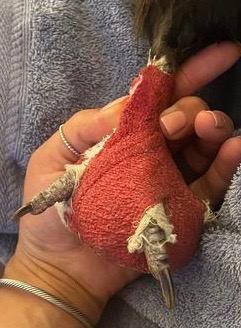
Dr Bowes: Dislocated bones are extremely painful so pain management is critical. A vet could anesthetize the hen in order to put the toe back into place. A home-based conservative approach will also work: wrap the toe, as you’ve done, and crate her for four weeks. Add extra padding under her foot to help distribute her body weight, which will allow the toe to callous over. She may end up with a limp but should be able to have a normal life.
He has Dystrophic Calcification, most likely caused from trauma. His legs started developing like this about 3 months after his spurs were removed. We’ll be doing a round of antibiotics and keeping him comfortable, no cure but managing the symptoms. The vet at Cornelius Veterinarian Clinic took X-rays and did an exam and felt it was not, cancer, gout, or lupus. – Jacki Coleman-Halstead

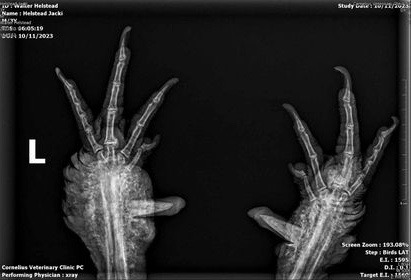
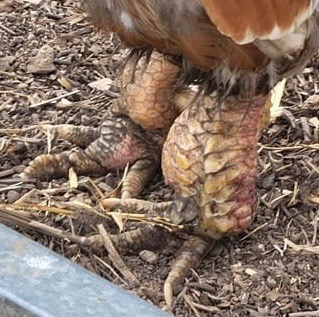
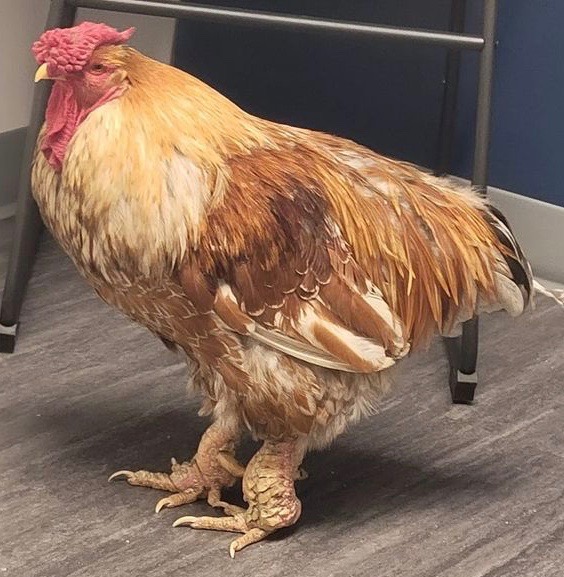
Dr Bowes: Dystrophic calcification is extremely rare in chickens and does not resolve on its own. It typically appears as a post-traumatic hard nodule under the skin and is often associated with leukemia or lymphomas. I’d like to know if his legs feel hard or soft? The cortical bone appears healthy. I’m leaning towards the diagnosis of osteopetrosis.
Bitchin’ Chickens: Dr Bowes and I took a quick internet search about information about, and images of, dystrophic calcification in poultry. The cases we found didn’t match the one above. I immediately thought it was similar to a heel spur, a bony growth caused by a calcium deposit. I have one myself, probably caused by stress on a particular part of my foot and only diagnosed through an X-ray. I’ve seen that image and it appears as a localized area – again, not like the case above.
Osteoporosis is the loss of structural bone whereas osteopetrosis (literally meaning ‘bone stone’) is caused by the abnormal growth in young birds. This is a proliferative bone condition that causes thickening of the long bones making them brittle and vulnerable to fractures. It is often associated with concurrent infection with Leukosis.
Kyphosis (photo: Jen Ruff)
Bitchin’ Chickens: I recently did a post specifically on skeletal deformities in chickens. I was pretty sure this was a case of kyphosis but asked Dr Bowes for her opinion.

Dr Bowes: I agree this rooster has kyphosis, but am curious about why he has no tail. I think an X-ray would indicate that he has further anomalies resulting in missing or abnormal vertebrae.
Well that wraps up another edition of Show & Tell With Bitchin’ Chickens and Dr Bowes. I hope that it’s been a learning experience for you.
If you’d like help with a case drop me a line using the ‘contact’ button on my home page. Remember to wear gloves, take good close up photos from several angles and supply us with plenty of information (e.g. timelines, symptoms, medications, general flock health, etc) so we’re able to more accurately pinpoint what’s going on.
Thanks again to Dr Vicki Bowes for her willingness to share her wealth of knowledge and experience to build capacity and skills in small flock keepers.
 Bitchin' Chickens
Interesting cases. Thank you once again for putting the time in to educate us all. Much appreciated.
LikeLiked by 1 person
It’s always a learning experience for me too (and sometimes even Dr Bowes).
LikeLike
Could you address at some point how best to deal with spurs? I notice that removal of spurs was named as a possible reason for a leg issue, and I see frequent comments in chicken groups about spur issues. Thanks for your pathology cases; they are very interesting, particularly today’s.
LikeLiked by 1 person
That information is in this post. Thanks for asking as lots of folks remove the spurs completely which isn’t advised. https://bitchinchickens.com/2020/10/22/chicken-pedicures-trimming-nails-spurs-beaks/
LikeLike
Thank you so much for your wonderful site and information. I would love some help with a current issue with my rooster Juneau. About a week ago I found him lying and unable to stand on his own. I noticed very inflamed lower legs especially in the feather folic.
We placed him a soft bedding and began daily Epsom salts baths and use of antiseptic. He began to improve walking around and overall mobile. He was interested in his hens, crowing and acting quite naturally. I took him to the vet a week after this incident. They suspect Marek’s disease. The whole flock was vaccinated when purchased. The vet put him on an anti- inflammatory and antibiotics, still on them. He continues to improve exhibiting normal behaviors, still sequestered in his little area in the chicken run until the meds are finished.
I would love to have a second educated opinion. I have progressive photos of the issue but not sure where to attached.
Thank you again for all the help you are sharing and your kind approach to roosters.
LikeLiked by 1 person
Thanks for the feedback. There are many symptoms that mimic Marek’s Disease (that aren’t Marek’s). If he is improving or at least, not declining, then I wouldn’t suspect Marek’s. You can use the ‘contact’ button on my homepage and I will give you my email in order to send photos.
LikeLike
Can I ask about why Tresaderm was recommended? It is well-known that dexamethasone can cause systemic toxicity in avian patients (possibly leading to hepatomegaly among other problems) and profound immunosuppression. Tresaderm also contains Neomycin which can be irritating to some animals, and it is an antibiotic. If the suspected problem is fungal, would it not be wise to do cytology and confirm a fungal infection and then treat with a more appropriate, targeted therapy?
LikeLike
I will admit this advice is out of my wheelhouse. I will ask Dr Bowes for an explanation and will update the post with her response.
LikeLike