
I’ve always been nervous to attempt euthanizing a sick bird in case I screw up and cause undue suffering, both theirs as well as my own. I’ve been fortunate to have friends that have stepped in to help, but it really is an essential skill for any chicken keeper to have.
I recently participated in a humane euthanasia workshop led by Dr Vicki Bowes, DVM/avian pathologist. As newbies, we weren’t let loose on live chickens. We practiced on four-week old meat birds that had been euthanized in a CO2 (carbon dioxide) chamber just beforehand. We were then given a deceased bird to practice cervical dislocation on without being concerned about inflicting pain on the birds if we didn’t get it right the first time.
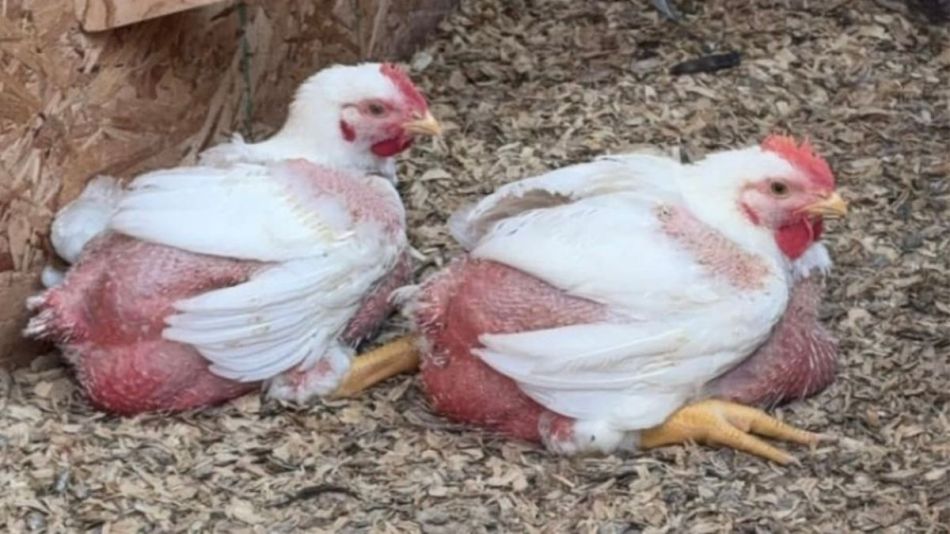
I have no direct experience with meat birds and was pretty appalled, as were the other participants, by the sorry state of the subjects of our workshop. The eleven Cobb broilers, at only 29 days old, were almost ready for butchering. The ones we got were clearly culls that the farm were happy to sell off. As someone who is used to curious and alert chicks these young birds were totally inactive and made no attempt to stand or explore the confines of their crate. They were missing belly feathers. One of them had viral arthritis affecting its legs and another had one grossly swollen leg. They sat in their own poop, unable to stand or walk around.
This breed, and others such as Cornish cross, are your typical rotisserie chickens found in many grocery stores. They’re what most of us have eaten without really knowing their origins and the sad lives they lead in order to put a meal on our plates.
Now’s your opportunity to learn about broilers – the chickens that never get to retire, never get to live their best life scratching in the sun, and honestly, never even make it to their first birthday. These birds are the muscle-bound bodybuilders of the poultry world, bred to turn chicken feed into chicken nuggets as fast as biologically possible. But where did they come from, and why are they such a mess?
How the Broiler Was Born
In the 1940s, chickens were basically dual purpose homestead birds. You’d hatch a bunch, eat the roosters, keep the hens for eggs, and call it a day. But the Great Chicken of Tomorrow Contest in 1948 changed everything. Sponsored by A&P grocery stores and the USDA, this nationwide breeding contest aimed to create the ultimate meat chicken: fast-growing, plump-breasted, and cheap to raise.
Enter the Cornish cross, a hybrid that still dominates the market today. These birds are the freaks of the chicken world: abnormally muscular, with a growth rate that would make any 1950s farmer’s jaw drop.

The Fast and the Fragile
Here’s the catch: when you breed for speed, you don’t get endurance. Modern broilers hit butcher weight in about six weeks – which is basically toddler age in chicken years – but that super-speed comes with a buffet of health problems:
- Leg Issues: Their bodies grow so fast their skeleton can’t keep up. Cue limping, splay leg, or complete inability to walk by week 7.
- Heart & Lung Problems: Broilers are notorious for sudden death syndrome and ascites (fluid around the heart and lungs). Imagine being a bodybuilder with a heart the size of a hamster’s.
- Skin Troubles: Breast blisters and hock burns from spending too much time lying down on litter.
- Boredom: If they live past slaughter age, they get restless and start feather-pecking or eating way too much. Some people have to ration-feed them so they don’t literally eat themselves sick.
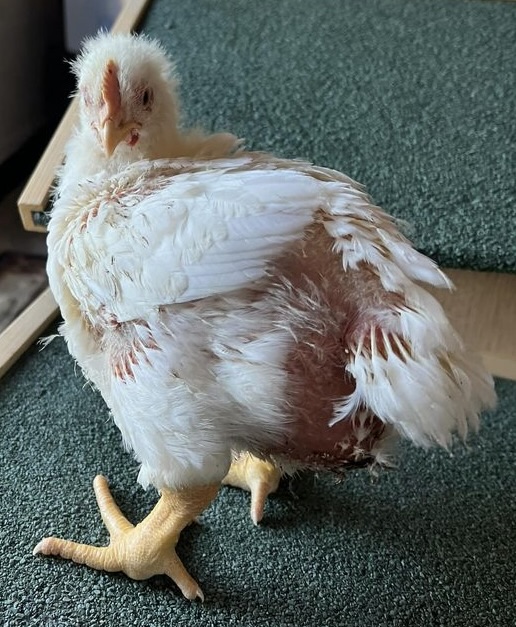
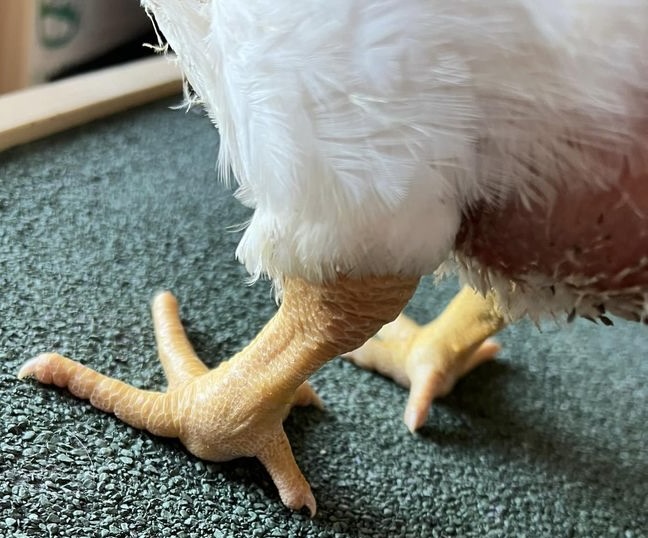

Ascites (water belly) is very common in Cornish cross. They are mutants whose bodies have been pushed to accomplish unimaginable growth in record time, and their hearts and other organs just can’t keep up. It’s a sorry breed, a feat of human accomplishment and a clusterf**k of animal misery. – Didi Hatcher
Backyard Broilers
Plenty of homesteaders raise their own broilers, and with good reason: they grow quickly, taste great, and you know exactly how they were treated. Judging from my brief experience with those meat birds I’m not sure how you would raise them humanely. If you do keep them it means adjusting expectations:
- Give Them Space: These guys get big, fast. A cramped pen just means more leg problems.
- Manage Their Diet: Free-choice feed 24/7 is fine for a few weeks, but after that, they need rationing so they don’t overeat.
- Watch the Heat: They run hotter than heritage breeds – literally – so good ventilation is a must.
Can You Rescue A Meat Bird? (Desiree McEntire)
I feel like all the people that support trying to keep a meat bird alive have never been obese or had health problems relating to it. Or have an understanding of how biology affects the body. Or, at the very least, if they have been obese, they lack the empathy to relate the discomfort, pain, and health problems they’ve dealt with to a chicken. Otherwise they would know what a painful existence it is and would know better than to try to force a meat bird to live a normal life. Imagine being so heavy you have to be carried? Do you think there’s no pain associated with that?! No amount of spoiling will ever be enough to counteract the bird’s genetics.
I strongly do not recommend trying to keep this bird as a pet. While I know a rare few do it, it’s hard to manage, and if you are unsuccessful it means pain, suffering, and death for the bird. NOT worth it and just selfish. Even those that are successful will eventually lose the bird to an unnatural death. They will not live a full, natural life even with “proper” strict care. Their organs aren’t developed to support their unnatural size so, at best, they’ll die of a heart failure before the natural life expectancy of a chicken because their heart can’t keep up with the physical demands. I hate that these birds exist and I hate that the general public has access to them because too many unsuspecting pet chicken owners don’t do enough research and accidentally end up with a bird that’s not meant to live past eight weeks. It always ends up bad or worse. Either the owner is sad and/or the bird ends up suffering. Did I mention I hate it? Even when I processed for meat, I only ever used dual-purpose breeds. I would never buy these even to stock up on meat. It doesn’t bother me that other people do as long as they know what they’re getting into because at least their meat birds are treated better than the commercial poultry industry birds. But I still think the breeding of these birds is grossly unethical. – Desiree McEntire
The Future of Meat Chickens
There’s a growing movement to slow things down. Heritage meat programs, slower-growing hybrids like Freedom Rangers, and welfare-focused breeding initiatives are starting to gain traction. They take longer to raise but have fewer health issues and more natural behaviour. If you’ve ever had a pastured, slow-grown roast chicken, you know the flavour is worth the wait.
Final Thoughts
Broilers are a miracle of modern breeding, but also a cautionary tale about what happens when we push biology to its limits. Whether you raise them yourself or just want to know what’s on your plate, it’s worth remembering that these birds were designed for one thing: speed. If you are looking for a more ethical option try dual purpose and slower growing poultry.
References
- United States Department of Agriculture. Chicken of Tomorrow Contest Records, 1948.
- Kestin, S.C. et al. “Prevalence of leg weakness in broiler chickens and its relationship with genotype.” Veterinary Record, 1992.
- Julian, R.J. “Physiological, management, and environmental triggers of ascites syndrome: A review.” Avian Pathology, 2000.
- Shepherd, E.M. & Fairchild, B.D. “Footpad dermatitis in poultry.” Poultry Science, 2010.
- Dixon, L.M. “Slow and steady wins the race: welfare of slower growing broiler breeds.” Animals, 2020.
- The Livestock Conservancy. “Raising Meat Chickens Humanely.”
- North Carolina State University Extension. “Small Flock Management: Broilers.”
- Compassion in World Farming. “The Chicken Welfare Problem.”
- University of Guelph Poultry Welfare Centre. Reports, 2022.
- Smithsonian Institution Archives. “The Chicken of Tomorrow.”
- National Chicken Council. Animal Welfare Guidelines, 2024.
Featured photo credit: Sheila Juricic
“Backyard chicken keeping, unfiltered and unapologetic.”
 Bitchin' Chickens
I’ve chosen to free range my meat birds the last few years I’ve raised them. It’s a wonderful thing to see them do. They love their grass and feeling the sunshine. Actually, I’ve spoiled each flock of meat birds I’ve raised. IMO they deserve to be treated just as well as “regular” chickens. When you treat them well you see their little personalities, too.
LikeLike
This is a very interesting article. My husband and I have raised meat birds one time. We kept thinking we were doing something wrong because of the bare skin showing, no feathers. We did all the things you talk about, and we butchered at 8 weeks. From 5-8 lbs. they were huge! But I never realized all the health issues. This has been very eye opening.
Kelly
LikeLike