
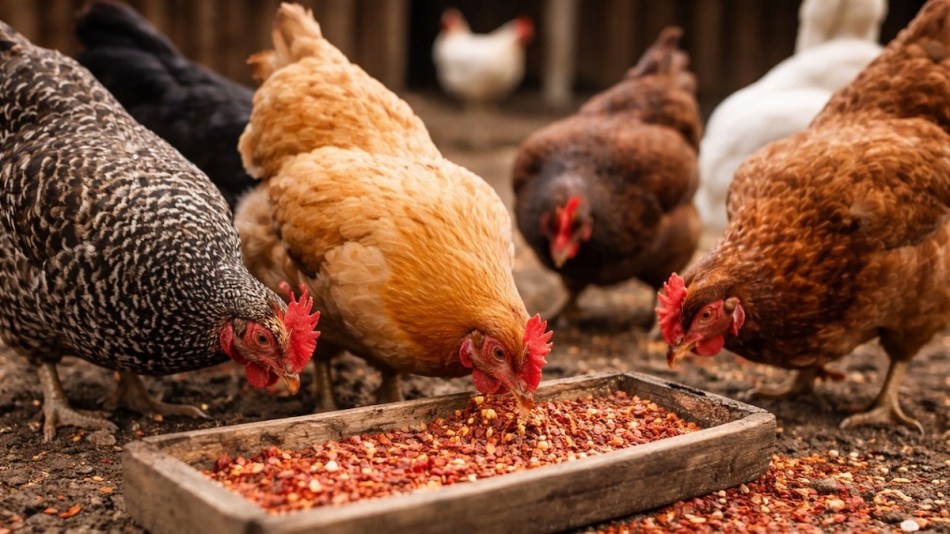
Crushed red chilli pepper, known for its spicy heat, comes from a variety of capsicum peppers, which start off green before ripening into an orange-red to deep dark red colour. The most well-known cultivars – jalapeños, serranos and anaheim chillis – are used to make crushed red chilli pepper.
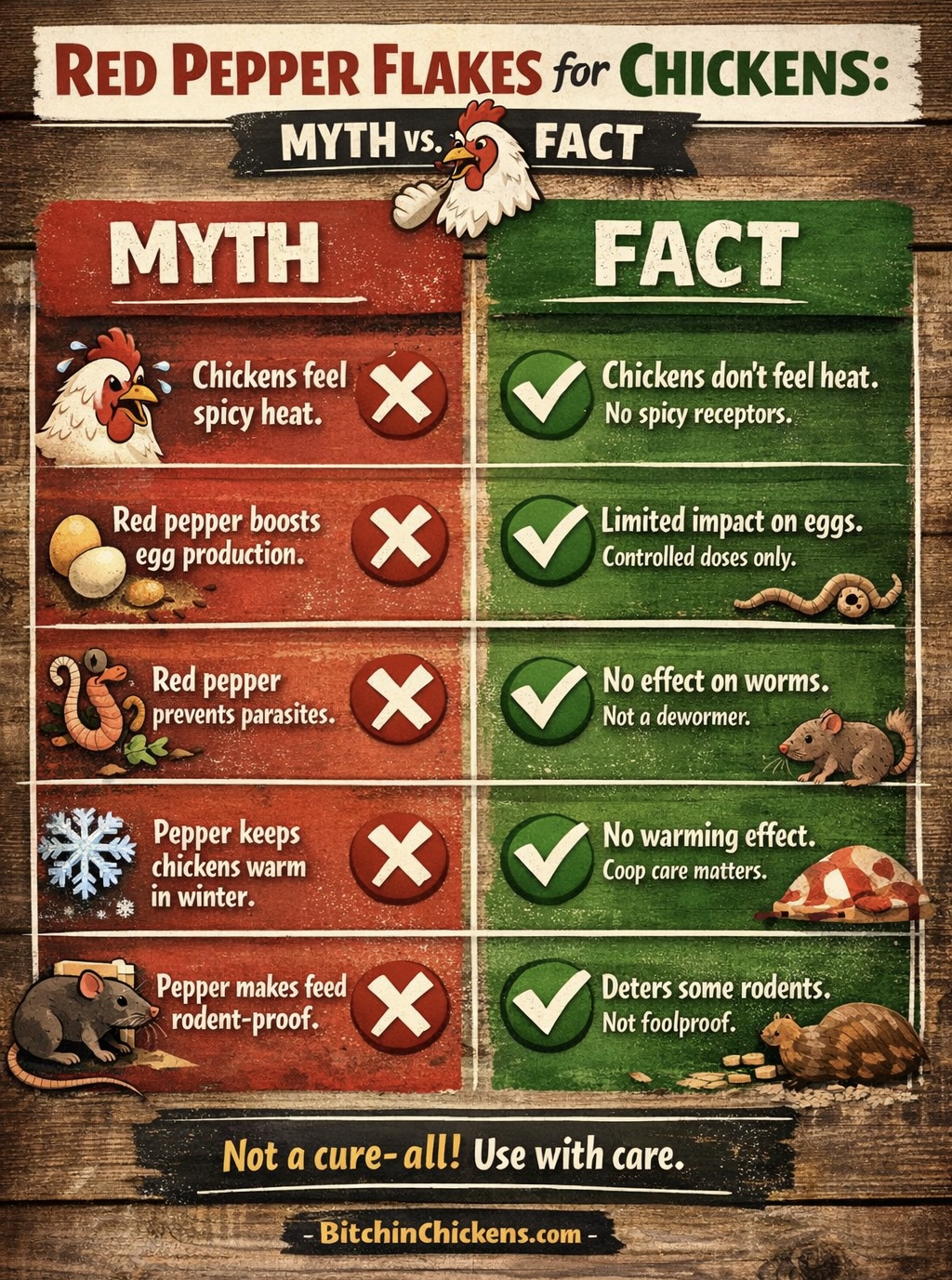
Red pepper flakes are often touted in online chicken groups as a panacea for many poultry issues. Supposed benefits range from increased egg production and parasite control to winter warmth and rodent deterrence. But what actually holds up under scientific scrutiny?
Myth: Chickens Benefit From The “Heat” Of Red Peppers
Chickens do not experience spicy heat. Birds lack functional TRPV1 receptors, the sensory receptors that make capsaicin feel hot and painful to mammals. This is why wild birds readily eat chilli peppers and disperse the seeds, while mammals avoid them.
Myth: Dramatically Boosts Egg Production
Some poultry studies using measured capsaicin or pepper extracts show modest improvements in laying performance, egg quality metrics and antioxidant status. But here’s the catch: These are controlled trials using standardized dosages and not handfuls of grocery-store red pepper flakes. Backyard use is inconsistent and unlikely to reproduce lab results.
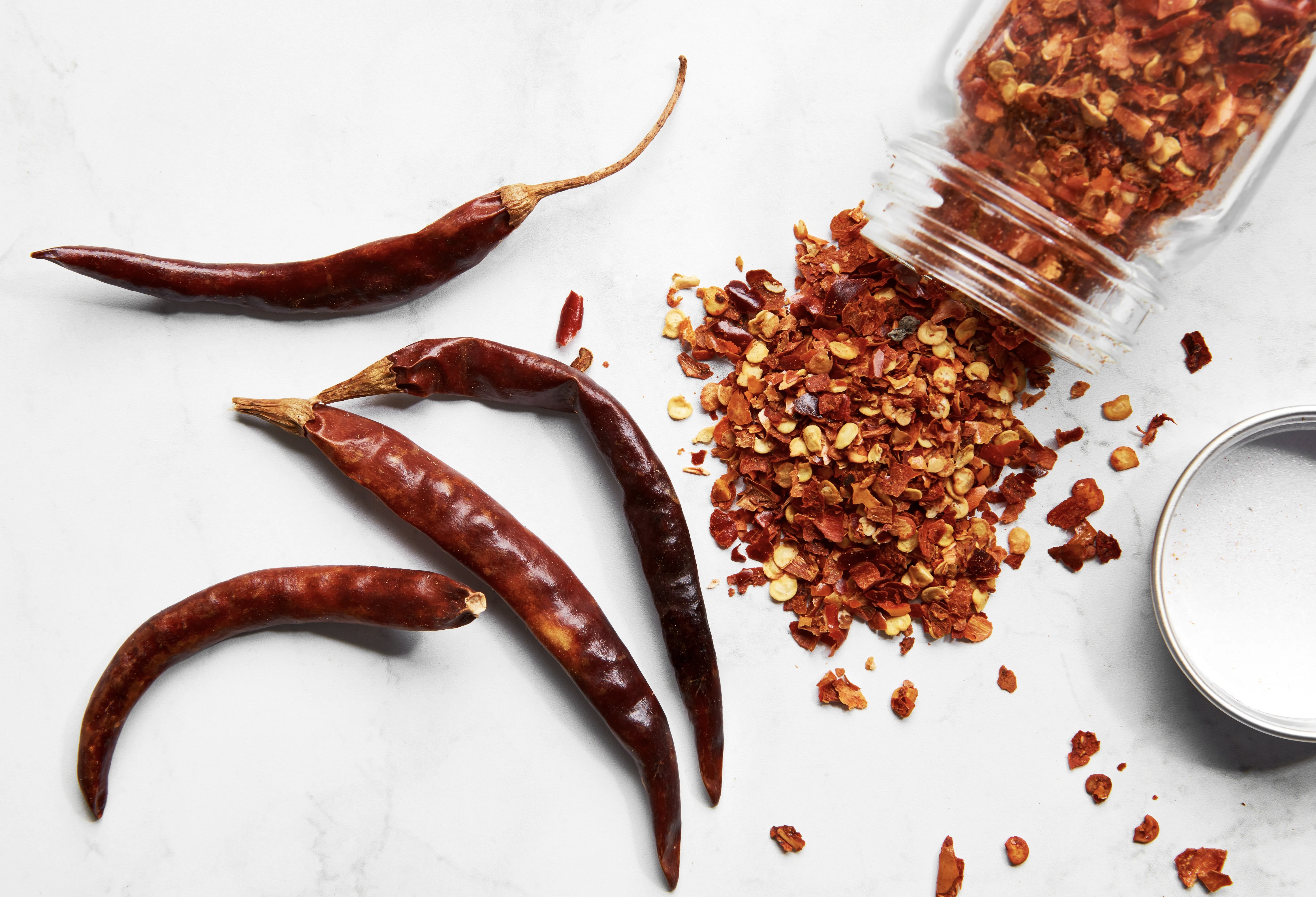
Photo credits: Unknown; Epicurious
Myth: Produces Darker Yolks
Any yolk-colour change comes from carotenoid pigments, not capsaicin. Red peppers contain pigments similar to those in marigold petals and alfalfa.
Results depend on quantity, pigment concentration and overall diet. A pinch of flakes here and there may do nothing noticeable. Colour comes from pigments, not spice power.
Myth: Internal Parasite Prevention
There is no solid scientific evidence that feeding red pepper flakes prevents worms, treats internal parasites or replaces deworming or fecal testing.Capsaicin has antimicrobial properties in lab settings, but that does not equal parasite control inside a living chicken. Pepper flakes aren’t an effective dewormer. Don’t skip real parasite management.


Myth: Keeps Rodents Out of Chicken Feed
Rodents are mammals and mammals do hate capsaicin. Research shows capsaicin can reduce rodent feed consumption. Chickens eat it just fine; rodents avoid it. However it won’t stop determined rats. Poor feed storage still attracts pests.
Myth: Keeps Chickens Warmer in Winter
There’s no evidence that capsaicin raises body temperature, improves cold tolerance or heats chickens from the inside. Warmth comes from calories, feather condition, dry, draft-free coops and proper ventilation.
“It Can’t Hurt, So Why Not?“
Most poultry research uses precise doses. Random supplementation can mean inconsistent intake, unknown exposure levels, and potential changes in feed acceptance. Small amounts are generally considered safe, but unnecessary supplementation is still unnecessary.
What science supports:
- Minor gut health and antioxidant benefits at controlled doses
- Possible egg quality support in formulated feeds
- Some rodent deterrence benefits
What science does not support:
- Parasite prevention
- Cold-weather warming
- Guaranteed egg production increases
Red pepper flakes aren’t harmful, but they carry few positives. Most benefits are subtle, context-dependent, and often exaggerated online.
Peer- Reviewed References
Abdel-Latif, M. A., et al. (2023).
Capsaicin supplementation improves antioxidant status, immune response, and laying performance in hens. Animals, 13(2), 250.
Al-Kassie, G. A. M., et al. (2006).
Influence of red hot pepper (Capsicum annuum) on reproductive performance of laying hens. International Journal of Poultry Science, 5(9), 842–846.
Srinivasan, K. (2016).
Biological activities of red pepper (Capsicum annuum) and its pungent principle capsaicin. Critical Reviews in Food Science and Nutrition, 56(9), 1488–1500.
Mason, J. R., et al. (2003).
Capsaicin-treated feed reduces rodent consumption without affecting birds. Crop Protection, 22(1), 27–31.
Jordt, S.-E., et al. (2004).
The capsaicin receptor: a heat-activated ion channel in pain perception. Nature, 427, 260–265. (Referenced for mammalian TRPV1 function and avian insensitivity.)
Klasing, K. C. (2007).
Poultry nutrition and immune function. Poultry Science, 86(6), 1043–1050.
“Breaking down chicken science, one cluck at a time.”


Thank you for the clarification!
LikeLike
When will you be completing your PhD? Very informative. thank you. m
LikeLike
If I hadn’t been steered away from science I might have gotten a degree in that field. As is, my Honours BA is in Cultural Anthropology & Women’s Studies. My neighbour went on to get both a Masters and a PhD after she retired. Having just turned 65 I think my days of formal training are over but I’ll continue to learn – and share – more about chickens.
LikeLike
Thank you for clarifying the truth! Much is spent on these products. I won’t buy anymore!
LikeLike
And thanks for the feedback.
LikeLike