

Understanding your chickens’ digestive system will help you navigate any problems that might affect it. Avian digestive systems are different from ours: their food travels from their beak through the esophagus to the crop: the holding area where food is moistened, stored and sorted, then sent on to the equivalent of our stomach. In chickens, that consists of two parts: the proventriculus, where easily digested food is processed by acids and enzymes; and the gizzard, which deals with food that requires breaking down with muscular contractions and grinding grit. Processed food then moves into the small intestine and the remaining digestive tract.


The crop is located on the right side of the upper chest. If it is firm it is full. A healthy full crop should be about the size of a plum, full at bedtime and empty in the morning. The first time new chicken keepers see a full crop they often go into panic mode because it looks like a large lump on one side of a chicken’s breast. A full crop at night is a good thing; if it’s still full in the morning that’s cause for concern.
Various crop issues can affect digestion, which can be serious, or even life threatening. Typical symptoms include: weight loss, lethargy, turning their head from side to side, pasted vent, increased thirst, decreased appetite and isolation.
Sour crop: Occurs when the crop empties slowly, allowing food to sit, ferment and develop a yeast infection (candida albicans). The crop feels large and squishy, not firm. You may hear gases or gurgling if you touch it. I don’t have a great sense of smell, but if you do, your bird’s breath might smell bad.


Impacted Crop: An impacted crop will be firm and large like a tennis ball, may be tender to touch and does not empty overnight.
In either case, your chicken may look ‘off’ and lose weight. An impaction may also affect the gizzard, where you can’t see the blockage.
Possible causes of sour crop and crop impaction include:
- Eating long grass, hay, straw, wood chips, sand, or foreign objects such as string, rubber bands or plastic
- Recent antibiotic use
- Bacterial or fungal infections
- Diseases that slow down the movement of the gut, such as Marek’s disease, egg yolk peritonitis, or lead poisoning
- Damage to the gut from swallowing metal objects, or having intestinal worms
- Eating moldy food
I’ve only dealt with crop issues once. I noticed my hen, Bif Naked, had difficulty flying up to the roost bars one night. I did a quick physical exam and didn’t find anything worrisome. In the morning, when her crop should have been empty, it was still full and felt squishy.
I separated her so I could monitor her input and output. I gave her water, grit, yoghurt and added apple cider vinegar (ACV) to her water (you can also put Epsom salts in their water).
I tried tipping Bif forward and massaging her crop upward in an attempt to get her to vomit whatever was there, with no success. You need to do this carefully so your bird doesn’t suffocate, or aspirate the contents of their crop into the lungs.

After a couple of days of that regime things didn’t get better, but worse. Her crop was now feeling hard. The most common treatment is to gently massage the crop to assist emptying it. Sometimes that works immediately; in my case it didn’t.
I repeated the massage morning and evening. I carefully syringed a small amount of olive oil into her mouth and also gave her small pieces of soft bread soaked in olive oil, in the hope they would act as a lubricant. Still no joy.
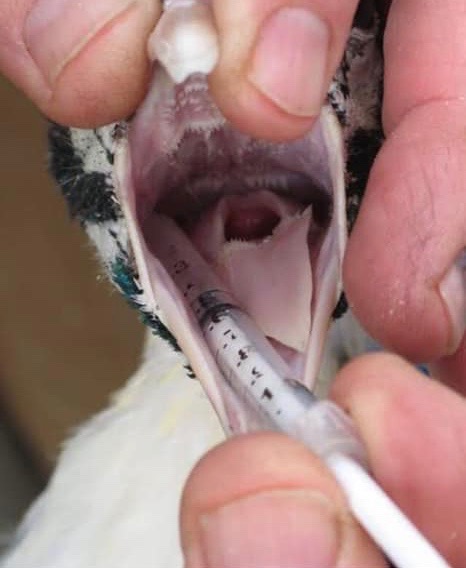
At some point you have to make a decision about your bird’s future prospects if there is no progress. Bif was affected for about ten days: during that time I had tried all the recommended remedies. I was about to throw in the towel when, during one of my massages, I felt a popping under my fingers. Somehow I managed to break the encapsulated impaction and by the next day she had turned the corner.
I later learned that I could have given her Monistat, an over-the-counter product, which is used for vaginal yeast infections. Cut one suppository into 1/3 and give orally once a day for a week. You can also give .25 cc Monistat cream orally twice a day for a week.
If the crop is severely impacted the only option is surgery. Some folks are willing to go that route and if you are, I strongly advise you to take your chicken to a trained vet who is experienced and will provide anesthetic. I don’t recommend at-home surgery for dealing with impacted crop.


Pendulous Crop
Damage to the muscles can occur from a previously impacted crop. Pendulous crops are initially treated by giving water only for 24-48 hours to allow the crop rest. It’s recommended to reintroduce regular food with plenty of grit afterwards. Treats, seeds, scratch, fruits and vegetable consumption should be avoided until the crop has returned to normal functioning.
I’ve only twice seen a pendulous crop: it appears enlarged and flops from side to side when the chicken is moving. In both cases, these hens were living with long-term pendulous crop – one of them for three years. Both seemed to be functioning normally and had no further issues related to their condition. You can buy or make a special bra to support a pendulous crop.


Promoting Crop Health:
- Feed your flock plain yoghurt with active bacterial cultures to help promote good gut bacteria.
- Provide prebiotics and probiotics to their diet, especially if they have recently been treated with antibiotics.
- Provide access to grit at all times.
- Add apple cider vinegar (1 tablespoon per gallon) to their water supply, which helps balance pH levels. (Use plastic waterers, vinegar will cause metal ones to rust.)
- Avoid feeding human food which contain sugars.
- Be aware if your birds are eating long grasses, straw or hay.
- Routinely worm your flock.
- Clean up your yard of any foreign objects that chickens could potentially ingest. You can use a magnetic sweeper to remove metal bits.
- Always have fresh water available in clean containers.
- Avoid feeding moldy foods.
- Do routine health checks on your birds, which include running your hands over their crop.
 Bitchin' Chickens
Your articles are so informative. Always seem to save every one. And I love that you have a chicken named Bif Naked. 🙂
LikeLiked by 1 person
Have you ever heard of using papaya or magnesium citrate to help with impacted crop? One of pullets that was recently given antibiotics for a respiratory infection has developed an impacted crop. There’s no sour smell so I’m guessing just impacted. I tried massaging and trying to get her to vomit but it didn’t work. I have done that successfully on another bird— her brother actually. I saw her brother eating feathers two days ago. Both of them appeared to have impacted crops yesterday. This morning I confirmed by removing the food from the coop at night and checking their crops first thing this morning. The cockerel had only a nickel or quarter sized lump this morning. But the pullet still has a huge crop. I gave .25 mL olive oil this morning. At noon I offered some fresh papaya and administered some magnesium citrate with water. I’m going to try to make her vomit again in a little while. I may try the Monistat tomorrow if this doesn’t work.
LikeLiked by 1 person
No, I haven’t used them as treatments but I would be curious as to why they work. I’m always looking for alternatives to pharmaceutical solutions. I’d try to avoid vomiting your pullet if possible because of the risk she might aspirate. Just gently massage her crop in an upward motion. Good luck.
LikeLike
Papaya has enzymes that are supposed to help digest and break down what’s in the crop. Magnesium helps with relaxing muscles and is supposed to also help empty the crop.
LikeLiked by 1 person
I think I’ll do a little research on that. Thanks for the suggestion.
LikeLike
Hi! Thanks so much for this article, it’s really helpful. I have a young hen who I believe has pendulous crop – I’ve treated her with the usual regimens for sour crop, it hasn’t improved but she’s still acting fine. I’m going to try the Monistat regimen – which specific product do you recommend? I see the suppositories with applicators, but am not sure what to get. Any help would be really appreciated, and thanks in advance!
LikeLiked by 1 person
I used both Monistat and Canesten but there are generic brands. You can ask the pharmacist if they are interchangeable. If so, they are often less expensive then the big name brands. If she has pendulous crop it’s about lack of muscle tone and it may be unnecessary to treat her for sour crop, especially if she seems just fine. Have you tried putting a crop bra on her?
LikeLike
Hi! Thank you so much for all your research & articles. I have a chicken who may have sour & possibly also impacted crop.
We have been out of town a few days & our friend was watching our place. When we left, our chicken Eggbert seemed just fine, other than a tiny bit of poo on her back feathers. I got back last night & noticed today that her comb is very flopped over & she is listless. I picked her up and felt her crop (this was at about 3pm) and it was pretty large & hard, especially compared to the other chickens. I felt her body/abdomen and she felt extremely underweight, like skin & bones.
I followed instructions for giving her some olive oil (which she ate happily on her own -seemed very hungry). I massaged her crop for a while & it felt more squishy than hard that time. I caught a whiff of her stinky breath which makes me think she has sour crop & not impacted? We will know better in the morning if she’s been able to digest at all.
I went to check on her after she’d gone in the coop & she really seemed unwell – puffed up & eyes closed & the first one to bed. She’s usually the last in the coop! My main concern is how listless & skinny she is.
Any advice?
LikeLiked by 1 person
I would do as you suggested: withhold food and water overnight and monitor if her crop has emptied or not. Stinky breath is a sign of sour crop so you can treat for that. If she is thin it’s a sign that she hasn’t been eating enough/not absorbing nutrients. Was she eating and drinking normally before you left? What is her poop like?
LikeLike
So we waited a couple of days and withheld food. She was able to poo a little bit, weird kind of slimy green (like grass). We know she had gorged on grass before we left, so we were pretty sure she had both sour & impacted crop. I called & consulted with a vet, who sent me Nystaten and walked me thru how to fix impacted crop at home. It was clear she wasn’t improving and was obviously worsening. I got further consultation from a vet of how to do impacted crop surgery from home. We decided to do it as safely and cleanly & painlessly for her as possible. It actually went very well and her wound is healing nicely.
We’re giving her Nystaten because she still has sour crop infection. We briefly gave her antibiotics after the surgery to reduce risk of a second infection, but now we think the antibiotics are hurting more than helping. She is still pretty weak. we are continuing with Nystaten in hopes she’ll gain her strength back and fight off the rest of the sour crop. Her poop has been pretty clear & watery because she isn’t eating enough and is mainly drinking water. I hope she pulls through.
LikeLiked by 1 person
Thanks for the update, that was a pretty dramatic remedy. I’m surprised a vet recommended you attempt the surgery yourself, but good for you giving her a chance. If you are finished the course of antibiotics and there is no sign of infection I’d start her on probiotics. Do you have photos of the procedure or what you removed from her crop?
LikeLike
It did feel like a strong response, but given our situation at that moment, it was our best option. The vet wasn’t like “oh yeah go for it!” He was cautious but supportive & gave us the info we needed. We did not take any pictures – we had our hands full! But the cut was surprisingly clean (very little blood, we were careful to avoid cutting through veins) and she stood surprisingly still while we cleaned her crop. The actual procedure took us about 45 minutes, but we spent about 3-4 hours learning, preparing, and cleaning up from the procedure. We found a ton of grass, and pockets of whole foods that she hadn’t been able to digest for at least 10 days, so they were fermenting. We feel good about being able to empty her crop – she needed the help. The sewing up went well, too and her wound is healing well. No signs of infection. Good idea to start on probiotics.
All of that said, I agree that I would NOT recommend doing the procedure at home. It’s not easy and does take a fair amount of preparation, care and knowledge gathering. I watched several videos online from other people trying to do this procedure, and that’s where I learned what NOT to do, by watching other people’s mistakes. Trying this remedy really depends on the animal owners’ level of interesting in doing a thorough, deliberate, pain-minimal job, and that is not for everyone.
But this blog has been a super helpful resource, so thank you for maintaining it!
LikeLiked by 1 person
Thanks for the feedback and thanks for sharing your experience. Hopefully that’s your first, and last, at-home surgery.
LikeLike
They do stand still because they are prey animals, it has little connection to how much pain they are experiencing though. 😓 I don’t think any significant medical procedure should be attempted without pain medication. I’m glad she is well and survived the ordeal though.
LikeLiked by 1 person
Dear Anonymous did your chicken recover?
LikeLiked by 1 person
Good morning,
Just read through your article as I have been dealing with a number of crop issues here this past several months. I do have a feeling it might be something sinister like Mareks but if that is the case then there isn’t much one can do. This is a recount of the issues I have been dealing with.
The first was a hen that had a watery crop with I tried to correct, she unfortunately passed away. FYI she was not vaccinated for Mareks.
I then had a 12 week old pullet pass away, her crop just would not resolve either, and she just didn’t thrive. Again not vaccinated.
Another hen I was able to resolve and she seems fine now other than a large mass in her abdomen, she’s perky and running about, tail up and eating well, crop emptying by morning. Not vaccinated for Mareks.
A fourth hen had a hard crop which after a couple weeks of my massaging and giving Ducosate Sodium to help break it up it just wouldn’t give. This girl is vaccinated for Markes, having purchased her from Peavey Mart (Hoover Hatchery chicks, they offer vaccinated chicks).
As a trained Nurse I figured I had nothing to lose doing a crop surgery as I was sure it was packed with hay and such, so I gathered scalpel, saline for irrigation, syringes, dissolving sutures (for the crop), and regular suture for the skin. I used a topical numbing agent for the skin. The skin was about a 2cm incision horizontal, and the crop about a 1cm vertical incision (you can always make the incision bigger, but holy cow it’s hard to make it smaller!). Then I started extracting the material from her crop using a pair of tweezers with ‘teeth’ – as I suspected it was packed with hay which the horses had kindly dropped over the stall doors for them. There was also long green grass in there. This all took about 45 min, one doesn’t want to pull to hard or too fast and causing further damage to the crop. Anywho – it’s been 3 weeks and she is putting weight back on and once again back to be in a cheeky chook. One thing I should warn people who may think of trying this is to be prepared for the most ‘fowl’ smelling material to be removed.
Now I have another hen (Flopsy) with a crop issue, the sister to the first hen, I noted yesterday morning she has a full watery crop that didn’t go down overnight, I also noted that she had lost weight from the previous week when I told her ‘you have some heft to you girl’. Now she’s just so thin – in a week or so to lose so much weight and now the crop points to some serious issues. But I figured I would pop some Clotrimazole into her which I had luck with the one hen. I went to pick up Flopsy and she regurgitated copious amounts of brown liquid, to say I was freaking out is an understatement. I set her down and she stood up stopping the flow of fluids, this is very serious as the bird can very easily aspirate and develop pneumonia. I let her settle down a bit, then carefully picked her up so I could dose her with the Clotrimazole, settled her in the Hen House next to the IR heater for the night. This morning her crop is still full, but she did come on out and pick at some of their morning mash. I am considering draining her crop of the fluid using a Gastric tube, help relieve any pressure on it, give it a rest.
All these crop issues though after the years I have had these chooks makes me worry – is this Mareks? who knows, only a Lab test would confirm, and really if it is what can I do? It’s too late to do any vaccinations, separate the sick birds is the only thing that I could do and realistically would this be preventing any further issues? Not likely. So I deal with the issues as they crop up (pun intended), and hope for the best, which is what any of us can really do.
LikeLike
Crop issues can be a symptom of a number of issues, including Marek’s Disease. I’ve had MD in my flock that has not presented as crop stasis (slow to empty). Do you have access to a service that does necropsies on chickens? That should give you a definitive answer as to what you are dealing with.
Like with most pathogens keeping your birds healthy and avoiding stress goes a long way to staying asymptomatic, even if they have been exposed to MD.
Kudos to you for taking on surgery (not something I would recommend for the untrained). I’m crossing my fingers that you took photos of the process. If you need help you can drop me a line using the ‘contact’ button on my homepage.
LikeLike
Once again, a very helpful and informative post on sour crop. Is there an egg withdrawal for the use of Monistat? Thanks, Corinna
LikeLike
I don’t know of any withholding period, probably because there’s no study of it’s use in chickens. It’s an antifungal and the recommended remedy by vets so I think it’s safe with no egg withdrawal.
LikeLike