
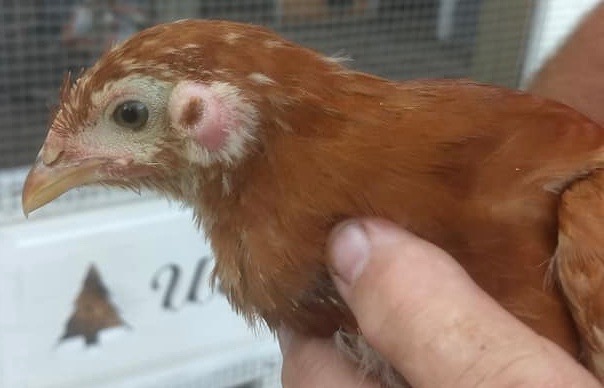
We’re not accustomed to thinking of birds as having ears because we don’t see them. They do have ears and sometimes they get infected.
Just like ours, their ears are used for both hearing and balance. The three components are comprised of: an external part, which is hidden by a tiny clump of stiff feathers; a middle part with an air filled tympanic cavity; and an inner part, a complex structure with the membranous labyrinth.


Ear infections can affect any, or all, portions of the ear.
Inner ear infections (Otitis interna): The inner ear, the sensory receptor for both sound and balance, consists of the cochlea and a vestibular organ. The chicken’s inner ear is considered to be a part of their nervous system and helps with balance. Inner ear infections can cause neurological signs in affected chickens, in the form of head tilt, loss of coordination and balance, and wryneck. They are most likely caused by a viral infection and are much more difficult to treat.
Middle ear infections (Otitis media): The middle ear is an air-filled tympanic cavity containing a muscle, ligaments, the tympanic membrane, the cochlear window and a rod-like bone (ossicle) known as the columella. Middle ear infections are usually caused by a chronic bacterial infection or tumours. These infections tend to be difficult to treat as many of the pathogens are considered to be opportunistic and highly resistant to antibiotics.
Outer ear infections (Otitis externa): Inflammation of the external ear may be caused by bacteria or fungal infections. Symptoms include: scratching their ears or rubbing their head, red swelling around the ears or head feathers matted with discharge.
Ear infections in chickens are often referred to as Ear Canker (unrelated to protozoan infection Trichmonosis, known as oral ‘canker’).
Canker can be caused by various bacteria, including E.coli. (Not all strains of E.coli are pathogenic, hence the great number living in the lower intestines of poultry and other animals.)
The bacteria causing ear infections are opportunistic pathogens that take advantage of birds with compromised immune systems. They are often prevalent in the environment and spread through contaminated feed, water and droppings.
Bacteria enter the body through the infundibular cleft, which is located in the roof of the mouth. It is situated behind the chonal cleft, a larger opening leading directly to the sinus cavities.

The infundibular cleft opens directly into the auditory canals of the ears. The canals are semi-circular in shape and lead to the external ear opening. It is in these canals that the infection takes hold. If left unchecked, it will eventually protrude from the external ear opening.


Symptoms
- Matted head feathers
- Rubbing, scratching head
- Swollen ear lobes
- Head shaking
- Tilted head
- Discharge from ear
- Wry neck
- Loss of balance
- Yawning
- Decreased crowing
Treatment
- Use Q-tips and hydrogen peroxide to gently clean out any build up from the external part of the ear. A small amount (i.e. a couple of drops) of peroxide helps to soften debris in the ear and will make it easier to remove. Just like with people, do NOT push the Q-tip too deep or you may make the situation worse. If you have an avian vet you can take the extracted material from the ear for identification.


- Medications include corticosteroids and antibiotics (gentamycin, amoxicillin and the fluoroquinolone). Many, but not all pathogens related to ear infections, have become highly resistant to most antibiotics, so be careful to get the correct diagnosis and use the meds according to the instructions.
Featured Photo courtesy of Darren Rohr; additional photos courtesy of Backyard Chickens.
 Bitchin' Chickens
I have a hen with an ear infection like this. It is protruding out of her ear and is really big. I have been battling it for months. I got it flush with her ear but was never able to remove the entire thing intact. Do you have any suggestions?
LikeLiked by 1 person
Can you take a sample of what you’re getting out of her ear to the vet? They can do a culture to determine what bacteria is causing the infection and then prescribe the appropriate medication. Good luck with her.
LikeLike
Try a small cerumen spoon, it works for me , be very gentle and patient. Try getting behind the wax mass
LikeLiked by 1 person
Have you tried applying some Vaseline to help remove crusted area?
LikeLiked by 1 person
I just got mine out on the first try- all in one piece!
I used a q tip dipped in melted coconut oil and rubbed around the outer part of the solid mass. Left it (left the oil on… not q tip) and came back an hour later. Got my daughter to hold the chicken wrapped in a towel. I spend about 4 min dipping a q tip in oil and rubbing around the outside near the skin again-this time sometimes times pushing gently on the skin next to the mass hoping it would allow the oil to get more in the crack between ear and mass or even push it out. At one point I noticed a section of the mass moved a little.
I grabbed a little metal thing… like what the pedicure people use to clean under your toe nails and very gently rubbed against the hard mass starting near the skin to see if it would pry loose. It was a little difficult at first but then it broke free and a large solid mass of white puss was behind it. I stopped and ran for tweezers in hopes not to separate the mass.
I used the tweesers to grasp the hard part and it came out in one piece. There were a few small bits of white puss just inside the opening and I VERY gently tried to rub that out with the metal toe nail cleaner thing-she didnt fuss at all.
I used a dropper and put a drop or 2 of fresh clean coconut oil in her ear in hopes it would flush the rest out. We’ll see how she feels in the morning! It was not traumatic for her at all and the towel seemed to help her remain calm-especially when we tucked her feet in too.
LikeLiked by 1 person
Hello,
I have a turkey that has a past respiratory infection but the inner ear is clogged and been applying peroxide drops to soften it but it’s far inside were I cannot use anything to reach and barely visible, like is hiding around the corner with a little piece hanging out, I’m assuming it’s a cork like preventing healing, it’s been 8 weeks since I been treating her, my question, how would I be able to remove it with out pulling it?
By the way, great resource here, will bookmark, I’ve crawled the net on this subject during this 8 week treatment with this Turkey, not many out there.
LikeLiked by 1 person
I don’t have any experience treating avian ear issues, but I do have plenty with dogs with chronic ear problems. There are drops that you can get from the vet that dry out or soften the accumulated material making it easier to remove. Have you tried a bit of mineral oil at the end of a Q-tip? Don’t push too far or you can damage the ear or push the material in further. Or use an eye dropper to lubricate the ear canal with mineral oil. Hopefully the clog breaks up and you can remove it. Good luck.
LikeLike
I been using a syringe to administer peroxide drops in the ear during the day when I’m able to, in the evenings I been using poultry vetRX keep it soft over night, I’ve been doing this for about 8 weeks now with improvement, now it’s the material build up from drainage which has harden, and preventing her vertigo from going away, any ideas on ear solution that can break up hard/rubber like material?
LikeLiked by 1 person
Sorry, I’m not sure what to suggest. Have you talked to an Avian Vet? There must be an easier way of flushing/extracting that material out.
LikeLike
Hello again,
I’ve called our local vet and wanted me to bring her in and that’s something not possible, but for now I’ll keep looking, I’ll post if I find a solution, thanks for your help, and great blog by the way 🙂 cheers!
LikeLiked by 1 person
Good luck. If you do find a solution please post it here.
LikeLike
Did you find a treatment? I have a 19 week old cockerel whose right ear is red, swollen and protruding. It appears ear opening has healed shut at some point. I used a dental syringe to apply peroxide around opening and I could hear popping and then pus shot out. I did this several times but I can’t find an opening it’s coming from. I am convinced there is hardened pus inside. He is active, eating and drinking. Sweet in nature. How do I safely open and drain pus? Hope you got good advice. Thank you.
LikeLike
Are you able to apply a warm compress on the ear and then apply some mineral oil to soften the plug in the ear. Can you see into the ear?
LikeLike
i have the sweetest little hen who had this and it caused wry neck , I’ve had to hand feed her and keep her inside with her best friend. She has healed well (the vets were useless but extracted hundreds of dollars from my wallet in exchange for extracting a bit of pus from her ears and antibiotics didn’t fix the problem). She healed after I used castor oil (in her ears after cleaning with cotton bud then gave it to her internally with some evening primrose oil). I fed her all organic food bananas, a good probiotic yoghurt, pineapple, pawpaw including the seeds small watermelon cubes, sourdough cubes soaked in water as she wasn’t drinking easily. I also gave her mince that had powdered multivitamins pressed into it. It took a few weeks but was so worth it as she is a divine little creature.
LikeLiked by 1 person
I also put other things in her mince (diatomaceous earth, cayenne pepper)
LikeLiked by 1 person
My cockerel woke up two days ago and seems to have overnight lost complete sense of balance. He is eating but not crowing. He tries to get up but after a few tottering steps he just falls forward and then spins around on the ground. It’s heartbreaking to watch and I have no idea what to do? His legs feel strong and his eyes are bright . Any ideas????
LikeLiked by 1 person
Balance issues can be neurological, but also (just like in people) related to ear problems. Have you looked at his ears to see if there is any sign of infection or a ‘plug’ in his ears?
LikeLike
My Rooster is exactly the same! Turns out it appears he has an ear infection. I’ve been to the vets and he’s had a round of antibiotics and anti-inflammatory to no avail, been back to the vets and have a stronger antibiotic, I’m on day 2 and there appears to be no improvement. I’ve just cleaned his ear with a cotton bud and some olive oil. I have him in the house ATM and have everything crossed that he will recover as he’s only 2.5 years old and lovely 😫. How is your rooster doing, any update?
LikeLiked by 1 person
I have a hen just like that
LikeLike
Have you tried to treat her? If you need help drop me a line using the ‘contact’ button on my homepage
LikeLike
I’ve been feeding her and giving her water and love. Put on the heating blanket to help her warm her up
LikeLike
If you need help drop me a line using the ‘contact’ button on my homepage.
LikeLike
I have a chicken who has inflated ears both sides,it was sudden and she still eats and drinks but she does seem slower and sadder,what should I do
LikeLike
Can you send me an email via the ‘contact’ button on my homepage and I’ll give you my email in order to send a photo?
LikeLike