

Back in the fall of 2019 I thought it might be useful to learn how to do fecal float testing – the microscopic study of poop looking for potential parasites. I posted on our community Facebook group on the hunt for a used microscope. I had a couple of responses from folks willing to loan me theirs and took Val up on her offer. She showed up at my place with a box in hand containing a microscope, the requisite supplies to do the tests, a coloured chart on identifying what you might find and a book on keeping chickens. We hung out for a while playing with the scope and yakking by the woodstove. When she left, Val generously gave me everything in the box. I thought I’d use it more often, but never really got the hang of it.
Almost 18 months later, my mentor Dr Vicki Bowes, avian vet/pathologist offered to teach me how to do fecal float testing. I headed over to her home-based lab and we checked out four samples with unspectacular results: three roundworm eggs, which she considered inconsequential and not necessary to treat.
My flock has been very healthy and I haven’t felt the need to do further fecal analysis. That is, until last week when such an opportunity just landed in my lap.
As some of you may know I am the Team Lead for the Education and Outreach programs at a community health centre that focuses on mental health and substance use. I’m also the self-titled Queen Of Freecycling (the giving or receiving of stuff for free). Recently I came across a large case of expired Covid testing kits at work. Most folks would just toss them in the garbage without a second thought. Sending useable stuff to the landfill pains me. I opened up the box and found dozens of individual test kits in ziplock bags. Each contained two wrapped cotton tipped swabs, two plastic vials with a filtered top and a plastic stand. I roped a volunteer into helping me disassemble all the kits and salvage what we could. The plastic stands ended up in the garbage and the boxes went to recycling. We made three neat piles of the remaining items: two sizes of ziplock bags, nasal swabs and vials. I could easily find a use for the former, but wondered about the latter.
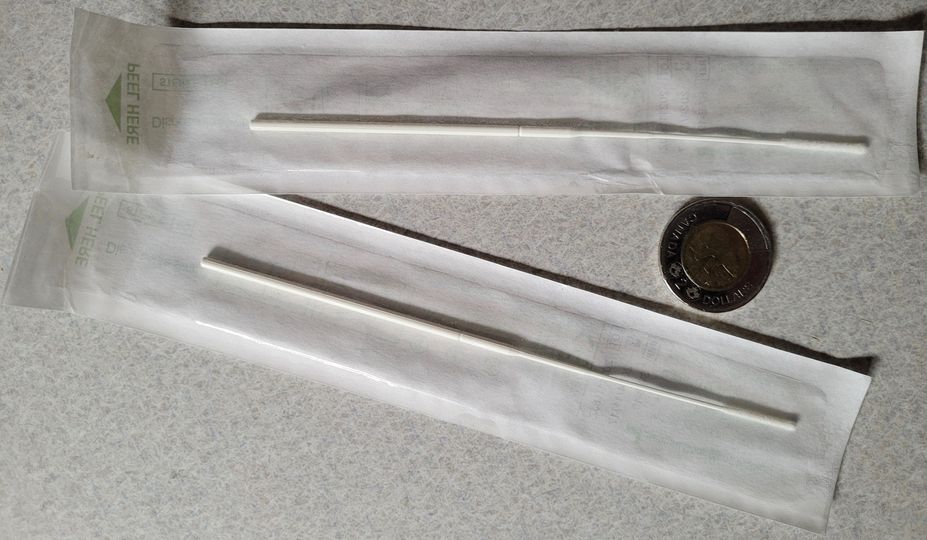

I live in a small community that engages in a lot of trading and freecycling. I posted photos of the items and had two takers: a woman who wanted some of the swabs for cleaning animal skulls and a man who was interested in both swabs and vials. I messaged them pick up details and curious me asked the man how he was going to use those things. He responded that the very fine swabs were perfect for cleaning his microscope lens and the vials would be suitable for collecting water samples, which he analyzed under said microscope.
Never one to be shy about approaching strangers with strange questions I asked if he’d ever done fecal float testing and if he’d be open to looking at some of my chickens’ poop for the presence of parasite eggs. Apparently Al was up to the challenge: “Happy to help if I can. We might have to get a bit more specific before I can make any promises but it sounds interesting! I’m set up to use a number of options besides normal brightfield microscopy, if needed. Darkfield, phase contrast, polarized light and EPI fluorescence are within my choices depending on what is needed. Would I be looking for something specific or a just a general look-see?” Clearly this guy was more knowledgeable and equipped than expected.
I headed over to his place prepared for an exploration of what came out of my flock. I used plastic fecalizers I got from Val to collect four fresh samples: one big broody-looking poop, one cecal poop, another that was a bit sloppy and a normal one. I figured four would be a good sampling of my flock of 24, as you often expect that if one bird is carrying an internal parasite they probably all are.
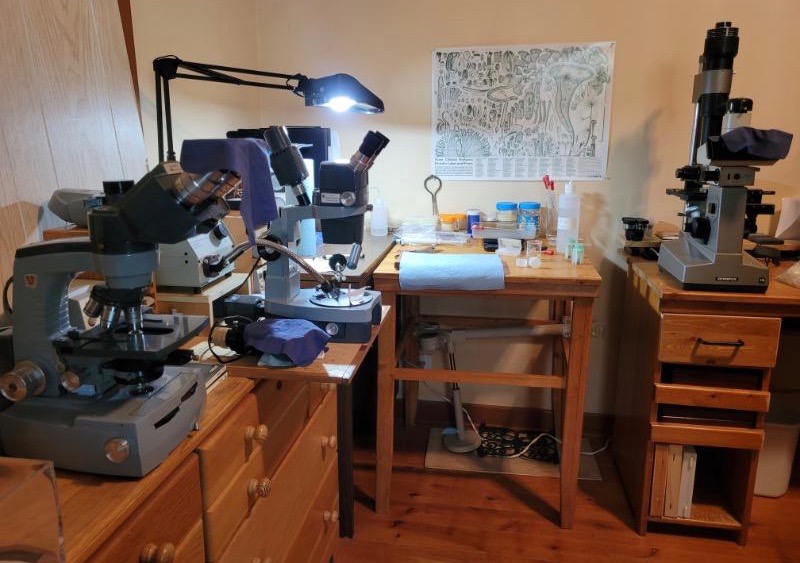
When I got to Al’s place, a big West Coast style house in the woods, he led me to a room with seven microscopes lining two sides of the room. I had expected a normal lab microscope but these were varying sizes and shapes with one connected to a camera that projected the slide images onto a large screen. He told me they were state-of-the art machines when they were new, but now could be picked up for a song on used online sites.

The purpose of our investigation was to search through the poop for evidence of internal parasites. The eggs are more prevalent than adults and when mixed with a special solution they float to the surface for easy collection. Every species has distinctive characteristics that allow you to differentiate between them.
We prepped the samples by adding fecal float solution to the containers’ fill lines and then gently twirled (not shook) them for three minutes to separate the sample. Al added more solution using a pipette higher than the rim forming a convex meniscus. It’s important not to overfill the containers because that’s where the most eggs will be found.


He then carefully placed a very thin 1” square glass cover slide over the top of each tube. The solution has a higher specific gravity than the organisms to be floated so that the worm eggs rise to the top and the debris sinks to the bottom. If we were to find anything of interest it would be in the very top layer of the water and adhere to the cover glass.
They were left to sit for 20 minutes, during which time we chatted while Al made tea. I discovered that he was a retired boat builder and former instructor at the now defunct Silva Bay Shipyard School, Canada’s only full-time traditional wooden boatbuilding school. When he built his house two decades ago he added a shop for his woodworking projects. Unfortunately he experienced some health issues, including rheumatoid arthritis, which forced him to give up working with his hands. He has, however, taken up a new hobby: using microscopes to investigate the myriad life forms in water.
When our break time was over we headed back to our samples. The square cover slides were placed face down on glass slides and tamped to squeeze out any air bubbles.
Al placed each slide, one at a time, on the microscope’s stage and moved it back and forth so we had a comprehensive look at various areas on the slide. For the most part we saw remarkably little. I did bring Val’s laminated colour illustration of various parasites found in chickens but nothing really jumped out as significant. Al’s expertise is not poultry so he wasn’t certain what we should be looking for. He did note some features that appeared to be air bubbles or organic debris. Every time there was something I was curious about he snapped a picture.


We wrapped up our examination within the hour and I waited until he emailed me the photos he took. Once received later that evening I posted them on the Facebook group The Floaters Club for their opinions.
Three people waded in and confirmed some of what I suspected (i.e. air bubbles, debris and plant material).
Air Bubbles


Plant Material


Air Bubbles & Trichomes (Plant Hairs)

There were only two potential parasite eggs: coccidia and roundworm. There was no second opinion about the former, but there was some contention about the latter. One person was sure the following was a roundworm egg, one doubtful and the third was in total disagreement: “I can’t agree with that. There are lots of different species and they all have different egg morphology. Ascaridia galli, the chicken roundworm, has an oval egg shape. This has a nice thick wall like a roundworm egg but it’s so perfectly round. I don’t know what this is. Probably an artifact.”
Identified As Coccidia & Roundworm Eggs


Unknown Objects


Both Al and I had a good time exploring what was invisible to the naked eye even if we didn’t find any conclusive answers. I was glad to know that even experienced folks don’t always know what they are looking at. If you’d like to weigh in as to what you think you see feel free to leave a comment.
All chickens that have access to the soil carry some level of internal parasites, often with no negative consequences. The problem is when the worm load is high or the host is vulnerable. It’s important to understand when and why to worm your birds: use the right product (i.e. most broad spectrum dewormers don’t target tapeworms); don’t routinely worm your flock as a ‘preventative’ or too often. Those products are effective but can also be hard on your birds.
If you don’t have a Dr Bowes or Al in your life take a sample to your small animal vet. Most clinics that don’t have experience with poultry are still able to do fecal float testing as many of the common parasites are also seen in dogs and cats. My local vets, who work mostly with dogs and cats, provide the service for $36.
Thanks to Al for generously sharing his time and photos, used with permission. Featured image credit: International Journal For Parasitology
 Bitchin' Chickens
Good for you! I have considered getting my own microscope and doing fecal floats as well. Being a retired small animal veterinarinan I don’t have access to a local lab anymore. I recently took my chicken into an avian vet and had her stool tested…direct fecal, float and sedimentation. Cost $200! Next time I will dropping a sample off to the UC Davis CAHFS lab.
LikeLiked by 1 person
I have a good microscope for this…it could be a fun learning curve to tackle next winter!
LikeLiked by 1 person
Sounds like a good time, keep me posted about what you find.
LikeLike
Fascinating! Thanks Claire!
LikeLiked by 1 person